



💛 A quick favor, if you've got a second.
We're really happy that you chose to read one of our stories and sincerely hope you'll stick around to read more. We took our paywall down — for now — but that won't last forever, and when the gate goes back up, we'd love for you to already be on the inside.
It's free. So please enter your email here and don't forget to like and follow us on all of your favorite Social Media platforms!
Smartphones can deliver weather alerts and traffic warnings, but some environmental threats demand immediate notification that conventional notifications cannot provide. Hazardous gases may already permeate the air around you, while contaminated water can appear completely safe to the naked eye. The critical lag between receiving a smartphone alert and checking it—if you notice it at all—could expose you to dangerous substances for far longer than necessary.
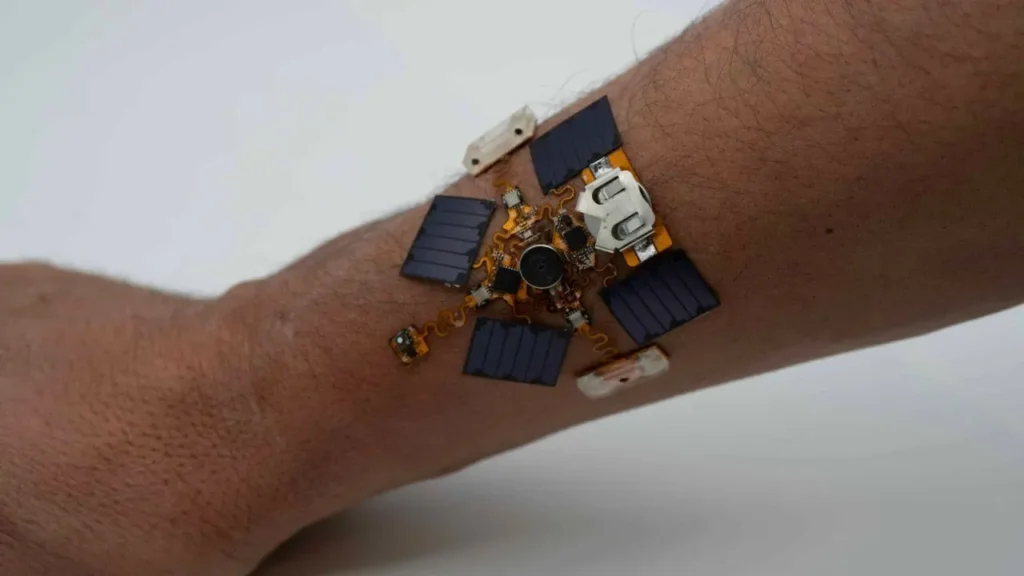
Scientists at North Carolina State University have created a wearable patch that bypasses the smartphone entirely, detecting environmental hazards and communicating danger through targeted vibrations against the wearer’s skin. The device produces distinct vibration sequences for different threats, allowing users to identify specific hazards through tactile sensation alone. The technology also extends to robotic applications, equipping machines with their own chemical sensing capabilities.
The square patch, slightly smaller than a driver’s license, incorporates a microcontroller, small battery, and six environmental sensors within its compact design. It attaches directly to clothing or skin and monitors air quality and water contaminants including dangerous gases and heavy metals. When a threat is detected, a tiny actuator generates vibrations against the skin that prove harder to ignore than typical phone notifications.
Existing environmental sensors can transmit alerts to smartphones, but this approach fails when devices remain pocketed, buried in bags, or silenced during work. The direct vibration method reaches the body instantaneously upon threat detection. The researchers engineered textured surfaces between the motor and skin—miniature bumped patterns with adjustable size and spacing—to create distinct, noticeable sensations without discomfort.
Each hazard triggers a unique vibration pattern, establishing a tactile language that communicates threat type without requiring a visual display. Proof-of-concept testing demonstrated successful detection of targeted substances with immediate appropriate vibration responses. Users would require training to interpret each pattern, particularly in workplaces with multiple potential hazards.
Battery longevity posed a critical challenge for practical deployment. Researchers embedded thin-film photovoltaic cells on the patch’s exterior to harvest solar energy, supplementing the internal battery. This combination maintained operation for approximately 24 hours during testing—sufficient for a complete work shift, though real-world performance depends on sunlight exposure, sensor activity, and wearing patterns.
The research team extended the concept to robotic applications by developing an electronic skin, or e-skin, that places the sensor patch atop a piezoelectric layer. When the patch vibrates, movement generates electrical signals the robot can read and interpret. During testing on quadrupedal robots, the system enabled machines to detect chemical hazards, alter course, and navigate safer routes without wireless communication delays.
This robotic adaptation could enable machines to explore hazardous environments unsuitable for humans while maintaining responsiveness when wireless connections fail. Traditional robotic systems rely heavily on cameras and digital instructions, which cannot detect invisible gases or dissolved contaminants. The e-skin provides machines an alternative sensing method while converting chemical warnings into internal physical signals for faster decision-making.
The patch and e-skin predominantly utilize commercially available components, requiring custom engineering for only a few elements. This design approach could facilitate scaling and reduce production costs compared to wearables relying on specialized parts. The modular sensor array allows developers to add or remove sensors based on specific environmental hazards or job requirements.
The technology remains unavailable for consumer purchase and operates at the proof-of-concept stage, with researchers requiring additional testing under harsh conditions before deployment in high-risk missions. Scientists must address durability through repeated wear, minimize false alarms, ensure vibration patterns remain easily recognizable, and confirm user comfort for all-day wearing. The patch’s protective value depends entirely on consistent daily use by workers willing to maintain the device.


More Stories
Looney Tunes’ ‘Coyote vs. Acme’ Debuts With $15.5 Million as ‘Spider-Man’ Holds Box Office Crown
Trump Calls NASA to Congratulate Agency on Roman Space Telescope Launch
Meta Ordered to Implement Sweeping Teen Safety Restrictions Under Settlement