



💛 A quick favor, if you've got a second.
We're really happy that you chose to read one of our stories and sincerely hope you'll stick around to read more. We took our paywall down — for now — but that won't last forever, and when the gate goes back up, we'd love for you to already be on the inside.
It's free. So please enter your email here and don't forget to like and follow us on all of your favorite Social Media platforms!
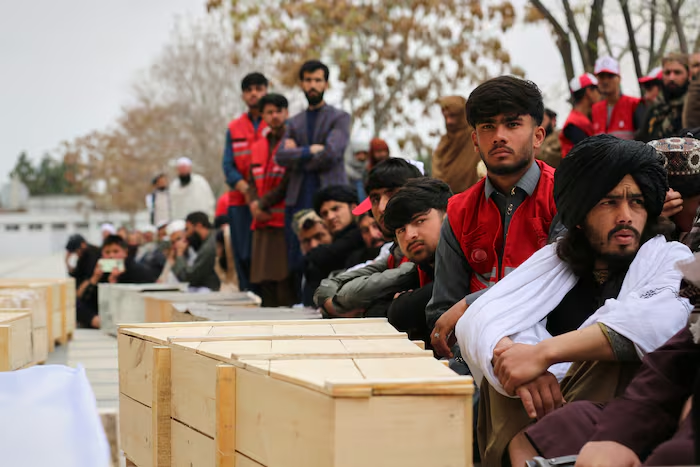
The United Nations documented approximately 499 civilian deaths and over 1,200 injuries in Afghanistan resulting from cross-border military operations with Pakistan spanning October through late June, according to a human rights assessment released Tuesday. The UN Assistance Mission in Afghanistan recorded the casualty figures as part of a broader examination of humanitarian conditions across the conflict zone, where escalating tensions have resisted international mediation efforts.
Hostilities between the neighboring nations intensified sharply in February when Afghan forces conducted retaliatory strikes across the border following Pakistani airstrikes, prompting Islamabad to declare a state of “open war.” Pakistan maintains that Afghanistan provides sanctuary to militant groups responsible for attacks within Pakistani territory, particularly the Pakistani Taliban faction. Afghanistan’s government rejects these allegations, while international observers document the mounting civilian toll from aerial bombardments.
A March airstrike on a Kabul drug treatment facility emerged as the deadliest incident, claiming hundreds of civilian lives and prompting Amnesty International to characterize the bombing as a potential war crime warranting formal investigation. In another documented case, rescue workers attempting to extract survivors from debris became targets of subsequent strikes on the same location, illustrating the compounding dangers facing civilians.
Pakistan’s Foreign Ministry responded to the UN report by reiterating that military operations targeted “identified terrorist hideouts” and infrastructure supporting attacks on Pakistani soil, denying intentional civilian targeting. The Pakistani government has not released overall casualty figures for civilian harm within its own borders, while UN mandate restrictions limit monitoring capacity to incidents occurring in Afghanistan.
The UN report further documented a severe crackdown on women protesters in the western city of Herat during June, where at least 30 women faced arrest for dress code violations and security forces killed at least one demonstrator. Afghanistan’s Taliban administration enforces restrictive policies including mandatory full hijab coverage, educational bans beyond primary school, and employment prohibitions affecting the female population.
Recent Taliban decrees governing marital separation arrangements effectively legalize child marriage by permitting marriage contracts for minors, according to UN assessments. Ministry officials tasked with enforcing virtue codes have conducted visits to clinics and commercial establishments nationwide, instructing businesses to deny entry to unaccompanied women, highlighting the systematic implementation of gender restrictions.


More Stories
Federal Prosecutors Convene Special Grand Jury to Investigate D.C. Schools’ Attendance and Graduation Practices
State Department Reissues Level 3 Travel Advisory for Israel Amid Terrorism and Armed Conflict Concerns
Republican Gubernatorial Candidate Byron Donalds Discusses Florida’s Future