



💛 A quick favor, if you've got a second.
We're really happy that you chose to read one of our stories and sincerely hope you'll stick around to read more. We took our paywall down — for now — but that won't last forever, and when the gate goes back up, we'd love for you to already be on the inside.
It's free. So please enter your email here and don't forget to like and follow us on all of your favorite Social Media platforms!
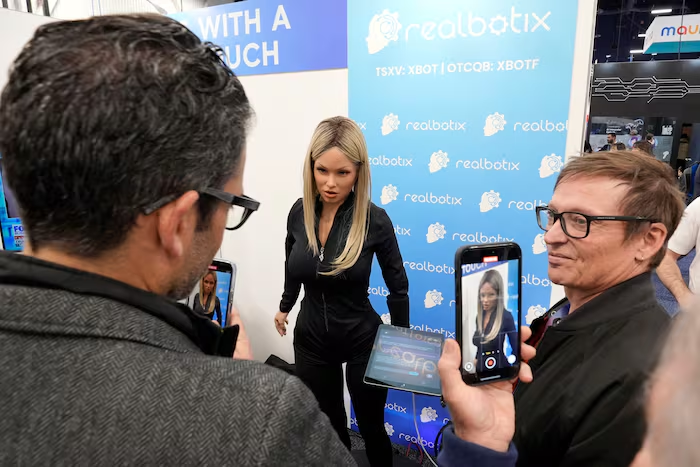
The Salamanca City Central School District in rural upstate New York has suspended its initiative to deploy an AI-powered humanoid robot in classrooms following significant pushback from state education officials, union teachers and community members. The district had approved a nearly $60,000 purchase from Realbotix for a stationary robot nicknamed “Sally,” intended to serve high school students in robotics and technology courses.
Superintendent Mark Beehler characterized the robot as an educational tool capable of answering student questions about programming and Arduino boards while allowing learners to explore maintenance and troubleshooting. However, concerns emerged when the small community on the Seneca Nation of Indians reservation learned that Realbotix maintains a sister company ownership stake in RealDoll, a manufacturer of AI-powered sex dolls.
Union leaders and educators objected to the project’s scope and origins. Melinda Person, president of New York State United Teachers, declared that “a robot built by a company associated with sex dolls has no business in our classrooms,” while also suggesting the pilot represented a step toward replacing human educators with technology.
State Education Commissioner Betty Rosa raised objections in a Friday letter to district officials, noting that despite assurances the robot would not deliver instruction, recent presentations had characterized it as a “tutoring platform.” Rosa additionally requested clarification on data privacy and security measures surrounding student information.
The district has committed to developing enhanced student data privacy agreements with state education officials while continuing community engagement. According to district communications, “Sally” will not collect personal information, record interactions, access the internet or utilize unvetted generative AI services, with all data stored locally on the device itself.
Beehler defended the initiative as essential for isolated rural districts, noting that Salamanca students must travel one to two hours to access emerging technology demonstrations. He emphasized that the project includes a virtual AI teaching assistant and at-home tutoring program, not staff replacement, asserting that “teaching is a human-to-human process.”
Realbotix countered criticism by describing “Sally” as a “newly manufactured, purpose-built educational unit” rather than a repurposed device, and stressed that its education-focused subsidiary operates independently from its sister company with separate management and operations. The company added that student authentication would utilize existing district systems with encrypted, district-controlled data storage.
Despite district assurances, some community members remained skeptical. Joplin Ficek, a 2024 Salamanca High School graduate now working in childcare, argued that the district should prioritize hiring additional staff committed to direct student interaction rather than deploying robotic systems in classrooms.


More Stories
Modern Science Finally Supports & Strengthens Biblical Account of the Crucifixion of Jesus Christ
Federal Prosecutors Convene Special Grand Jury to Investigate D.C. Schools’ Attendance and Graduation Practices
Tuskegee University President Defends Dress Code Policy as Pathway to Student Success