



💛 A quick favor, if you've got a second.
We're really happy that you chose to read one of our stories and sincerely hope you'll stick around to read more. We took our paywall down — for now — but that won't last forever, and when the gate goes back up, we'd love for you to already be on the inside.
It's free. So please enter your email here and don't forget to like and follow us on all of your favorite Social Media platforms!
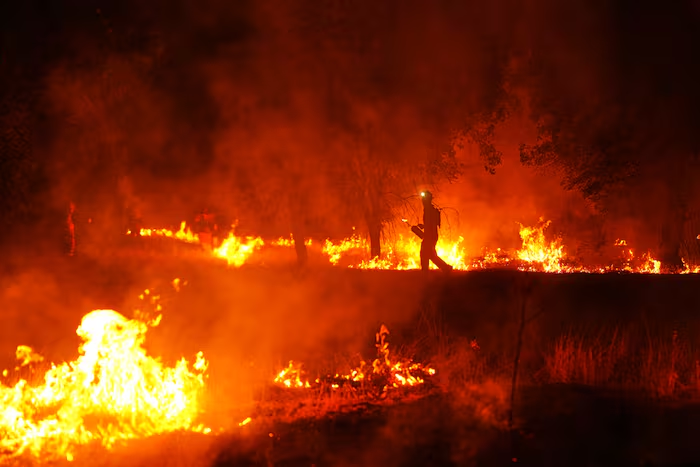
A massive wildfire raging near Madrid has shattered records for Spain’s largest recorded blaze, consuming 500 square kilometers across the hills of Ávila west of the capital. The uncontrolled fire has forced approximately 79,000 residents across multiple regions to abandon their homes, including those affected by additional fires in the Madrid region and eastern Castellón. Emergency responders say the scale and intensity of the inferno has fundamentally altered how they approach firefighting operations.
Javier García, a Spanish firefighter with two decades of experience protecting woodlands and rural communities, told The Associated Press that the current crisis has no historical parallel. His 40-member emergency brigade, based in Ávila, has been battling the fire continuously for three days while simultaneously responding to other major blazes in Guadalajara and near Zaragoza in recent weeks. The Guadalajara fire alone consumed 320 square kilometers, ranking as Spain’s third largest on record.
The ferocity of the Ávila blaze has forced firefighting teams to abandon traditional tactics of direct attack in favor of prioritizing evacuations and property defense. Raúl Guerrero, a 29-year-old firefighter in Castilla y León, explained that his unit has repeatedly retreated to safer positions as the flames advanced with what he described as “beyond the capacity of extinction”—a virulence that overpowers conventional suppression methods.
Climate change has substantially expanded the window of extreme fire danger in Spain. García noted that his brigade once faced approximately 15 days of high-risk conditions annually; that number has climbed to 30 to 40 days. Spain has already burned 1,530 square kilometers this year through June, six times the area scorched during the same period in 2025, according to Ecology Minister Sara Aagesen.
Firefighters attribute the growing threat partly to the disappearance of agricultural operations and forestry industries that once created natural firebreaks around populated areas. Vegetation now grows directly adjacent to homes, creating what Guerrero called “pure gunpowder” for future conflagrations. He has called on property owners and local authorities to engage in year-round brush clearing and forest management to mitigate future risks.
Neighboring France is simultaneously confronting its own catastrophic wildfire, which has displaced more than 200,000 residents. Despite the extraordinary scale of Spain’s current emergency, no deaths have been reported from the fires burning across the nation.


More Stories
New York’s Colombian Community Mobilizes Relief Efforts Following Recent Earthquakes
Arizona Influencer Pleads Guilty to Criminal Impersonation in Business Prank Videos
Nepal Buries Hundreds of Flood Victims in Mass Graves as Identification Efforts Lag