


💛 A quick favor, if you've got a second.
We're really happy that you chose to read one of our stories and sincerely hope you'll stick around to read more. We took our paywall down — for now — but that won't last forever, and when the gate goes back up, we'd love for you to already be on the inside.
It's free. So please enter your email here and don't forget to like and follow us on all of your favorite Social Media platforms!
The 1951 Refugee Convention reached its 75th anniversary Tuesday, marking three-quarters of a century since the international community established protections for people fleeing persecution, conflict and violence in the aftermath of World War II. The treaty has become a cornerstone of humanitarian law, with nearly 150 countries now party to its provisions and advocates crediting it with saving millions of lives worldwide. However, the convention faces mounting challenges as some nations restrict asylum access and the United States pursues policies directing asylum seekers to third countries, a departure from decades of prior practice.
Global displacement has reached unprecedented levels, with more than 41 million refugees currently living in forced exile. Approximately 70 percent of these displaced persons are hosted by low- and middle-income countries, straining resources across the developing world. The International Committee of the Red Cross has documented more than 130 armed conflicts currently active globally, suggesting refugee populations may continue expanding in coming years.
The convention’s cornerstone principle of “non-refoulement” prohibits returning individuals to territories where they face persecution, torture or serious harm. Elizabeth Tan, the U.N. High Commissioner for Refugees’ director of international protection and solutions, emphasized that the treaty “codified a simple but powerful principle that people forced to flee persecution, conflict or violence must be able to find safety and protection.” The framework rests on the recognition that no society remains immune to warfare, persecution or sudden destabilization.
Sayed Alom, a humanitarian worker among 700,000 Rohingya who fled Myanmar into Bangladesh camps during 2017, described systematic atrocities that forced his displacement. “Myanmar’s military forces raped our mothers and sisters, burned down our homes, threw our children into the river and set them on fire,” he recounted from refugee camps outside Cox’s Bazar. Now languishing in limbo for years, he faces kidnapping threats, ransom demands and environmental hazards including extreme heat, flooding and landslides destroying shelter structures.
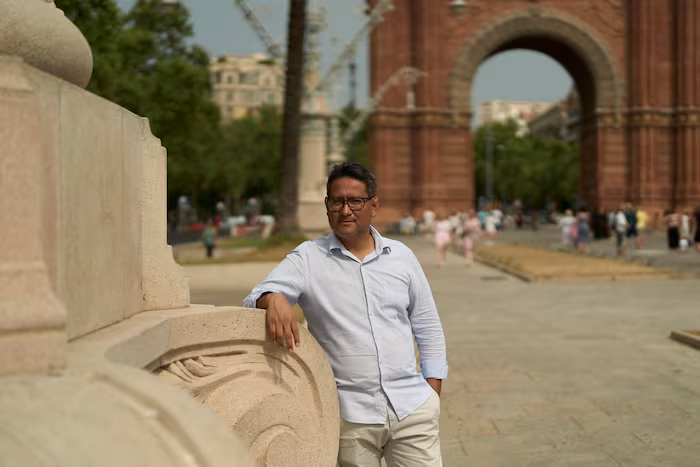
Juan Carlos Arce, a human rights lawyer, escaped Nicaragua in 2018 following a violent government crackdown against protesters that killed hundreds. After the organization where he worked was branded a “terrorist organization” by President Daniel Ortega’s government, Arce fled to Costa Rica and later relocated to Barcelona, Spain through a UNHCR resettlement initiative. Standing beneath Barcelona’s Arc de Triomf, he reflected on his new circumstances: “Feeling safe and protected, that is priceless.”
Hussniyah Ahmad Ghozlan, now 88 years old, has lived as a Palestinian refugee in Lebanon for more than seven decades since fleeing her village during the 1948 war. Her hometown of Yajur, located southeast of Haifa, Israel, was depopulated during the conflict, forcing her family to seek shelter in the Shatila refugee camp in Beirut. Despite living through the convention’s era, Ghozlan acknowledged she had never encountered knowledge of the treaty, having never learned to read or write.
Hershel Greenblat was born in a Ukrainian cave in 1941 as his Jewish family hid from Nazi persecution during World War II. After the war ended, his family relocated to Austria and later immigrated to the United States in 1949 following approval of their resettlement application. Greenblat recalled his father waking him as their Army transport ship approached the Statue of Liberty, with American middle-school students having prepared welcome boxes for arriving refugee children. Now 85 and living in Atlanta for decades, Greenblat observed that modern refugees receive markedly different receptions than those of his generation.
Wenyen Gabriel, a professional basketball player standing 2.08 meters tall, was born in Khartoum, Sudan in 1997 after his parents fled civil war in southern Sudan. His family subsequently moved to Egypt before being resettled in New Hampshire when Gabriel was 2 years old. Gabriel earned a basketball scholarship to the University of Kentucky, played professionally in the NBA and represented South Sudan at the 2024 Olympic Games in Paris, becoming UNHCR’s newest goodwill ambassador on Monday.
Sisters Yusra and Sarah Mardini fled Syria in 2015 during that country’s ongoing conflict, initially seeking shelter in Lebanon before moving to Turkey. They paid human smugglers for sea passage to Greece but jumped from an overcrowded vessel to prevent it from sinking, then trekked across southeast Europe before finally receiving asylum in Germany. Mardini, designated a UNHCR goodwill ambassador in 2017, expressed cautious optimism about Syria’s future now that the war has concluded, noting that approximately 1.3 million Syrians have already returned home. “You can’t just snap your fingers,” she said, acknowledging the difficulty of rebuilding lives after such trauma.

More Stories
Modern Science Finally Supports & Strengthens Biblical Account of the Crucifixion of Jesus Christ
Chicago Mayor Issues Executive Order Requiring Contractor Diversity Disclosures and ICE Ties Reporting
Federal Prosecutors Convene Special Grand Jury to Investigate D.C. Schools’ Attendance and Graduation Practices