


💛 A quick favor, if you've got a second.
We're really happy that you chose to read one of our stories and sincerely hope you'll stick around to read more. We took our paywall down — for now — but that won't last forever, and when the gate goes back up, we'd love for you to already be on the inside.
It's free. So please enter your email here and don't forget to like and follow us on all of your favorite Social Media platforms!
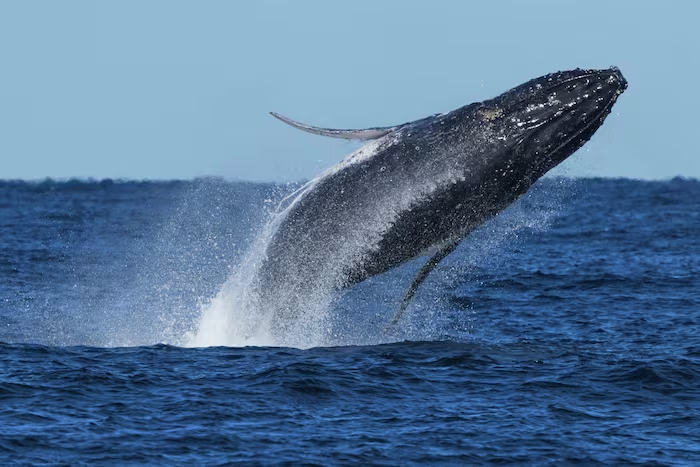
A husband-and-wife wildlife team off South Africa’s west coast documented nearly 300 humpback whales gathered together in December, marking what researchers believe to be the largest supergroup of the species ever recorded. The sighting by Chris and Monique Fallows, who catalogued 299 individual whales by photographing each animal’s distinctive tail flukes, provides striking evidence of population recovery in the Southern Hemisphere decades after commercial whaling ceased.
Humpback whale numbers have climbed from fewer than 10,000 at the peak of industrial whaling to more than 100,000 today, according to assessments by the International Whaling Commission and marine scientists. The 1986 international moratorium on commercial whale hunting stands as one of conservation’s most significant achievements, with supergroups now appearing with increasing frequency in food-rich waters where the marine mammals congregate to feed on krill and small fish.
Scientists attribute the resurgence partly to humpbacks’ feeding behavior in supergroups, which generate underwater vocalizations that attract additional whales to resource-rich areas. Els Vermeulen, chief scientist at the University of Pretoria’s Whale Unit, noted that supergroup sightings began recurring around 2012, directly correlating with population recovery from whaling’s devastating impact.
However, marine experts warn that mounting threats now endanger the species’ continued recovery. Commercial fishing equipment entanglement, vessel collisions, and climate change pose ongoing risks, with seven of 14 great whale species classified as endangered or vulnerable by international conservation authorities.
A new hazard has emerged off South Africa’s coast: dramatically increased shipping traffic diverted around Africa due to Middle East conflicts. Vessel traffic quadrupled since December 2023 following the Israel-Hamas war and subsequent Houthi attacks on Red Sea shipping, further compounded by security concerns over the Strait of Hormuz and the broader Iran conflict.
While exact statistics remain unavailable due to whales sinking after fatal ship strikes, Cape Town environmental manager Gregg Oelofse confirmed whale carcasses wash ashore bearing propeller wounds indicating vessel collisions. Scientists are now advocating for mandatory speed restrictions on ships near the South African coast to provide crews additional time to avoid whales in their path.

More Stories
Colombia backs Trump security push while limiting U.S. role in anti-gang operations
Federal Prosecutors Convene Special Grand Jury to Investigate D.C. Schools’ Attendance and Graduation Practices
State Department Reissues Level 3 Travel Advisory for Israel Amid Terrorism and Armed Conflict Concerns