

💛 A quick favor, if you've got a second.
We're really happy that you chose to read one of our stories and sincerely hope you'll stick around to read more. We took our paywall down — for now — but that won't last forever, and when the gate goes back up, we'd love for you to already be on the inside.
It's free. So please enter your email here and don't forget to like and follow us on all of your favorite Social Media platforms!
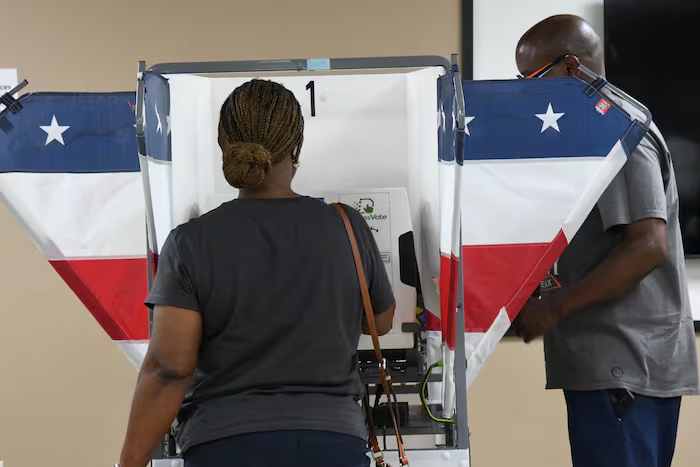
Tennessee won court approval Thursday to implement newly drawn congressional districts that fragment a historically majority-Black voting area centered in Memphis, marking a significant legal win for Republicans seeking to flip a Democratic-held seat in this year’s midterm contests. The three-judge federal panel rejected a request for a preliminary injunction, allowing the redrawn boundaries to take effect for the Aug. 6 primary elections without delay. The state had introduced the revised map in May, capitalizing on a Supreme Court decision that narrowed protections previously afforded to minority voters under the federal Voting Rights Act.
The redistricting effort reflects a broader Republican strategy encouraged by President Donald Trump to redraw districts favorably in GOP-controlled states, with Tennessee among eight states pursuing such mid-decade changes. The Trump administration views these revisions as crucial to preserving the party’s narrow House majority, countering the historical tendency for the president’s party to lose congressional seats during midterm elections. Republicans specifically targeted Tennessee’s lone Democratic district, controlled by Rep. Steve Cohen, a white lawmaker who has represented the Memphis area for roughly two decades.
The court panel—comprising two judges appointed by Trump and one appointed by former President Barack Obama—concluded in their ruling that challengers lacked sufficient evidence of racial discrimination, stating that political motivations adequately explained the map’s effects. “The road to a reliably 9-0 map runs through Memphis,” the judges wrote, noting that partisan objectives alone justified the redistricting approach. Under a 2019 Supreme Court ruling, state legislatures retain the authority to draw districts along partisan lines without legal restriction.
Civil rights advocates and voters challenged the map as unconstitutional racial gerrymandering, arguing that Republican lawmakers deliberately dismantled Black political representation. The Memphis metropolitan area was fragmented across three separate districts, with Cohen’s redrawn seat now stretching hundreds of miles eastward toward Nashville suburbs. Cohen announced his retirement from Congress shortly after the redistricting was finalized.
Amber Sherman, a Memphis voter and lawsuit plaintiff, expressed dismay at the court’s decision, stating it was “painful” to proceed under districts that diminish Black electoral strength. “We deserve the same opportunity to shape our future as anyone else,” Sherman said. “When our voting power is diluted, our neighborhoods have a harder time making their voices heard on the issues that shape our daily lives.”
The Voting Rights Act’s weakening followed a late April Supreme Court decision striking down a majority-Black congressional district in Louisiana as an illegal racial gerrymander. That ruling effectively permitted Republican-controlled Southern legislatures to cite political intent while redrawing districts containing substantial minority populations that have historically elected Democratic candidates.
Ari Savitzky, an attorney with the American Civil Liberties Union Voting Rights Project, argued that Republicans sought to eliminate Tennessee’s sole area of federal Black political influence. State election officials countered that racial data was excluded from the mapmaking process and that reverting to previous boundaries had become impractical, as primary ballots were already printed under the new configuration. Early voting commenced July 17.

More Stories
Colombia backs Trump security push while limiting U.S. role in anti-gang operations
Former NFL cheerleader and ex-aide face off in close Rhode Island GOP primary
Chicago Mayor Issues Executive Order Requiring Contractor Diversity Disclosures and ICE Ties Reporting