

💛 A quick favor, if you've got a second.
We're really happy that you chose to read one of our stories and sincerely hope you'll stick around to read more. We took our paywall down — for now — but that won't last forever, and when the gate goes back up, we'd love for you to already be on the inside.
It's free. So please enter your email here and don't forget to like and follow us on all of your favorite Social Media platforms!
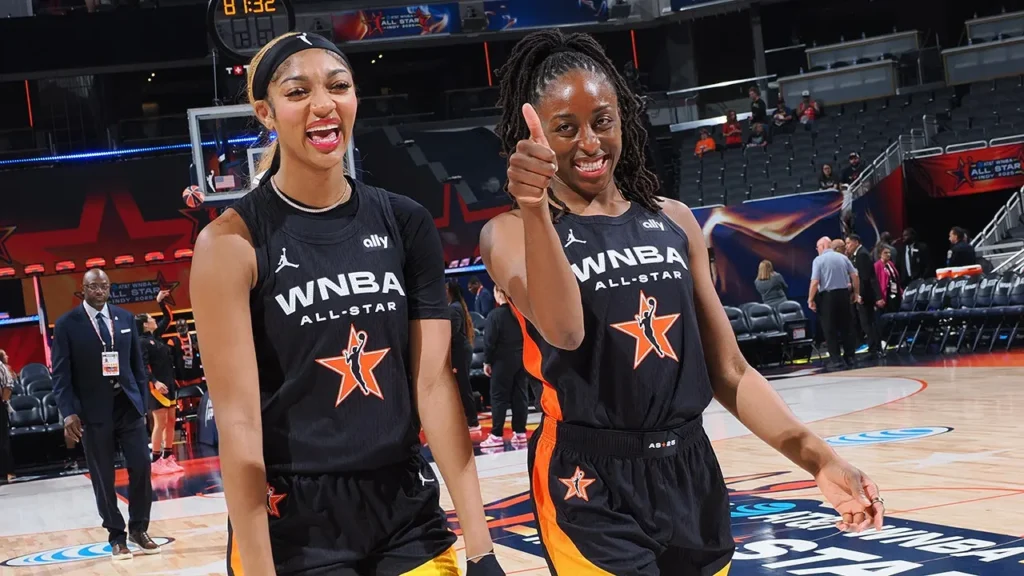
The Women’s National Basketball Association is marking its 30th anniversary season by launching an All-Star charity program aimed at supporting organizations that keep girls engaged in athletics. The league is distributing $100,000 from the All-Star Game competition to two Chicago-area nonprofits, with the winning team’s chosen charity receiving $70,000 and the runner-up organization collecting $30,000.
One of the two beneficiary organizations, Girls in the Game, has drawn scrutiny for language on its website stating the group is “moving beyond the binary of ‘girl'” and welcomes “gender-expansive participants regardless of gender identity or expression.” Girls in the Game serves as the designated charity for Team Spoon, while Angels Athletics represents Team Coop in the 2026 All-Star competition.
The WNBA described Girls in the Game in a July 15 release as an organization that “partners with schools, parks, and community centers in Chicago to offer sports, health, and leadership programs.” However, the organization’s public materials present a more complex picture of its mission and participant eligibility standards.
Girls in the Game’s own website materials indicate the organization facilitates programs described as operating in “all-girl settings” while simultaneously stating it welcomes youth regardless of gender identity. The organization’s resource pages direct users toward gender-affirming health services and support groups for transgender and nonbinary individuals, creating questions about how eligibility for girl-centered programming is determined.
According to the organization’s 2025 annual report, Girls in the Game served 3,059 participants in the fiscal year. The Chicago After School program alone engaged 921 participants in what the report describes as sports activities within an “all-girl setting,” though the organization’s public program materials do not explicitly specify whether participation eligibility is based on biological sex or gender identity.
Neither Girls in the Game nor Angels Athletics responded to inquiries about whether their girl-centered sports programs limit participation to biological females or accept participants based on gender identity. The WNBA also declined to comment on whether it was aware of Girls in the Game’s inclusivity language before selecting the organization for the All-Star initiative or whether such language aligns with the stated goal of keeping girls involved in sports.
The unanswered questions underscore a broader tension: the WNBA promoted this program specifically as supporting organizations dedicated to keeping girls in sports, yet one recipient organization publicly states it operates beyond traditional definitions of what constitutes a girl. League officials and both organizations have not clarified their respective positions on participant eligibility or how the $100,000 in charitable funds will be allocated.

More Stories
Christa Pike Survives Botched Double Execution Attempt; Tennessee Halts Remaining 2026 Executions
Tennessee’s Lone Death Row Female is Scheduled for Execution Wednesday for 1995 Torture/Murder
Modern Science Finally Supports & Strengthens Biblical Account of the Crucifixion of Jesus Christ