


💛 A quick favor, if you've got a second.
We're really happy that you chose to read one of our stories and sincerely hope you'll stick around to read more. We took our paywall down — for now — but that won't last forever, and when the gate goes back up, we'd love for you to already be on the inside.
It's free. So please enter your email here and don't forget to like and follow us on all of your favorite Social Media platforms!
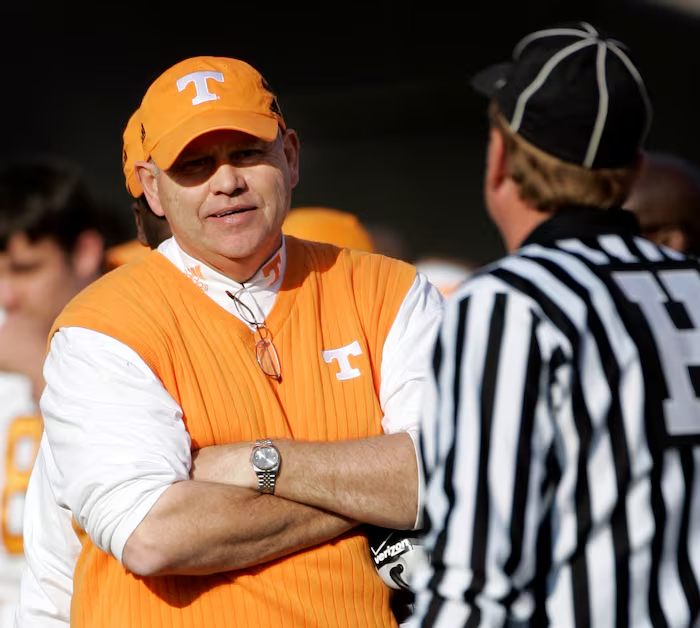
The Southeastern Conference’s expansion to 16 teams has triggered significant changes to its conference schedule beginning this season, forcing the league to eliminate some of its most storied matchups while simultaneously resurrecting rivalries dormant for years. The move to a nine-game league slate represents a calculated effort to strengthen the overall quality of competition as the College Football Playoff system allocates seven at-large berths among its 12 teams. SEC Commissioner Greg Sankey defended the restructuring, noting that no other collegiate conference generates the caliber of weekly competition found within the SEC’s ranks.
Among the casualties of realignment are several cornerstone rivalries that defined the conference for decades. Florida and Tennessee, which have not missed a scheduled meeting in 37 years, will not face each other in 2026, while the Alabama-LSU matchup disappears from calendars for the first time since 1963. The Florida-LSU series, dormant since 1970, and Georgia-Tennessee, a rivalry dating to 1899 that became annual in 1992, also fall victim to the restructured format. These changes result directly from the dissolution of the SEC’s divisional structure, which once guaranteed these contests annual prominence.
Under the new system operating through 2029, each SEC school maintains three permanent annual opponents, with selection prioritizing the conference’s most established rivalries. Alabama-Auburn, Florida-Georgia and Auburn-Georgia earned preservation status, while others were deemed less essential to maintain competitive equilibrium. Georgia coach Kirby Smart addressed the removal of Tennessee from his team’s regular schedule, acknowledging the program’s historical significance while expressing optimism about facing new conference opponents.
The conference simultaneously restored several historic matchups that transcend recent memory. Arkansas-Texas, a cornerstone of the old Southwestern Conference featuring the 1969 Game of the Century attended by President Nixon, resumes as an annual affair. Texas-Texas A&M, known as the “Lone Star Shootout” and played consecutively from 1915 through 2011, returns to the permanent schedule. Missouri and Oklahoma also renewed their rivalry from their Big Eight era.
SEC mandates requiring each school to schedule a 10th game against Power Four opponents have created additional high-profile matchups, including Kansas-Missouri’s “Border War,” Oklahoma-Michigan, Clemson-LSU, Ohio State-Texas, Auburn-Baylor, Arkansas-Utah and Arizona State-Texas. Oklahoma coach Brett Venables characterized the demanding slate, stating that opponents cannot gain competitive advantage through surprise in such a rigorous conference environment.
SEC officials have committed to revisiting and potentially realigning each school’s annual opponents before the 2030 season to maintain competitive balance. The extent to which college football and conference alignments may shift by then, however, remains uncertain as the sport continues its period of substantial structural transformation.

More Stories
Indiana coach Curt Cignetti tells restless Hoosiers fans not to gripe over 38-0 win
Colombia backs Trump security push while limiting U.S. role in anti-gang operations
Chicago Mayor Issues Executive Order Requiring Contractor Diversity Disclosures and ICE Ties Reporting