


💛 A quick favor, if you've got a second.
We're really happy that you chose to read one of our stories and sincerely hope you'll stick around to read more. We took our paywall down — for now — but that won't last forever, and when the gate goes back up, we'd love for you to already be on the inside.
It's free. So please enter your email here and don't forget to like and follow us on all of your favorite Social Media platforms!
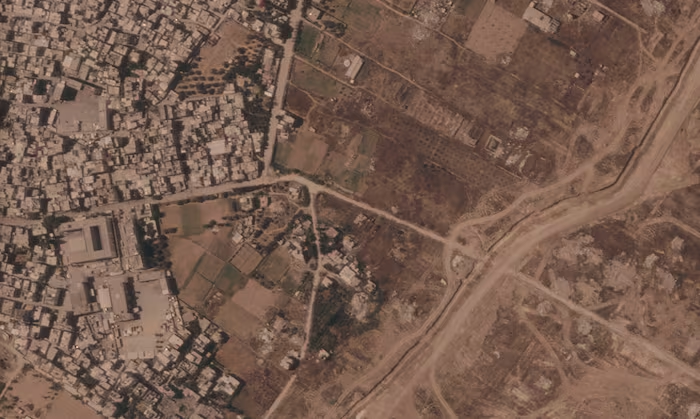
Israel’s military has undertaken a substantial construction project to erect an earthen barrier across the Gaza Strip, effectively dividing the territory it controls from remaining areas, satellite imagery reveals. More than 23 kilometers of the barrier has been completed in recent months, traversing through Palestinian communities that the military had previously demolished, according to analysis of geographic data.
The barrier spans roughly half the length of the coastal enclave, which measures approximately 40 kilometers long and 11 kilometers wide and houses more than 2 million Palestinians. When presented with satellite images, the Israeli military confirmed to The Associated Press that it had constructed a physical barrier along the so-called yellow line, the boundary established under an October ceasefire agreement with Hamas.
The yellow line was designated in the U.S.-backed truce as a temporary demarcation pending broader Israeli withdrawal from Gaza. However, as the ceasefire process stalls, Israel appears to be solidifying its military footprint, deepening Palestinian concerns that the provisional line is becoming a permanent border.
The Israeli military stated the barrier aims to prevent infiltration and protect troops alongside nearby Israeli communities. Officials also disclosed the development of a “security zone” equipped with surveillance and technological infrastructure surrounding the line but declined to specify the barrier’s full intended route.
Construction has accelerated notably since the ceasefire took effect in October. A section of the barrier network in southern Gaza expanded by more than 2 kilometers within a two-week span in July, according to satellite imagery provided by Planet Labs PBC, extending from Israel-controlled Rafah to Muwasi, where substantial Palestinian tent camps are located.
The longest continuous stretch of the barrier extends approximately 17 kilometers from Khan Younis in the south toward Gaza City in the north, with construction beginning in February and continuing to expand southward. Additional barrier segments appear in northern Gaza near the largely demolished town of Beit Lahia.
U.S. Central Command, responsible for monitoring ceasefire compliance, and the Board of Peace, established under President Donald Trump’s administration to oversee Gaza’s future governance, declined to comment on the construction project.
The Israeli military has substantially destroyed and depopulated the half of Gaza under its control, utilizing bulldozers and explosives to level the majority of structures. Towns including Rafah, formerly inhabited by more than 250,000 residents, have been virtually erased, replaced by new military installations and road networks.
The yellow line has never been precisely defined in official documentation and remains inconsistently marked on the ground. Israeli forces have fired upon Palestinians approaching or crossing the boundary, resulting in civilian casualties including children, according to reports, though the military contends it targets militants threatening troops.
Since the ceasefire commenced, Israeli forces have killed more than 1,100 Palestinians through airstrikes and drone operations, while militant attacks have claimed five Israeli soldiers. The original October 7, 2023 Hamas-led assault killed approximately 1,200 Israelis and resulted in 251 hostages, prompting Israel’s military response that has caused more than 73,000 deaths in Gaza according to the Gaza Health Ministry.
Under the ceasefire agreement, Israel was scheduled to withdraw troops to Gaza’s perimeter, with an international security force assuming control. Implementation remains stalled after months of negotiations, with disputes over Hamas disarmament blocking progress toward permanent resolution.

More Stories
Colombia backs Trump security push while limiting U.S. role in anti-gang operations
Federal Prosecutors Convene Special Grand Jury to Investigate D.C. Schools’ Attendance and Graduation Practices
State Department Reissues Level 3 Travel Advisory for Israel Amid Terrorism and Armed Conflict Concerns