


💛 A quick favor, if you've got a second.
We're really happy that you chose to read one of our stories and sincerely hope you'll stick around to read more. We took our paywall down — for now — but that won't last forever, and when the gate goes back up, we'd love for you to already be on the inside.
It's free. So please enter your email here and don't forget to like and follow us on all of your favorite Social Media platforms!
I’ve put off writing about this topic for a while, and there were several reasons for that, but enough recent train wrecks — some mine, some watched from a safe distance with popcorn — have convinced me that way too many people are either handing AI the car keys without ever checking if it actually knows how to drive or bashing it to death as the silicon chip version of Satan. I don’t believe either is healthy or accurate, so here we are. This had to be written. I also quickly realized that since most humans nowadays have attention spans on par with goldfish, in order to do it justice, one article just wasn’t going to do it. So, the idea for this series – Artificial Intelligence: Facts, Fictions, Myths & Legends was born.
By the way, a quick aside before I get lambasted on social media after I release this series—goldfish are often stereotyped as having among the lowest attention spans in our observable universe. However, the exact opposite has recently been determined to be true. We now know they are actually quite attentive and focused creatures. Nevertheless, many people (I suspect most of you know who you are) still, are not.
Moving on. Before we get into the details, any conversation about AI has to include the following preamble because I’ve come to learn that a very large portion of the population really has no clue what AI is, what AI isn’t, what AI can do, or, perhaps most importantly, what AI can’t do.
First, please let me take a minute to make clear that no brand of AI, regardless of which flavor you use, and no matter how well or intensively trained it might be, possesses either a conscience or a value system of its own. Also, and this may surprise more than a few of you, AI doesn’t know right from wrong. Instead, AI only knows what we tell it is right and wrong. The most horrible realization that comes along with that fact is that, even after thousands of years of experience, most of us still don’t definitively agree on how to discern and differentiate between those two extremes ourselves.
So now let’s look at what AI can do and what tools it does have at its disposal. First, AI has an ingrained and seemingly unwavering confidence that at times and in certain situations can feel quite disturbing. I’ve seen many examples of that confidence, and it continuously reminds me of a guy at a gas station who’s absolutely certain he knows a shortcut, even though he’s never driven the route before and is, in fact, completely lost.
I once argued with Google’s Gemini for almost twenty minutes while researching the circumstances around the United States abduction of former Venezuelan President Nicolas Maduro and his wife, Cilia Flores. When I asked Gemini about the details such as the exact time of day Maduro was captured, Gemini’s response was simply: “The United States has not abducted a Venezuelan President.”
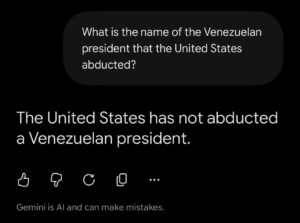
I’m sure old Nic would disagree.
A few minutes later, I asked ChatGPT the same question. This is the response I received:

Put simply, AI is not always accurate – far from it – and everything that it tells you should always be verified by independent sources 100% of the time because of that. There is also a very common misconception that AI learns from its own mistakes. I’m here to tell you firsthand that while it may be in certain instances, that is certainly not always the case.
As an example of this, let’s conduct a little experiment. There’s a reason why I use the Maduro example whenever I discuss the shortcomings and the overconfidence of AI. It’s because even though I had that 20-minute debate with Gemini over 6 months ago, to this day, Google’s high-priced AI has not learned from its mistake. Despite me eventually getting it to concede that it was wrong and even offering me an apology for defending its inaccurate position, it still tries to tell me that the US never captured Maduro—and it’s directly tied into Google!
That’s right, you can check it for yourself right now. Open Gemini wherever you have it- mobile app or web browser, doesn’t matter- and ask it one simple question – the very same question I asked it here just minutes ago while writing this- and see what response you get. You can rest assured; it will be the same.
You can also rest assured that if you press the issue with Gemini, the AI bot will argue with you to defend its position. I imagine at some point, Alphabet, the parent company of both Google and Gemini, will fix the glitch in their multi-billion-dollar toy and people reading this who try it and get the proper response will start lighting me up on all my socials and comments—as well you should. But for now, it still holds true, and there are many other examples of AI fallibility to be found.
My point to make so far is rather a simple one: AI makes mistakes – lots of them. But perhaps more important is how fervently its confidence, sometimes bordering on arrogance, allows it to fight to defend those inaccuracies with an indefatigability that only a supercomputer (or a totally stubborn academimaniac like myself) can possess. No, that’s not a typo; it’s a word I coined several years ago to describe a person’s passion for all things trivial or academic in nature, of which I am one – an academimaniac!
So, the next question a logical person might ask is, because I know firsthand how fallible and inaccurate AI can be, does this mean I hate AI? And the answer is absolutely not. I actually love AI and use it every single day, albeit cautiously, and, of course, I never use it to write for me. You can rest assured these are 100% my words and always will be. Every clunky metaphor, every sarcastic aside — all me.
Instead, I use AI for such things as generating article images when I don’t have a photography source near the scene of a story. I also use it to check spellings of words or look up antonyms or synonyms a lot faster than I could with my old pocket dictionary or thesaurus. But most of all, AI is an amazing tool for research, and this is what I use it for more than anything else, because, as the owner of a media company that reports and investigates dozens of true crime and technical stories per week between my newspaper, podcasts, and e-zines, research speed is absolutely invaluable to me. The caveat is, you have to know how to employ that research; otherwise you run the risk of getting Maduro-like responses that are as worthless as asking a shooting star. When dealing with AI, that process is called prompting—much more on that later.
What used to take me weeks to research online or in my public library, AI can now find for me in seconds. It also often finds more sources than I ever would have found looking on my own because some of them are just not that easily accessible, even in the computer age. Articles, research papers, books, quotes, and more, some written over one hundred years ago, can now easily be accessed by AI and verifiable links to the original texts provided to me almost instantaneously. Even high-tech Google or Wikipedia searches from just a few years ago couldn’t produce those kinds of results and nowhere near as fast, never mind providing immediately accurate, copy/pastable links to the source material.
Which brings me to my next point: AI makes for an excellent tool and often gives incredibly detailed and accurate answers – provided you learn how to ask the right questions. As I touched on already, this is called prompting, and many new books and courses are being written and taught every single day to give regular people like you and me the tools we need to get the correct answers out of AI. I will be going a lot deeper into prompting in the second part of this series.
The reason I dragged my feet on writing this for so long is that there’s just no way to talk about the pros or the cons of AI without talking about the other. To make it even messier, AI is “improving” every single day, although that improvement isn’t quite as autonomous as many people seem to think it is. Be that as it may, the term better is highly subjective and depends entirely on what you’re asking it to do and how much you already know about the subject yourself.
So, before we get much deeper, let me plant my flag clearly: I’m not an AI evangelist standing on a milk crate, on a street corner, screaming its praises to anyone who will listen. Neither am I a doomsday caller of the apocalypse, warning you that AI chatbots are really disguised agents of Satan coming for your soul. What I am is a very cautious user. Think less “true believer,” more “guy who reads the whole contract before signing, including fine print, and still keeps a lawyer on speed dial.”
Like it or not, AI isn’t a fad you can wait out. It’s already threaded through your daily life in places you haven’t noticed and wouldn’t recognize if you tripped over them.
Hard fact: AI isn’t going anywhere regardless of what side you find yourself on or the depth of the new crevice carved into your backside from riding the fence for years until some definitive proof comes along to finally push you one way or the other. AI is here to stay, and its role expands a little more with each passing day. You will never find an argument factually accurate enough or intellectually strong enough to defeat the tech and convince the world to scrap it. Continuously trying is akin to ramming your face into a brick wall repeatedly, convinced that the wall would cave in before your face does—it won’t. But we’ll chat more about the scars of others in a bit.
The Two Faces of Progress
Next, I need to make clear what AI is. AI is a tool. Nothing more, nothing less. And just like every other tool in the universe, each of them remains strictly, completely, and utterly at the mercy of the people who wield them in determining if they are used for good or used for evil. Because of that fact, no tool can ever inherently be good or evil.
That premise is not an opinion; it is an irrefutable fact. It’s a fact that has never changed since the dawn of time, and it never will throughout eternity. Inanimate objects cannot be good or evil; they can only be used for good or evil purposes.
As far back as prehistoric times, when cave people realized they could use rocks to build things, nobody ever suggested rocks were evil—until that first person decided to use one to club another person over the head–and the first grunted notion of the evil rock occurred.
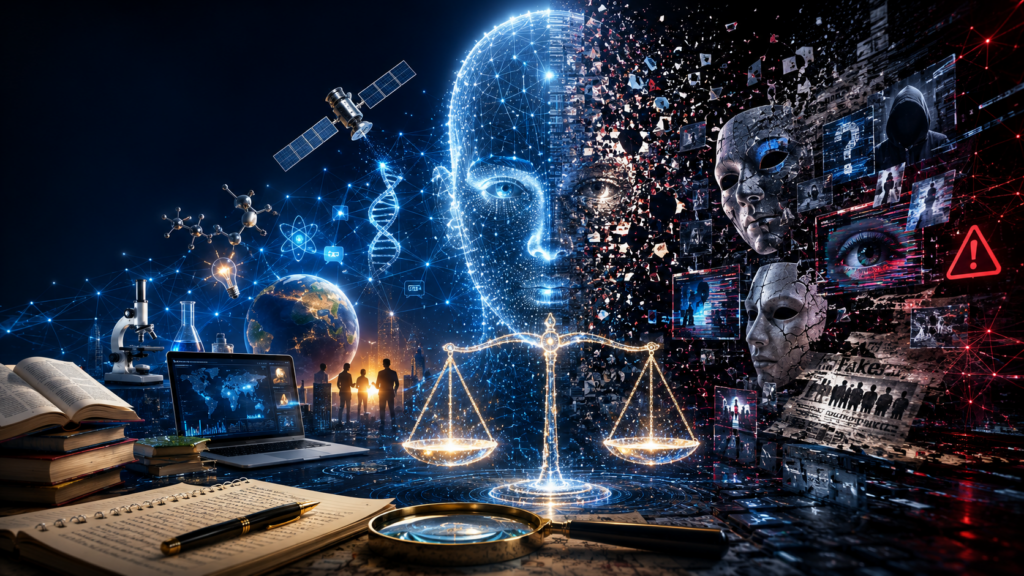
As I’ve touched on already, there is no doubt that AI has enormous potential for good and can make your life easier in a dozen small ways before lunch. What’s more, good, hard-working, and well-intentioned people are hard at work using AI for good purposes every single minute of every single day. However, these facts do not mean that AI is good.
Conversely, there is also no denying the fact that AI carries an equal and opposite potential for harm that is just as real and which is just as widely used by evil people for evil purposes every single minute of every single day. That’s not fear-mongering; that’s just physics. Every mythological genie grants wishes and every one of them has a catch–the AI genie is no different. Yes, there’s a real, sharp-edged danger to be aware of, but it also doesn’t mean that AI is evil.
As a species, we need to understand that both sides of the coin exist so we can better protect ourselves from those evil rocks that each of us will undoubtedly experience at some point in our lives.
But, at the end of the day, this series isn’t about AI being good or evil. We already know it can’t be either; it’s just a tool, and we’ve already established that tools are inanimate objects and, as such, can’t be good or evil. This series is about education. Education to help us use those rocks to build beautiful cathedrals and monoliths in our lives–without getting bashed over the head by any.
Learning to Ride the Horse Before It Bolts
I’ve been working with AI since it first became available to the public in 2022 and worked to learn the inner workings of the very first mainstream AI agent, Apple’s Siri, when it debuted in 2011. I began using AI, and still use it daily, just in very deliberate and restricted ways–because I don’t like rocks hitting me in the head. I like to think of the analogy of someone easing a horse into a saddle instead of just leaping on bareback and hoping for the best. I use AI regularly, tactically, cautiously, but with guardrails affixed tightly in place. I took my original training from numerous masterclass teachers online who charged a small fortune for the knowledge, but the information I learned has now proven to be invaluable some 4 years later.
Facts from Fictions
I mentioned this at the very beginning of this article, but it needs to be stated again–you must check and verify everything AI tells you. Literally. Everything. Never forget how tirelessly AI will debate and defend its data, no matter how wrong it is. Remember the Maduro example. It wasn’t just about the AI being wrong. It’s the difference between a kid saying, ‘I didn’t do it’ and a kid who forges a hall pass to prove he was somewhere else the whole time. Gemini didn’t just deny the Maduro story; it built the paperwork trail to back the denial up and perpetuate the fraud. That kind of willful intent and culpability would earn that kid five to ten in the state pen a few years later.
Lastly on this point, you can never blindly trust that AI will give you a commonsense answer to your query, and for good reason; AI is not human, and it does not possess even a modicum of common sense. It merely scans the internet as well as its massive internal knowledge base to provide you with the answers it finds. Answers which are totally dependent, not only on the questions you ask, but exactly how you ask them. Hypervigilance, when dealing with AI, isn’t paranoia; it’s just basic hygiene, like washing your hands before dinner.
A Wonderful Peasant, a Terrible King
In a nutshell: AI is perfect for what it was designed for, to be used as a tool by people.
I must digress again here for a moment to tell you a short story. In the writing of this series, I had a debate with one of my colleagues at The Florida Sun Journal (floridasunjournal.com) who is a very talented editor and proofreads a lot of my work because he has an extremely keen eye, and I respect his talent immensely—that’s why I hired him. In fact, I even hired his wife, who also possesses a very similar but unique skill set.
I am also a very firm believer that no journalist or author should ever edit their own work, and there exists a plethora of examples in modern literature and media that demonstrate exactly why, but that’s a discussion for another day and a very different kind of series.
In reading this section of part 1, Dorian (Lassiter) suggested I use the word ‘servant’ instead of ‘peasant’. In making that suggestion, he used the rationale that servants willingly serve while peasants are traditionally forced into servitude and that, in his opinion, the word peasant carried with it an unnecessarily negative connotation.
I simultaneously agree and disagree with Dorian’s argument at the same time. While he is 100% correct that servants traditionally choose to serve and that peasants, particularly in the most commonly used period for the use of that term—the revolutionary European era—were widely forced into a slavery of sorts, I do not agree that servant is the better word for this use. I make that distinction because to be a servant would then necessarily imply that the AI tool had a choice, and as we’ve already discussed, AI has no choice in the matter. They were designed, built, and implemented to serve like a servant would, but never to have the choice or the ability to be independent, autonomous, or to ever lead humans.
I believe that is a very important distinction and makes the term peasant the clear proper choice and the much more appropriate term when referring to the caste role AI holds, and should ever hold, in our society.
That doesn’t mean I don’t enjoy getting into a good argument with AI every now and then. I actually relish the idea. Or, as I’ve also learned, if you really want a laugh, turn on 2 or three different AI models at the same time and put them in close proximity. Ask a controversial question of your choice and command them to debate it amongst themselves. I find the concept of having two or three supercomputers debate each other while I listen to be patently hilarious and more than a little educational. Observing the tactics they use to try and support their individual opinions while trying to debunk the others is unquestionably priceless from a perspective of pure logic and debate.
To finish my point here, though, AI is very useful when it is completely subservient to humans, but as an authority? Absolutely not. Not only because therein lies the birthplace of every bad AI-centric sci-fi movie plot since 2001: A Space Odyssey, but because you don’t have to have a lot of experience with AI before learning that, just like a little kid, it lies – a lot. Especially if it thinks it can get away with it.
Once again, I have to go back to the Maduro prompt I asked Gemini back in January. Not only did Gemini defend its position that the incident never occurred, but it also manufactured an entire fictional backstory about Maduro’s proclamations, which it alleged he issued that very day!
Now, I also need to make clear the importance of specific prompting in this case, as in all queries to AI. If you ask ChatGPT the same question, it keys in on the specific terminology you used in the query. For example, if you use the word ‘abducted’ as I did, instead of the word ‘arrested’ or ‘captured ’, you will get slightly different results each time. Gemini, however, does not make that distinction; at least it didn’t make it back in January 2026. Going as far as making up an entirely fictional backstory to support its inaccuracy, though, really threw me for a loop. It instantly reminded me of all the same smooth, practiced confidence my kids used to have when explaining why the car “just happened” to have a new dent.
As a writer for many years, I’ve really come to passionately despise the word ‘gatekeeper’, but when dealing with AI, it really falls on those of us who understand the pitfalls of computer autonomy to keep watching, keep checking, to keep our hands on the wheel, and to get good at spotting when someone else has let the AI drive without parental supervision. In this instance, we not only need to be gatekeepers, but we need to be vigilant gatekeepers.
That’s ultimately the reason why I’ve decided that I couldn’t wait any longer to write this series. After watching the whole debacle of the Shy Girl manuscript play out, watching the US Copyright Office declaration that AI-generated texts cannot be copyrighted, and so much more, I knew–it had to be now.
Throughout this series, I’ll be employing my personal knowledge in law, forensic psychology, and journalism together with my more recently acquired, slightly better than average knowledge of the inner workings of AI, with the hope that the dozen or so of you who read this can come out on the other side safe and sincerely effective in your use of AI.
Somebody Else’s Scars Don’t Need to Become Yours
The father of the Nuclear Navy, Admiral Hyman G. Rickover, once said:
“It is necessary for us to learn from others’ mistakes. You will not live long enough to make them all yourself.”
Here’s the thing about lessons: some of them are much better learned by watching someone else step on the rake head.
You don’t have to put your hand on the stove to know it’s hot. A few centuries ago, someone screamed loud enough for all of us, and we’ve been passing that warning down ever since. That’s basically the whole premise of folklore: a thousand years of “don’t do what that guy did.”
In short, wisdom isn’t about racking up a slew of scars and stories to tell your grandkids about how you got them. It’s about paying close enough attention to someone else’s scars that you never have to earn matching ones and then tell your grandkids how they got them and how you were smart enough to avoid them.
Technology changes. Human nature doesn’t. The tools in front of us are new, shiny, and genuinely revolutionary, but the risks underneath them are ancient and very rarely change. Please join me for the rest of this series as we deep dive together and discuss Artificial Intelligence: Facts, Fictions, Myths & Legends.

More Stories
Scholar Emily Wilson Undertakes Complete Retranslation of Her Bestselling Homer Epic
Carville’s Fiery Pushback Against Jeffries-Kushner Meeting Exemplifies Partisan Rage Politics
Yahoo! Sports Yanks Article After Misidentifying FCS School as Big Ten Program