


💛 A quick favor, if you've got a second.
We're really happy that you chose to read one of our stories and sincerely hope you'll stick around to read more. We took our paywall down — for now — but that won't last forever, and when the gate goes back up, we'd love for you to already be on the inside.
It's free. So please enter your email here and don't forget to like and follow us on all of your favorite Social Media platforms!
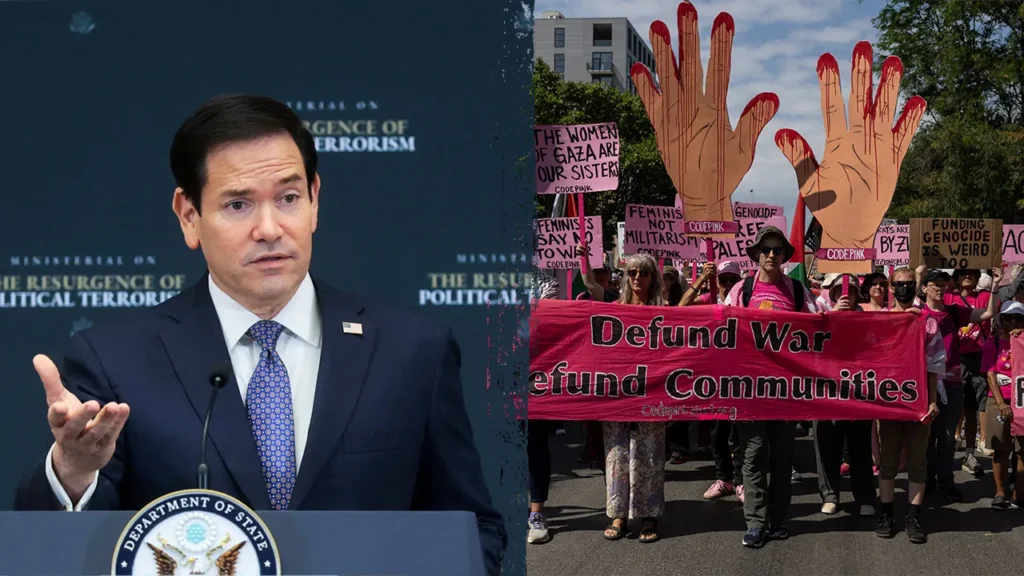
The State Department has released a report contending that Cuba has established ties with numerous American activist organizations capable of mobilization against U.S. policy objectives. The agency cited a June “National Rapid Response Plan” distributed by the National Network on Cuba—a coalition encompassing more than 60 groups—as evidence of this alleged coordination, pointing to the network’s publicly available protest strategy.
The National Network on Cuba maintains connections to the Cuban Institute of Friendship with the Peoples, known as ICAP, a Cuban government entity that the State Department sanctioned in June on allegations of supporting Cuban intelligence operations. ICAP is headed by Fernando González Llort, a former operative in Cuba’s Wasp spy network who previously served 15 years in U.S. prison before returning to the island.
The rapid-response plan outlines “coordinated nationwide actions” to occur within 24 hours of any U.S. military attack or credible threat of one. The strategy establishes specific timelines: demonstrations would commence at 6 p.m. local time on the day military action begins if it occurs before 3 p.m. Eastern time; otherwise, mobilization would happen at 6 p.m. the following day.
Protest targets identified in the plan include federal buildings, courthouses, post offices, military bases, recruiting offices, ICE detention centers, field offices and sports arenas during major events. The document directs activists to a Black Alliance for Peace database that catalogs 1,335 U.S. military and law-enforcement locations throughout the Western Hemisphere.
The State Department report identifies six organizations as central to Cuba’s alleged influence operations. ICAP represents the Cuban government side, while the National Network on Cuba serves as the U.S.-based coordinating body. The report also examines Code Pink, an anti-war group; the People’s Forum, a New York activist center; the Democratic Socialists of America; and the National Lawyers Guild.
The report notes that the Democratic Socialists of America dispatched multiple delegations to Cuba, including a 2023 visit during which members held private meetings with Cuban President Miguel Díaz-Canel and attempted to establish formal channels with Cuban ministries. However, the State Department acknowledged that the organization was not created or controlled by Cuban intelligence, attributing its Cuba support primarily to ideological alignment rather than external manipulation.
The People’s Forum is characterized in the report as a major organizing nexus linking Cuba advocacy with anti-ICE and pro-Palestinian activism. The organization has served as fiscal sponsor for the Venceremos Brigade, which has transported American activists to Cuba for decades, and has coordinated delegations meeting with senior Cuban officials.
Code Pink and the National Lawyers Guild have also participated in Cuba-focused delegations and campaigns opposing the U.S. embargo, according to the report. The National Lawyers Guild adopted a resolution in 2026 pledging cooperation with the National Network on Cuba and the broader Cuba solidarity movement.
The administration has intensified its Cuba pressure campaign during 2026. President Trump signed an executive order in January permitting tariffs on imports from nations supplying oil to Cuba, followed in May by sanctions targeting foreign entities operating in or supporting key Cuban economic sectors, supplementing the decades-long U.S. trade embargo.
Code Pink has separately faced federal scrutiny through an investigation into the financial network of Neville Roy Singham, husband of co-founder Jodie Evans and a major group benefactor. A Manhattan federal grand jury is examining potential foreign-agent and tax violations linked to Singham’s network, though Code Pink has not been publicly identified as an investigation target and no charges have been filed.
The Treasury Department has also sought information from Code Pink co-founder Medea Benjamin regarding a March aid convoy to Cuba as officials examine potential sanctions violations. Code Pink has denied wrongdoing, asserting that the delegation delivered humanitarian supplies to address shortages on the island.
The Cuban embassy in Washington did not immediately respond to requests for comment. The State Department report does not announce sanctions or legal action against the U.S.-based organizations and relies substantially on public records, organizational materials and previous reporting to support its conclusions.

More Stories
Colombia backs Trump security push while limiting U.S. role in anti-gang operations
Chicago Mayor Issues Executive Order Requiring Contractor Diversity Disclosures and ICE Ties Reporting
University of Pennsylvania Climate Scientist Demands Supreme Court Packing Pledge From Democratic Candidates