


💛 A quick favor, if you've got a second.
We're really happy that you chose to read one of our stories and sincerely hope you'll stick around to read more. We took our paywall down — for now — but that won't last forever, and when the gate goes back up, we'd love for you to already be on the inside.
It's free. So please enter your email here and don't forget to like and follow us on all of your favorite Social Media platforms!
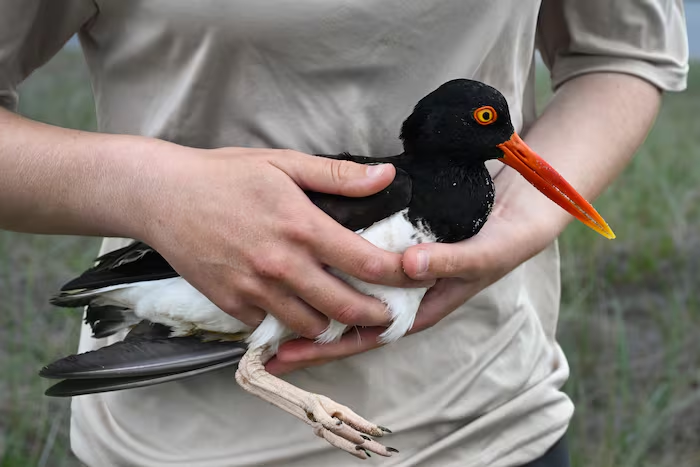
Biologists working across Rhode Island’s Trustom Pond National Wildlife Refuge recently captured and banded American oystercatcher chicks as part of a decade-long restoration campaign that has yielded remarkable results. The 787-acre refuge served as one of dozens of coastal sites where researchers tracked the distinctive birds, which sport bright-orange bills and piercing calls, to monitor their comeback from near-extinction in New England.
The coordinated effort marshaled approximately $10 million in funding and involved 35 coastal organizations spanning 16 states working under the American Oystercatcher Working Group. Led initially by conservation biologist Shiloh Schulte of Manomet Conservation Sciences, who died in a 2023 helicopter crash while on a shorebird protection mission in Alaska, the campaign identified chick survival as the primary driver of population decline and developed site-specific interventions accordingly.
Between 2008 and 2023, oystercatcher populations grew by 45% along the Atlantic and Gulf coasts, a particularly significant achievement given that most North American shorebird populations have declined. The recovery effort combined public education about the birds’ nesting habits with protective measures including fencing, predator control, and restrictions on beach vehicle traffic and pets during breeding seasons.
Individual states implemented tailored approaches to address regional threats. Martha’s Vineyard installed seasonal chicken-wire fencing to exclude raccoons and skunks from nesting areas and posted informational signage, resulting in a 77% increase in breeding pairs since 2009. South Carolina designated nearly 30 breeding sites for protection, while Georgia and North Carolina controlled predators like foxes and coyotes during nesting season and constructed elevated nesting platforms from oyster shells.
Despite these successes, climate change poses an escalating threat as rising sea levels and increased erosion destroy nests and erode critical habitat. Recent modifications to the Endangered Species Act have prompted environmental groups to file lawsuits, citing concerns that weakened protections could enable unchecked development and oil and gas operations on breeding grounds, potentially unraveling years of conservation progress.

More Stories
Forest Service Proposes Steep Fee Increases at Lake Tahoe Recreation Sites
Son Discovers Father Missing After Himalayan Disaster in Nepal-Tibet Border Region
Archaeologists Unearth 1,300-Year-Old Trading Hub Near Ancient Jaffa in Israel