


💛 A quick favor, if you've got a second.
We're really happy that you chose to read one of our stories and sincerely hope you'll stick around to read more. We took our paywall down — for now — but that won't last forever, and when the gate goes back up, we'd love for you to already be on the inside.
It's free. So please enter your email here and don't forget to like and follow us on all of your favorite Social Media platforms!
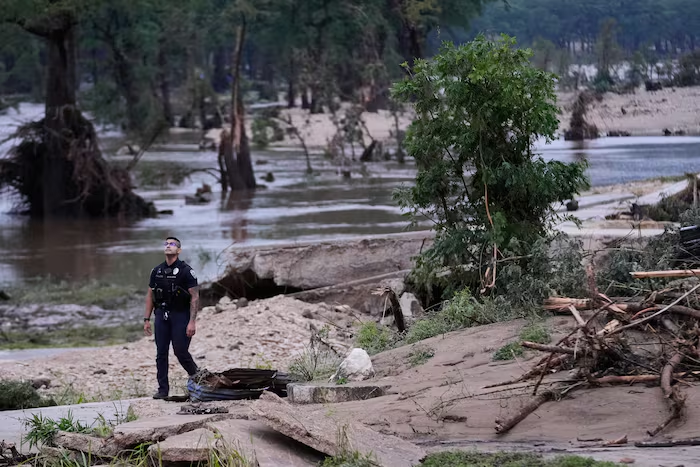
Severe thunderstorms returned to Texas Hill Country this week, providing the region’s first significant test of flood-warning systems installed following last July’s catastrophic deluge that claimed more than 136 lives, including 28 children at a youth summer camp. State officials had pledged comprehensive improvements including new early-alert infrastructure, enhanced safety rules for youth programs and upgraded water management approaches across the vulnerable region.
The latest round of dangerous weather struck the same communities with renewed intensity, resulting in at least two deaths and forcing emergency responders to conduct hundreds of rescue operations. Flash flood conditions again threatened infrastructure and lives throughout multiple jurisdictions.
Many residents in affected areas credited the newly installed warning network with providing critical evacuation time. Alert sirens activated during pre-dawn hours throughout the region, while emergency notifications reached cell phones in a dramatic contrast to the previous year’s silent catastrophe.
Still, some communities experienced notification failures that exposed continued gaps in coverage. Rising water caught residents off-guard in scattered locations, highlighting the challenges of protecting expansive, low-density regions prone to rapid-onset flooding.
Kerr County officials issued four separate evacuation alerts Thursday, with the city of Kerrville adding one more, a marked departure from their reluctance to order evacuations during last year’s disaster. This aggressive notification approach represented a fundamental shift in emergency management strategy.
Kerrville resident Suzanne Sutphin Gschwind contrasted the two events starkly: “Last year, we got no alarms. We had no idea what was going on.” This week brought repeated warnings from municipal officials, the National Weather Service and residential security systems arriving approximately every two hours.
Between Tuesday morning and Thursday at 9 a.m., the National Weather Service distributed 38 alerts across southwest Texas, including 14 tornado warnings and 24 flood notifications. Despite this intensive alert campaign, some counties remained underserved.
Uvalde County, which suffered extensive flood damage, apparently received no wireless emergency alerts from local authorities, according to Associated Press records, though officials may have employed alternative notification channels. Individual residents like Jaclyn Gonzales learned of threats only through personal phone calls from acquaintances, discovering floodwaters already inside their homes upon awakening.
Kat Sprawls near Batesville received her sole warning via a friend’s 3:30 a.m. call Friday; because her phone was silenced, water was already rising near her residence before she heard the alert. Zavala County law enforcement subsequently shifted tactics, deploying deputies for door-to-door notifications while distributing evacuation details through social media.
State Sen. Paul Bettencourt, who championed legislation funding flood-alert infrastructure, confirmed that newly operational sirens in Ingram and throughout Kerr and Kendall counties activated this week. An additional 28 counties qualify for similar equipment funding and are finalizing implementation plans for state authorization.
Tara Bushnoe, managing the Upper Guadalupe River Authority, reported that three of six newly installed sirens in Kerr County functioned as intended to direct residents to higher ground. The remaining three sirens stood idle in areas experiencing only minor water elevation.
Comfort recently expanded its siren capacity from one device to three. Assistant Fire Chief Danny Morales acknowledged the persistent difficulty of convincing residents to heed evacuation orders, requiring repeated alarm activations to communicate genuine danger.
Private sector initiatives complemented government preparations. River Sentry, established by Ian Cunningham following last year’s disaster, manufactures specialized flood-alert sirens for private facilities including campgrounds and hospitality businesses. The company has deployed 104 devices along the Guadalupe River corridor, with several positioned near an RV park where dozens died in 2025.
Cunningham expressed surprise at the immediate deployment: “We installed them about three months ago and did not expect them to be used so soon.” Technology firms also expanded capabilities, with Hononu securing a state contract to enable agencies to adopt its water-sensor and real-time alert network, while the flood-tracking application Watch Duty launched in early 2026.
Gov. Greg Abbott attributed improved emergency outcomes to enhanced regional preparedness efforts. “Everybody in Texas has been far more prepared to deal with what has happened this year,” Abbott told reporters during a Uvalde news conference, concluding that “lives have been saved.”

More Stories
Colombia backs Trump security push while limiting U.S. role in anti-gang operations
Chicago Mayor Issues Executive Order Requiring Contractor Diversity Disclosures and ICE Ties Reporting
University of Pennsylvania Climate Scientist Demands Supreme Court Packing Pledge From Democratic Candidates