


💛 A quick favor, if you've got a second.
We're really happy that you chose to read one of our stories and sincerely hope you'll stick around to read more. We took our paywall down — for now — but that won't last forever, and when the gate goes back up, we'd love for you to already be on the inside.
It's free. So please enter your email here and don't forget to like and follow us on all of your favorite Social Media platforms!
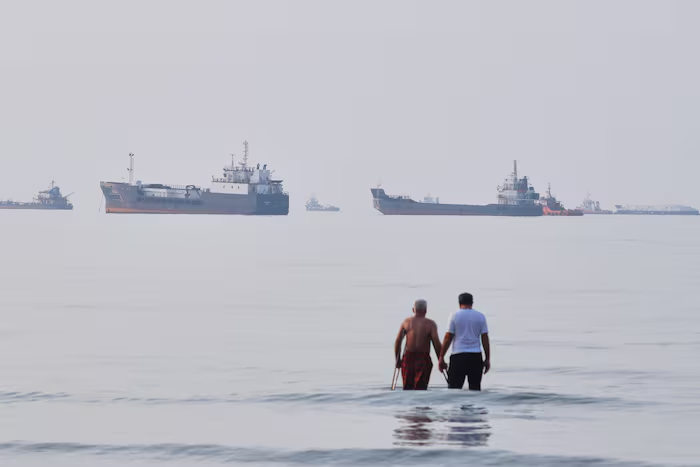
A fragile ceasefire agreement between Washington and Tehran fell apart after just seven days, descending into rapid cycles of military retaliation across the Persian Gulf. An Iranian drone struck a merchant vessel in the Strait of Hormuz on June 25 without causing casualties or major damage, but the incident triggered a cascade of escalating attacks that would ultimately destroy the nascent peace framework.
The Iranian drone assault targeted a U.S.-controlled shipping route that operates independent of Iranian authority—a corridor Tehran had previously demanded be closed. Iran viewed the waterway as inconsistent with the emerging peace agreement and had issued directives forbidding maritime traffic through the passage.
The Strait of Hormuz functions as a vital global trade artery, handling approximately one-fifth of worldwide petroleum and natural gas commerce during normal circumstances. Iran had blocked the waterway after a joint U.S.-Israeli military operation on February 28 that initiated the broader conflict.
The preliminary accord required unrestricted and toll-free passage through the strait, yet it contained vague language that allowed Tehran to interpret the terms as preserving its control over traffic regulation and revenue collection. This fundamental disagreement over the agreement’s meaning immediately sparked disputes between the parties.
The United States retaliated within 24 hours, launching airstrikes against Iranian missile batteries, unmanned aircraft facilities, and radar installations positioned along the coast. Within hours of the American response, Iran attacked a petroleum tanker in the disputed waterway, prompting additional U.S. bombing campaigns.
Iran subsequently broadened its assault to include Gulf allies of the United States, striking military installations in Kuwait and Bahrain where American forces operate. Both nations suffered direct Iranian attacks as hostilities intensified throughout the region.
A temporary lull lasting about one week emerged as both nations sent delegations to Qatar, which had functioned as the primary negotiation intermediary. The representatives maintained separate channels and avoided face-to-face talks, with tensions persisting during this interval.
Iranian officials used this pause to arrange funeral ceremonies for Supreme Leader Ayatollah Ali Khamenei, who was killed during the initial U.S.-Israeli military campaign. Beginning July 4, large crowds at the funeral openly demanded retribution against President Donald Trump.
Fighting resumed when Iran attacked three commercial vessels in the strait immediately following Khamenei’s funeral. American forces responded with extensive airstrikes targeting radar and air defense systems, as well as approximately 60 small boats operated by Iran’s Islamic Revolutionary Guard Corps.
Washington simultaneously terminated an exemption that had permitted Iran to conduct limited petroleum sales on international markets using American currency—a key provision underpinning the interim agreement. The restoration of energy sanctions represented a decisive breach of the diplomatic accord.
Tehran characterized both the bombing campaigns and reimposed oil sanctions as fundamental violations of the agreement. Military leadership declared control over the waterway a non-negotiable boundary that would not be relinquished.
Iran expanded its counterattacks geographically and politically, striking Kuwait, Bahrain, and Qatar—the neutral mediator attempting to prevent further escalation. These strikes reflected mounting frustration with international diplomatic efforts.
Trump issued conflicting statements regarding U.S. strategy, warning that further Iranian aggression would meet significantly more severe consequences while hinting that any future operations would occur with extraordinary speed. He also made indirect allusions to pursuing total military victory.
On Wednesday, the administration imposed a comprehensive embargo on Iranian ports, reversing another central component of the settlement agreement. The previous lifting of this blockade had served as compensation for Iranian concessions.
Subsequent American bombing missions have penetrated deeper into Iranian territory, striking targets far removed from the contested strait. Friday bombing raids destroyed bridges and power plants in southern Iran, including a Revolutionary Guard surveillance tower at a major port facility.
Iranian officials reported 46 deaths and more than 400 injuries resulting from the renewed fighting as of Friday. U.S. military officials defended the expanding strike targets as proportional responses to Iran’s repeated attacks.
The targeting of civilian infrastructure represents a significant escalation that may constitute crossing another critical threshold. Trump has previously threatened Iranian civilian installations but refrained from attacking them, citing continued hopes for diplomatic talks.
Iran retaliated by striking a desalination plant in Kuwait on back-to-back days, Friday and Saturday, targeting water supplies in the desert nation. This shift toward civilian infrastructure indicates both sides may now view established constraints as permanently fractured.
Trump has discussed militarily securing the strait through potential control of Iranian islands, an operation demanding substantially greater naval forces and possibly requiring deployment of tens of thousands of ground troops to the region.

More Stories
Colombia backs Trump security push while limiting U.S. role in anti-gang operations
Chicago Mayor Issues Executive Order Requiring Contractor Diversity Disclosures and ICE Ties Reporting
Federal Prosecutors Convene Special Grand Jury to Investigate D.C. Schools’ Attendance and Graduation Practices