


💛 A quick favor, if you've got a second.
We're really happy that you chose to read one of our stories and sincerely hope you'll stick around to read more. We took our paywall down — for now — but that won't last forever, and when the gate goes back up, we'd love for you to already be on the inside.
It's free. So please enter your email here and don't forget to like and follow us on all of your favorite Social Media platforms!
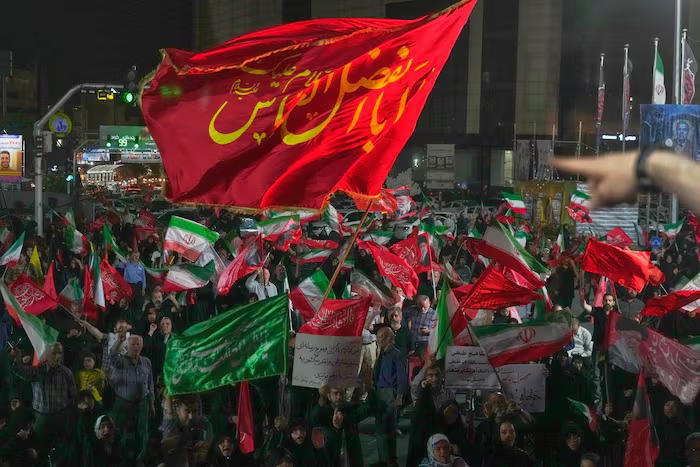
The Persian Gulf witnessed intensified military confrontation Saturday as American and Iranian forces launched reciprocal attacks on military and infrastructure targets throughout the region. The escalating exchange reflects mounting competition for dominance over the Strait of Hormuz, a critical global shipping passageway.
U.S. Central Command confirmed that American military operations continued for a seventh consecutive night, targeting weapon storage facilities, surveillance systems, logistics centers, and naval assets. Iran’s military responded with a sustained offensive involving cruise missiles and drone strikes aimed at multiple regional nations.
Kuwait sustained damage to a desalination plant after intercepting most incoming Iranian projectiles but suffering one direct hit. The nation, dependent on desalination for virtually all freshwater production, implemented temporary airspace closures and halted commercial flights as a protective measure against continued attacks.
Defense forces in Iraq and Jordan successfully repelled Iranian ordnance near Irbil and throughout Jordanian airspace respectively. Bahrain experienced multiple air raid alerts as regional instability continued to mount.
Iranian authorities reported 46 deaths and more than 400 injured from American bombardment, with infrastructure damage concentrated in Hormozgan province affecting power generation, water treatment, and transportation networks near Bandar Abbas.
The U.S. military disclosed that 13 additional service members sustained injuries since Monday, bringing cumulative casualties since late February to 14 fatalities and 427 wounded personnel.
The Strait of Hormuz remains the core dispute underlying the military escalation. Iran has asserted exclusive control over the waterway and imposed toll requirements on merchant vessels, contradicting the longstanding international framework recognizing it as an unrestricted shipping lane.
Approximately one-fifth of worldwide petroleum and liquefied natural gas shipments normally pass through the strait during stable conditions. Current Iranian restrictions have severely curtailed transit, with Thursday vessel counts dropping to eight—marking a three-week minimum based on maritime tracking systems.
Energy markets responded dramatically to reduced passage capacity, with crude prices surging above $86 per barrel Friday amid concerns about extended supply disruptions. Available pipeline alternatives in the region lack sufficient capacity to compensate for maritime transit losses.
President Trump declared Thursday that military operations are advancing as planned and anticipated demonstrable progress imminently. The administration indicated intentions to intensify strikes targeting Iranian electrical infrastructure and transportation systems to compel relinquishment of the strategically important strait.
The Iranian Revolutionary Guard Corps warned Saturday through state broadcasts that nations providing American military facilities would face equivalent retaliation, marking an escalation in rhetorical threats accompanying the military campaign.

More Stories
Colombia backs Trump security push while limiting U.S. role in anti-gang operations
Chicago Mayor Issues Executive Order Requiring Contractor Diversity Disclosures and ICE Ties Reporting
Federal Prosecutors Convene Special Grand Jury to Investigate D.C. Schools’ Attendance and Graduation Practices