



💛 A quick favor, if you've got a second.
We're really happy that you chose to read one of our stories and sincerely hope you'll stick around to read more. We took our paywall down — for now — but that won't last forever, and when the gate goes back up, we'd love for you to already be on the inside.
It's free. So please enter your email here and don't forget to like and follow us on all of your favorite Social Media platforms!
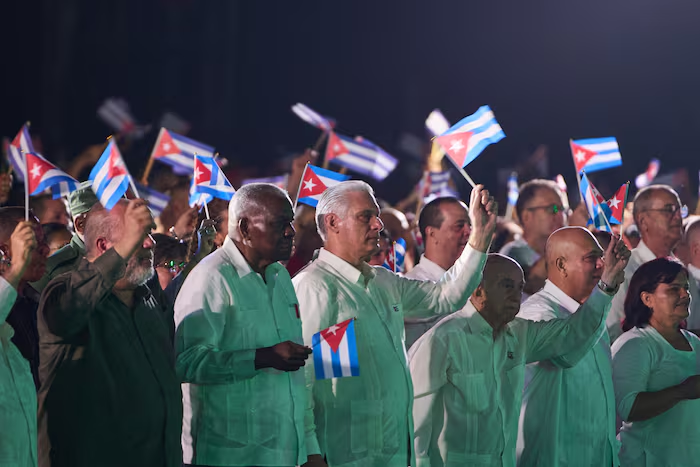
Five prominent Cuban economists have unveiled a comprehensive economic reform proposal that calls for transforming the nation’s centralized system into a social market economy supported by democratic governance and rule of law. However, according to Local 10’s Cuba Analyst Dr. Andy S. Gomez, a fundamental obstacle exists: Cuba has never experienced democracy in its modern history, having moved directly from pre-revolutionary governance into totalitarian rule since 1959. With nearly 68 years of centralized economic control entrenched in the system, achieving democratic transition may require years—a luxury the nation cannot afford given its current economic emergency.
July 26, 1953 marked the beginning of the Cuban Revolution when Fidel Castro, Raul Castro, and rebel forces attacked the Moncada Military Barracks in Santiago de Cuba. The event has become a defining moment in Cuban history, and this July 26 observers noted 73 years since that attack. According to Gomez, the revolutionary path taken has ultimately devastated the nation, leaving Cuba today far from the glory days Fidel Castro once envisioned.
The Trump Administration has escalated pressure on Cuba through successive rounds of sanctions targeting GAESA, the military-controlled economic conglomerate that dominates the island’s economy. Recent sanctions expanded to include companies such as Coral S.A., which assumed operations previously controlled by GAESA to circumvent American restrictions. Analysts including Gomez are questioning whether the ultimate U.S. strategy aims to force Cuba toward selling GAESA assets to American interests.
The State Department released a 100-page report titled “Cuba: The Capital of 21st Century Communism” that characterized the nation as a national security threat to the United States and global stability. The Cuban government swiftly condemned the document and blamed Secretary of State Marco Rubio for the threatening rhetoric. However, Rubio adopted a more conciliatory posture during a subsequent press conference in the Philippines, indicating Washington’s willingness to negotiate with Havana.
The initial shipment of American humanitarian assistance arrived in Cuba, consisting of 700 hygiene kits and 700 food packages coordinated by Secretary Rubio and distributed through Catholic Relief Services Caritas Cuba and allied faith-based organizations. The delivery represents the first installment of a $100 million humanitarian aid commitment, signaling American support for Cuban citizens enduring the worst economic conditions since the early 1990s.
Cuba released artist and opposition leader Luis Manuel Otero Alcantara after five years of imprisonment. Alcantara, a prominent figure in the San Isidro movement that sparked widespread island protests five years prior, arrived in Miami and called on the Cuban government to free all remaining political detainees while expressing gratitude to the Cuban American community.
The U.S. Department of Defense distributed $3 million in compensation to American personnel afflicted by Havana Syndrome under provisions of the 2021 Havana Act. The condition, which emerged in 2016 among diplomats and intelligence officers in Havana, produces symptoms including severe head pressure, vertigo, nausea, auditory disturbances, and cognitive impairment.
New U.S. sanctions have intensified economic pressure on entities controlled by GAESA and military brigades tasked with suppressing civil unrest. Intelligence reaching American officials suggests divisions within Cuba’s leadership regarding the government’s ability to survive without negotiating with Washington before systemic collapse occurs.
Raul Castro’s grandson, known as “Raulito” or “El Cangrejo,” triggered internal controversy by proposing direct negotiations with President Trump. Questions have surfaced regarding whether Raulito possesses authority to represent the Cuban government or merely the Castro family interests. Although the Cuban Communist Party endorsed his negotiation efforts, military leadership has remained silent on the matter.
Each year Cuba argues before the United Nations that the American economic embargo causes its economic deterioration, yet annual support for this position continues eroding. The United Nations possesses no legitimate authority to lift the embargo; only the U.S. Congress holds that power. Cuban government messaging has failed to persuade its own population, as most islanders and domestic economists now attribute economic hardship directly to government policies rather than external sanctions.
Raul Castro’s grandson announced through Reuters that Cuba stands prepared to negotiate with the United States, though ambiguity surrounds whether he represents the Castro family or the broader Cuban state. Recent weeks have witnessed Cuba attempting to sell military and non-military assets to attract foreign investment, but limited interest has materialized due to investor concerns about capital recovery.
Cuba’s psychological culture of fear, cultivated through decades of totalitarian governance, complicates democratic transition prospects. Citizens surviving under authoritarian systems internalize behavioral patterns and value systems aligned with government-imposed restrictions, requiring years of psychological reorientation to support democratic governance. Breaking such deeply embedded attitudes demands extended periods of societal transformation that may exceed Cuba’s current temporal capacity.


More Stories
Former NFL cheerleader and ex-aide face off in close Rhode Island GOP primary
Trump Threatens FCC Action Against NBC’s Welker Over Endorsement Coverage
Chicago Mayor Issues Executive Order Requiring Contractor Diversity Disclosures and ICE Ties Reporting