



💛 A quick favor, if you've got a second.
We're really happy that you chose to read one of our stories and sincerely hope you'll stick around to read more. We took our paywall down — for now — but that won't last forever, and when the gate goes back up, we'd love for you to already be on the inside.
It's free. So please enter your email here and don't forget to like and follow us on all of your favorite Social Media platforms!
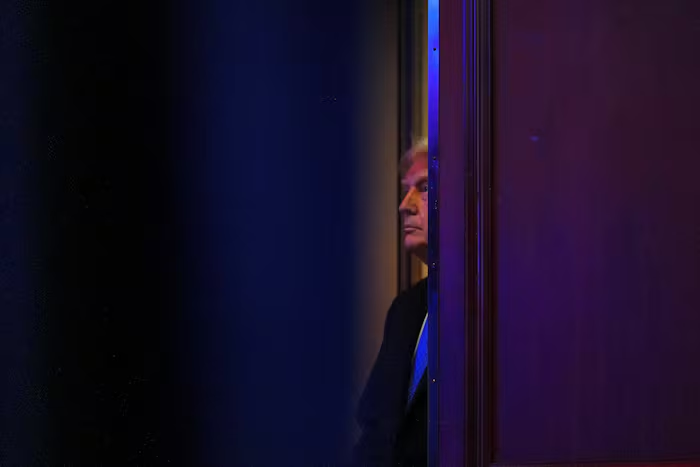
A New York federal judge on Monday rejected a legal challenge from interfaith organizations who contended that President Donald Trump’s Religious Liberty Commission was stacked with conservative Christian members and lacked the viewpoint diversity required by law. Judge John P. Cronan ruled that while federal statute mandates advisory commissions maintain balanced perspectives, the law does not prescribe specific methods for achieving this balance, leaving Trump considerable latitude in his appointments.
The lawsuit was brought by the Interfaith Alliance, a progressive organization, alongside Hindu, Muslim and Sikh groups who claimed the commission’s composition—heavily weighted toward conservative Christians with a single Orthodox Jewish rabbi—violated legal requirements for representation. The plaintiffs pointed to commissioners’ documented positions against church-state separation and their advocacy for characterizing America as a Judeo-Christian nation as evidence of ideological skewing.
Critics highlighted a June draft report from the commission that challenged contemporary interpretations of church-state separation and advocated instead for building “bridges” between religious and governmental institutions. Cronan determined, however, that the plaintiffs failed to satisfy the legal standards necessary for their lawsuit to proceed.
The judge noted that the commission demonstrated diversity in other dimensions, including both clergy and lay members, and claimed it includes “adherents of at least five different religions” by counting the Jewish member alongside various Christian denominations. He added that Trump’s executive order establishing the commission explicitly rejected the notion of religious liberty conflicting with civil rights protections, meaning the president bore no obligation to appoint members who disagreed with this foundational principle.
The Interfaith Alliance, which has remained critical of the commission, argues it favors certain religious groups over others and has failed to address significant concerns including attacks targeting Muslims. The organization has called the draft report inadequate for not examining these pressing issues.


More Stories
Trump Threatens FCC Action Against NBC’s Welker Over Endorsement Coverage
Packers Running Back Josh Jacobs Placed on NFL Commissioner’s Exempt List Following Domestic Arrest
Federal Prosecutors Convene Special Grand Jury to Investigate D.C. Schools’ Attendance and Graduation Practices