


💛 A quick favor, if you've got a second.
We're really happy that you chose to read one of our stories and sincerely hope you'll stick around to read more. We took our paywall down — for now — but that won't last forever, and when the gate goes back up, we'd love for you to already be on the inside.
It's free. So please enter your email here and don't forget to like and follow us on all of your favorite Social Media platforms!
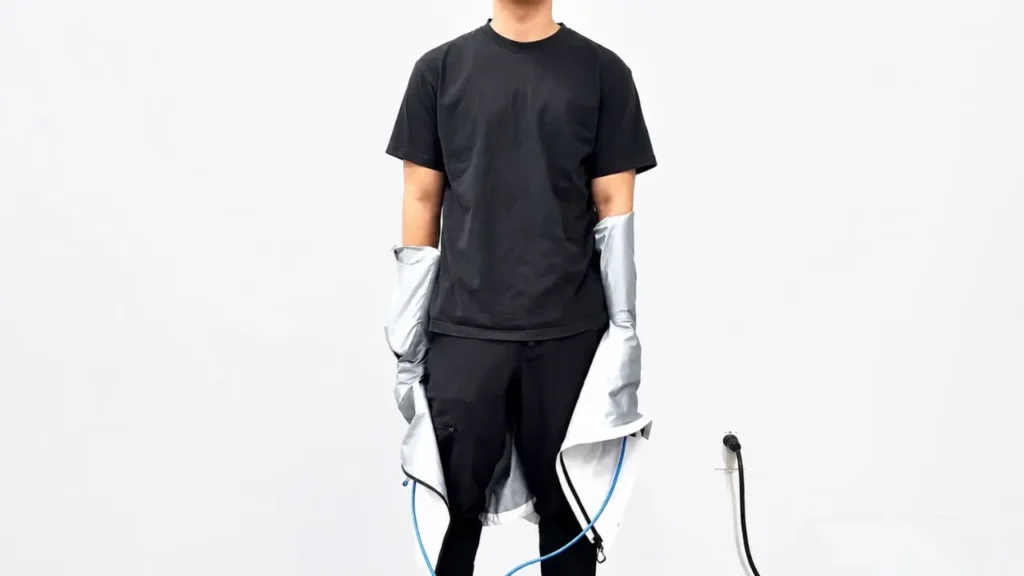
South Korean and American researchers have unveiled a breakthrough garment embedded with soft, air-powered robotic tubes designed to help people with limited mobility dress themselves. The technology, called SWAG (Self-Wearing Adaptive Garment), was developed jointly by KAIST and Stanford University as a potential solution to one of the most basic yet challenging aspects of aging in place.
The innovation addresses a widespread problem among older adults and people recovering from injuries. Conditions such as arthritis, shoulder stiffness and balance difficulties can transform the routine act of getting dressed into an exhausting or even impossible task. Researchers say their system could reduce dependence on caregivers and allow individuals to maintain personal autonomy longer, potentially enabling people to remain in their homes as they age.
The garment functions through a motion similar to ivy climbing a wall. When activated, pressurized air causes flexible robotic tubes built into the fabric to expand and unfold along the wearer’s body, effectively turning the garment inside out as it moves into place. This approach minimizes friction and friction and allows the clothing to contour naturally around different body shapes without requiring complex control algorithms.
Testing demonstrated that a full suit could be donned in approximately 10 seconds. Individual garments performed at varying speeds: a jacket required about 13 seconds, pants took roughly 21 seconds and a sleeve prototype needed approximately 14 seconds. All demonstrations maintained contact forces within the researchers’ established safety parameters.
The concept originated when postdoctoral researcher Nam Gyun Kim wondered whether a raincoat could don itself during an unexpected downpour while cycling. That simple question evolved into a comprehensive investigation of how clothing itself could become an assistive device rather than relying on external mechanical arms or human help.
Unlike traditional dressing robots that employ rigid mechanical arms and require users to maintain fixed positions, the SWAG system integrates robotics directly into the garment. This embedded approach reduces physical strain and creates safer contact by using flexible materials that bend around the body rather than rigid structures approaching it.
Though promising, significant hurdles remain before commercial availability. The current prototype connects to a pneumatic base station and lacks portability for everyday use. Researchers must conduct clinical trials with people experiencing actual mobility limitations to determine comfort and real-world effectiveness. Additional challenges include adapting the design for diverse body types, establishing washability standards and developing portable power sources.
Industrial applications may emerge before consumer availability. Semiconductor cleanroom workers and emergency responders could benefit from rapid protective clothing deployment. Medical professionals might use air-powered garments to apply compression bandages or protective coverings more efficiently. However, the research team emphasizes that controlled clinical testing remains essential before any practical deployment.
Future development priorities include automating the garment-loading process, improving controls and exploring how the clothing can be removed. Researchers also plan to investigate adjustable sheaths and elastic materials to accommodate varying body dimensions and movement patterns. Ultimately, the technology’s success will depend on affordability, comfort and demonstrated safety in home environments.
The research represents a meaningful step toward assistive technologies that integrate seamlessly into daily life. For aging populations and people with disabilities, such innovations could preserve dignity and independence during personal routines while reducing the physical and emotional burden on caregivers and family members.

More Stories
Christa Pike Survives Botched Double Execution Attempt; Tennessee Halts Remaining 2026 Executions
Tennessee’s Lone Death Row Female is Scheduled for Execution Wednesday for 1995 Torture/Murder
Modern Science Finally Supports & Strengthens Biblical Account of the Crucifixion of Jesus Christ