


💛 A quick favor, if you've got a second.
We're really happy that you chose to read one of our stories and sincerely hope you'll stick around to read more. We took our paywall down — for now — but that won't last forever, and when the gate goes back up, we'd love for you to already be on the inside.
It's free. So please enter your email here and don't forget to like and follow us on all of your favorite Social Media platforms!
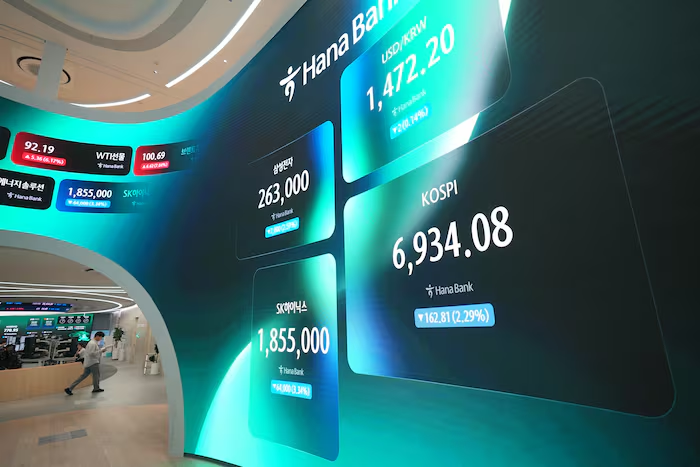
Asian equity markets posted significant losses Friday following a surge in crude oil prices to levels unseen since May, driven by escalating military tensions in the Middle East that threaten global petroleum supplies. The spike in energy costs rippled across regional exchanges, with major indices recording declines ranging from 1% to nearly 6% as investors reassessed exposure to sectors vulnerable to higher input costs.
Brent crude climbed to $102 per barrel during Thursday’s session before closing at $100.69, marking a 7% gain for the day. The rally stemmed from attacks on Saudi Arabian oil tankers in the Red Sea, a critical shipping corridor for petroleum moving from regional producers to international markets. Early Friday trading saw crude ease slightly to $100.40 per barrel, though prices remain substantially elevated compared to $72 per barrel before late February hostilities began.
South Korea’s benchmark Kospi index fell 5.9% to 6,681.98, with semiconductor manufacturers bearing the brunt of selling pressure. Samsung Electronics declined 8% and SK Hynix dropped 7.4%, reflecting broader concerns about technology sector profitability amid rising operational expenses. Japan’s Nikkei 225 retreated 3.1% to 64,377.28, as SoftBank Group tumbled 7.5% following its significant capital commitments to artificial intelligence ventures.
U.S. President Donald Trump responded to the Red Sea attacks by threatening “major military punishment” against Houthi rebels backed by Iran, cautioning that continued strikes on commercial vessels would trigger an American response. The administration simultaneously announced fresh tariffs of 10% to 12.5% on imports from 60 trading partners representing 99% of total U.S. imports, citing inadequate enforcement of forced labor prohibitions.
Wall Street extended losses into Friday as investors digested multiple headwinds including elevated oil prices, escalating tariff concerns, and mounting questions about the sustainability of artificial intelligence sector valuations. The S&P 500 declined 1.2%, putting the index on course for consecutive weekly losses for the first time since March, while the Nasdaq composite sank 2.2%.
Tesla stock plummeted 14.5% after the electric vehicle manufacturer reported quarterly profits below analyst expectations, magnifying broader market declines given its substantial weighting in major indices. Alphabet fell 7.1% despite the Google parent company delivering revenue and earnings above forecasts, as investors focused instead on dramatically increased capital spending plans earmarked for artificial intelligence development.
Currency markets reflected broader economic uncertainty, with the dollar reaching a 40-year peak against the Japanese yen at 163.83 yen per dollar—a level last recorded in 1986. The euro remained relatively stable at $1.1378, while Hong Kong’s Hang Seng dropped 1.3% to 24,891.84 and China’s Shanghai Composite shed 1.2% to 3,830.19. Australia’s S&P/ASX 200 lost 1% to 8,755.10 as regional markets felt the ripple effects of deteriorating global sentiment.

More Stories
Trump Threatens FCC Action Against NBC’s Welker Over Endorsement Coverage
Looney Tunes’ ‘Coyote vs. Acme’ Debuts With $15.5 Million as ‘Spider-Man’ Holds Box Office Crown
Trump Backs Christian-Led Initiative for Expedited U.S. Entry for Canadian Jews Facing Antisemitism