


💛 A quick favor, if you've got a second.
We're really happy that you chose to read one of our stories and sincerely hope you'll stick around to read more. We took our paywall down — for now — but that won't last forever, and when the gate goes back up, we'd love for you to already be on the inside.
It's free. So please enter your email here and don't forget to like and follow us on all of your favorite Social Media platforms!
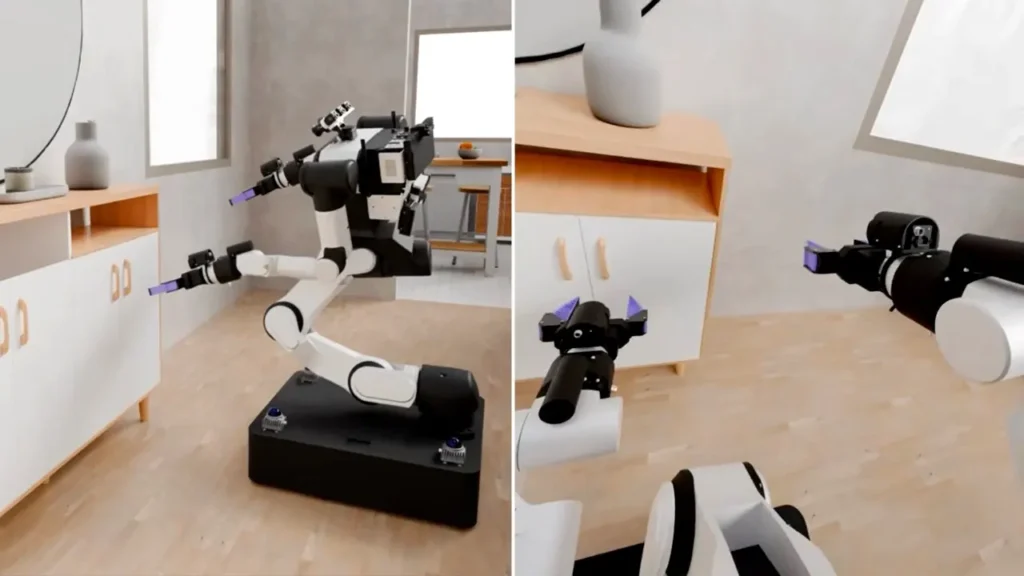
Performing simple household tasks presents enormous challenges for robots, which must navigate multiple variables that humans handle instinctively. Opening a cabinet, moving around furniture, and placing objects in their proper locations require robots to process each step methodically, unlike people who accomplish these chores without conscious thought. This fundamental gap between human and machine capability explains why robots often fail at basic domestic work despite impressive demonstrations.
Researchers at MIT’s Computer Science and Artificial Intelligence Laboratory and Toyota Research Institute have developed a potential solution: SceneSmith, an artificial intelligence system that generates detailed, interactive 3D indoor spaces from text descriptions. The platform allows robots to practice tasks repeatedly in virtual environments before attempting them in actual homes or factories, reducing both physical risks and training time. By creating realistic digital spaces filled with clutter and complex arrangements, SceneSmith bridges the gap between laboratory demonstrations and real-world performance.
The system operates through three coordinated AI agents powered by GPT-5.2 technology. A designer agent creates the room layout, a critic agent evaluates realism and appropriateness, and an orchestrator manages the iterative process until all agents agree the environment meets requirements. The system builds spaces layer by layer, starting with floor plans and furniture before adding wall objects, ceiling elements, and movable items that robots can interact with.
SceneSmith’s technical sophistication extends beyond visual authenticity to include functional physics simulations. The platform can generate cabinets with working doors, create objects with realistic mass and friction properties, and simulate how items respond when robots grasp or move them. Testing showed that 96% of objects remained stable during simulation, with fewer than 2% of object pairs colliding, essential for meaningful robot training.
Researchers generated more than 1,300 distinct scenes using the system, including conventional spaces like bedrooms and hotels alongside unusual environments such as pottery stores and gaming rooms. Some generated scenes contained six times more objects than earlier simulation methods, exposing robots to the realistic clutter that complicates actual household tasks. This variety prevents robots from relying on memorized layouts and better tests whether learned policies function across different situations.
In human preference testing, 205 participants rated SceneSmith’s virtual rooms superior to earlier scene-generation methods, with the system achieving a 92% win rate for realism and 91% for accurately matching text prompts. An AI evaluator assessing robot performance achieved 99.7% agreement with human judgments, suggesting that researchers could eventually screen robot attempts at scale without manual inspection of every attempt.
Current limitations include the hours required to generate individual scenes and limited support for deformable objects like sponges that change shape when touched. The researchers expect that expanded 3D object libraries and increased computing resources could eventually accelerate scene generation and broaden the system’s capabilities.
Despite its advances, physical-world testing will remain essential, as real homes present unpredictable variables—including people, wear, and unexpected objects—that no simulation can fully replicate. Nevertheless, SceneSmith represents a significant step toward efficiently preparing robots for the varied environments they will encounter in actual homes and workplaces.

More Stories
Looney Tunes’ ‘Coyote vs. Acme’ Debuts With $15.5 Million as ‘Spider-Man’ Holds Box Office Crown
Trump Calls NASA to Congratulate Agency on Roman Space Telescope Launch
Meta Ordered to Implement Sweeping Teen Safety Restrictions Under Settlement