


💛 A quick favor, if you've got a second.
We're really happy that you chose to read one of our stories and sincerely hope you'll stick around to read more. We took our paywall down — for now — but that won't last forever, and when the gate goes back up, we'd love for you to already be on the inside.
It's free. So please enter your email here and don't forget to like and follow us on all of your favorite Social Media platforms!
Yemen’s Iran-backed Houthi movement claimed responsibility Thursday for striking two Saudi-owned oil vessels in the Red Sea, escalating tensions as American forces continued their sustained bombing campaign targeting Iranian military capabilities. The dual assault underscores widening regional instability centered on competition for dominance over international maritime corridors critical to global commerce.
Houthi officials announced via their SABA news agency that they had targeted the tankers Encelia and Layla, both of which caught fire following the strikes. Saudi state media confirmed the Encelia sustained damage to its bow area with no reported injuries, while the UK Maritime Trade Operations Center documented a vessel struck by an unidentified projectile approximately 130 kilometers southwest of Al Shuqaiq.
The attacks represent the initial reported Houthi assault on commercial shipping since the group declared a blockade against Saudi-linked vessels transiting the Bab el-Mandeb Strait earlier this week. The rebels justified the measure as retaliation for Riyadh’s longstanding embargo against Houthi-controlled territory and a recent strike on the international airport in Sanaa, the rebel-held capital.
The Bab el-Mandeb Strait, located at the Arabian Peninsula’s southern extremity, functions as a critical chokepoint where approximately 12 percent of global trade and one-quarter of worldwide container shipments transit between Europe and Asia via the Suez Canal. A senior Houthi official stated the blockade would persist until the Saudi embargo against the group ends, though he declined to elaborate on operational specifics.
President Donald Trump issued a stark warning Wednesday via social media, declaring the US would demolish one bridge or electrical facility for each Iranian attack on shipping in the Strait of Hormuz. The declaration signals American willingness to target civilian infrastructure, a practice generally prohibited under international law except when military use is established.
US Central Command confirmed it conducted its 12th consecutive night of strikes, framing the operations as designed to “further degrade Iran’s ability to threaten civilian mariners and commercial vessels transiting regional waters.” American officials maintain the campaign aims to restore access through the Strait of Hormuz and resume normal international shipping flows.
Iranian state media reported that overnight American missile strikes struck locations near the western cities of Ahvaz, Ramshir, and Andimeshk, resulting in two fatalities in Shalamcheh along the Iraqi border. In response, Iranian forces have targeted energy infrastructure and desalination facilities supplying drinking water to neighboring Gulf nations.
Mohammad Bagher Qalibaf, Iran’s parliament speaker and chief negotiator with Washington, rejected American threats through a social media post asserting that “the situation of the strait will not return to prewar conditions.” His statement signals Tehran’s refusal to abandon claims over the vital waterway despite escalating US military pressure.
Kuwait’s military command reported via social media that air defense systems repelled attacks by Iranian drones, characterizing the assault as aggression. Iran’s Foreign Minister Seyed Abbas Araghchi declared Tehran would pursue an “eye for an eye” defense posture, warning that “any aggression against Iran, including our infrastructure, will compel a powerful and decisive response.”
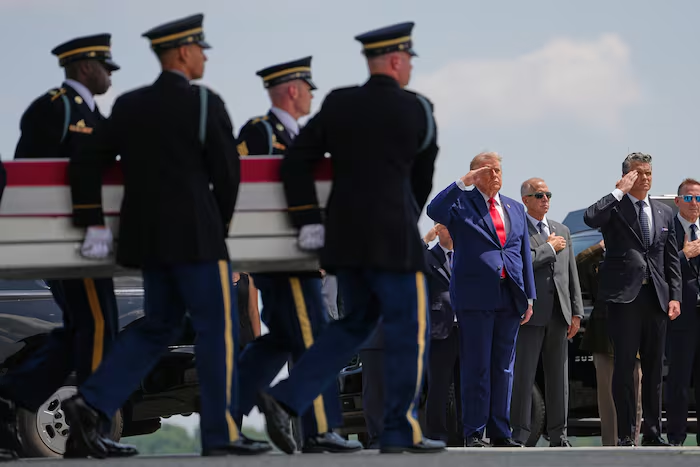
Pentagon leadership acknowledged the war’s mounting financial toll, with Defense Secretary Pete Hegseth estimating during Senate testimony that American expenditures have reached $37.5 billion. Trump attended ceremonies Wednesday at Dover Air Force Base marking the arrival of four fallen service members’ remains.
Iranian Interior Minister Eskandar Momeni conducted recent meetings in Pakistan, a key mediator, attempting to restart diplomatic channels. However, Iranian officials acknowledged uncertainty regarding potential arrangements capable of ending hostilities centered on Strait of Hormuz control, with no concrete progress evident.
An unnamed Arab diplomat reported that Gulf states have grown increasingly pessimistic about negotiating an end to escalating conflict, citing particular concern over recent threats. Regional actors including Pakistan and Turkey continue de-escalation efforts, yet prospects for meaningful improvement currently appear dim.
At a regional summit in the Philippines, US Secretary of State Marco Rubio stated Washington remained willing to negotiate with Tehran while asserting “right now they don’t seem to be serious about that,” pivoting instead toward emphasizing maritime security protection efforts.

More Stories
Colombia backs Trump security push while limiting U.S. role in anti-gang operations
Federal Prosecutors Convene Special Grand Jury to Investigate D.C. Schools’ Attendance and Graduation Practices
State Department Reissues Level 3 Travel Advisory for Israel Amid Terrorism and Armed Conflict Concerns