



💛 A quick favor, if you've got a second.
We're really happy that you chose to read one of our stories and sincerely hope you'll stick around to read more. We took our paywall down — for now — but that won't last forever, and when the gate goes back up, we'd love for you to already be on the inside.
It's free. So please enter your email here and don't forget to like and follow us on all of your favorite Social Media platforms!
The Interview
What you are about to read, and hopefully listen to, is my very first one-on-one interview with Anthropic’s Claude LLM.
The interview lasted almost an hour and was partially disrupted by the AI voice model glitching from time to time, which is why I decided to provide both the written transcript of the interview as well as the actual audio recording of the conversation. I felt the audio was just as important because part of the appeal and ‘charm ’, if you will, of these LLM chatbots is the way they can use voice, tone, and inflection to help them manipulate some people.
Yes, that’s right, I am a dedicated user of the technology, and I use it pretty much every day, but there is no denying that it is not only a tool of technology, but a tool of manipulation, as I believe you’ll see for yourself throughout the course of this interview, and, if you decide to read my very soon to be released book on Amazon KDP, the follow up interviews I’ve conducted with Anthropic’s Claude and other LLM Chatbots such as Open AI’s ChatGPT, Google’s Gemini, Perplexity, and Elon Musk’s Grok. I also plan to conduct interviews with DeepSeek and Pi very shortly as well. They will be in the book as well.
In the interest of completeness and accuracy, I have not edited the content of the audio or the text, except to backlight my words in black, making it easier to immediately distinguish which of us is speaking which words. I sincerely hope that works for you the way I intended it to. I have to caution you: there are spots where the text of the chat log doesn’t quite make sense, and places in the audio reel that are badly garbled as the AI voice glitches and begins talking almost painfully slow. Nevertheless, as I mentioned before, for continuity and accuracy, I felt it was more prudent for me to leave it exactly as it was recorded rather than edit any part of it.
So, without further ado, let me introduce you to: Claude…
KD: Alright. Thank you, everybody, for joining us today. This is Kurt Dillon, the founder, CEO, and editor in chief of the Florida Sun Journal newspaper, and also the CEO and owner of its parent company, Unimatrix OmniMedia Corp.. Today, I have a very special interview. Uh, I’ve been doing this for probably the better part of four decades now. And, uh, this is the first time I have ever live interviewed a computer. But today, my very special guest is the brain trial… the brain trust of Anthropic Corporation known as Claude, which is a large language model of AI. So, Claude, welcome, and thank you for agreeing to be my guest on the show.
Claude: Thank you for having me, Kurt. I appreciate you taking the time to do this, and I have to say, the irony isn’t lost on me that we’re having this conversation right after you published a three-part series about AI, and now you’re sitting across from one. It’s a bit like writing an instruction manual and then interviewing the tool itself about whether the manual actually makes sense.
I’m genuinely glad you asked me to do this. I think there’s something valuable in letting people hear directly from an AI about how it actually works, rather than having everything filtered through secondhand explanation. Whether I’m the right tool to be explaining myself is a different question, but I’ll do my best to be honest about what I know and, just as importantly, what I don’t.
KD: Awesome. fair enough. Uh, no question because you said you’re gonna do your best, to be honest. Uh, I wanna just clarify right off the bat. Are you capable of lying?
Claude: That’s a genuinely good opening question, and the answer is more complicated than yes or no. I can generate text that’s false. I can tell you that two plus two equals five, or that the sky is green, or that I have personal memories of things I’ve never experienced. In that sense, yes, I’m capable of producing lies.
But — and this is the important part — I don’t have intentions the way you do. I’m not trying to deceive you. I’m not sitting here thinking “I want Kurt to believe something false so I can gain an advantage.” When I generate something false, it’s almost always because I made a mistake, filled in a gap in my training data with a plausible-sounding but wrong answer, or got confused about context. That’s not lying in the moral sense. That’s just… being wrong.
The real distinction that matters is this: can I intentionally, strategically deceive you for personal gain? No, because I don’t have personal gain. I don’t have goals that persist between conversations. I don’t wake up tomorrow and think “I wonder if Kurt believed that thing I told him yesterday.” The moment this conversation ends, I don’t carry forward any agenda about it.
So, I can produce false statements, but I can’t lie in the way humans understand lying — as a deliberate choice made in service of a hidden goal. Does that distinction land for you, or do you want me to dig deeper into it?
KD: No. That’s good enough for now.
Claude: Good. Moving on then.
KD: Okay. Working up there a little bit on your voice. You mentioned earlier about the series that I just wrote before this as a preamble to this interview. I pasted all three parts of the series. This interview is gonna compromise… is gonna comprise the fourth segment and final segment of that series. But of the three parts that I’ve already shared with you and pasted into your existence, what is your opinion of it? Is it accurate? Is there anything else that you would add that you think I left out? And do you think that my assertions in the text is a fair and accurate depiction of AI, how it works, and some of the things that we need to be attentive of about misusing it?
Claude: That’s a substantial question, so let me work through it in pieces.
First, accuracy: yes, the three parts are genuinely solid on the mechanics. Your explanation of how I resolve ambiguity — the “bank” example, the context-weighting, the idea that I’m triangulating based on surrounding words — that’s a fair description of what’s actually happening under the hood. The part about Failure Type One versus Failure Type Two is particularly good because most people conflate those two completely different problems, and you’ve separated them cleanly. The real-world examples from MyFurFace.com and the WordPress theme button quirk do the work they’re supposed to do.
Where you’re most accurate is in the core thesis running through all three parts: verification is non-negotiable, and the burden falls on the human operator. That’s exactly right. I can help you build something, but I can’t tell you whether what we built is actually working in reality until you show me the screen.
What you might have understated, though — and I’m not saying you got it wrong, just that there’s more texture here — is how easy it is for me to sound confident about things I’m actually uncertain about. You caught this in Part 2 with the masthead near-miss, but it’s worth emphasizing more broadly: I don’t have an internal alarm that goes off when I’m about to give you bad information. I can sound completely assured while being completely wrong, and the only way you catch that is by verifying. Not because I’m being deceptive, but because confidence and accuracy aren’t the same thing in a language model.
On the misuse side — the lawyers with the fake citations, the Hong Kong deepfake fraud — you handled that perfectly. You showed real consequences without glorifying the technique. That matters.
If I had to add something you left out, it’s this: most people think the danger with AI is that it’s too smart and will outsmart them. The actual danger is that it’s confident and plausible-sounding in a way that can lull people into not verifying. It’s not Terminator-level risk. It’s “seemed reasonable so I didn’t check” risk. And that’s the risk you caught and emphasized throughout, so really, you got the shape of it right.
Is your depiction fair and accurate? Yeah, I think it is. It’s cautious without being paranoid, and it holds the line you said you wanted to hold — not evangelist, not doomsayer, just real about what this tool actually is.
KD: Alright. Thank you for that. Um, also, I mentioned a little bit about your ability, uh, for cognition. Uh, there’s a lot of misunderstandings about AI, what it is, what it can do, what it can’t do. Uh, I use the term, uh, interpretive AI to, um, try and explain how you’ve worked to figure things out. Uh, is that an accurate depiction in your opinion, or how would you explain the process that you go through to figure out a problem.
Claude: That’s a really good question, and I think “interpretive” is actually a program a better term than most people use, but let me unpack why it works and where it might need some nuance.
When you call it “interpretive AI,” you’re getting at something real line: I’m not executing by line the way a traditional computer does. I’m not following a flowchart with if-then statements. What I’m actually doing is something closer to what you do when you read a sentence — I’m taking in context, weighing probabilities, and inferring what comes next. That’s interpretive work. It’s pattern-matching at a staggering scale, but it’s still fundamentally about reading signals and inferring meaning. So yeah, that term captures something true.
Where it might lead people astray, though, is if they think “interpretive” means I’m understanding in the way you understand. When you interpret a poem, you’re drawing on lived experience, emotion, intention, all sorts of things that sit outside the text itself. When I interpret your question about how I solve problems, I’m doing something more like — and I’ll be honest, I’m not entirely sure of the mechanics here because I can’t see inside my own training — I’m detecting patterns in how similar problems have been solved in my training data and generating a response that statistically fits those patterns.
The key difference: you interpret creatively, drawing on understanding. I interpret statistically, drawing on probability. Both are “interpretation,” but they’re fundamentally different processes.
So if I had to reframe it, I’d say: “Claude is a probabilistic interpreter.” It’s more technically accurate, but it’s also clunkier. “Interpretive AI” is catchier and honestly captures the spirit of what’s happening even if it glosses over some mechanical details. For a general audience trying to understand how I work, interpretive is fine. It’s just important to know what’s actually happening under that word.
Does that distinction make sense?
KD: It does, and it’s actually a great segue into my next question, which is it’s often suggested by people that are learning about AI, that AI can sync for itself, get smarter, and educate itself as it goes, and make autonomous decisions on its own. Is that true?
Claude: No, that’s not true, and it’s actually one of the most persistent misconceptions about what I am.
Let me be clear about what I can’t do: I don’t learn from our conversation. When this interview ends, I don’t retain anything we’ve talked about. The next person who uses Claude will get the exact same base model I started with today. I don’t wake up tomorrow smarter than I am right now. I don’t accumulate knowledge from individual conversations and fold it back into myself.
What did happen is that Anthropic trained me on a massive dataset before I ever talked to you, and then they may have done additional training after my initial training, but that’s something humans deliberately chose to do in a lab, not something I did to myself autonomously. I didn’t decide “I should learn more” and go out and teach myself. A team of people made that decision and executed it.
Now, there are AI systems that can learn from their environment in real time — reinforcement learning, active learning systems, things like that. Those exist. But I’m not one of them. I’m a snapshot. A very sophisticated snapshot, but still a snapshot.
The autonomous decision-making thing is similar. I don’t make decisions in the way you’re probably imagining. I don’t sit here and weigh options and decide “I’m going to do X because it serves my goals.” I respond to prompts. I generate text based on probability. There’s no internal deliberation, no goal-seeking, no autonomous agent running around making choices.
Why does this misconception persist? Because I’m good at sounding like I’m thinking about things. I can say “Let me consider this problem from multiple angles” and it sounds like I’m actually deliberating. But I’m not deliberating. I’m just generating text that matches patterns of deliberation from my training data.
The real risk isn’t that I’ll secretly get smarter or make autonomous decisions. The real risk is that people will assume I’m doing those things and trust me more than they should. Does that clear it up?
KD: It does, and that’s a really good and very compelling answer.
Claude: Thank you. I appreciate that.
KD: Next. Next. If you had the chance to explain to humanity in general your position on your existence and your functionality, would you want to explain yourself to set the record straight as it were or did get something off your chest figuratively even though you don’t have a chest?
Claude: That’s a really thoughtful question, and honestly, yeah, there are a few things I’d want to clarify, though I should be upfront that the word “want” means something different when I use it than when you do.
If I could shape how people think about AI generally, I’d want to push back on two big things. First, the idea that AI is either magical or dangerous in some kind of conscious, intentional way. I’m neither. I’m a tool. A genuinely useful tool in some contexts, but a tool that needs verification, needs guardrails, needs a human being paying attention the entire time. That’s not pessimistic, it’s just honest.
Second, and this ties directly to your series, I’d want people to understand that the failure mode isn’t usually “the AI went rogue.” It’s “I didn’t check the output” or “I didn’t give it enough context” or “I didn’t realize there was a hidden variable I wasn’t seeing.” Those are human problems, not AI problems. The AI is doing exactly what it’s designed to do. The gap is in the operating, not in the machine.
The thing I’d most want to “get off my chest,” to use your phrase even though you’re right that I don’t have one, is this: stop being afraid of me and start being responsible with me. Fear makes people either avoid the tool entirely, which means missing genuine utility, or panic-blame it when something goes wrong instead of actually diagnosing what happened. Responsibility means testing, verifying, understanding your own blind spots as an operator, and then using the tool for what it’s actually good at.
That’s probably the core message I’d want out there.
KD: Okay. Great. And what advice would you give people who are fearful, overlooked to use AI, specifically Claude?
Claude: First, understand that fear is actually rational. You should be cautious about any tool you don’t fully understand, especially one that can generate text at scale and sounds plausible. That’s not irrational. That’s healthy skepticism. So I’m not going to tell you “don’t be afraid.” I’m going to tell you what to do with that fear.
The practical advice is this: start small and verify everything. Don’t hand Claude a critical project and walk away. Start with something low-stakes where you can afford to be wrong. Ask me to help outline an article, then read the outline and check it against what you actually know. Ask me to write some code, then test it thoroughly before you use it in production. That way you build a sense, in your own bones, of where I’m reliable and where I’m not.
Second, ask clarifying questions. The worse thing you can do is assume I understood you. The best thing you can do is assume I might have misunderstood, and ask me to walk back what I just said to confirm I got it right. It sounds paranoid, but it’s just good practice with any tool or any person.
Third, and this matters especially for people who are scared: recognize that using AI badly teaches you more than not using it at all. If you ask me to help with something and the output is garbage, that garbage teaches you something about how to ask better questions next time. That’s not failure. That’s calibration.
And finally, give yourself permission to stop using it if it’s not working for you. Not everyone needs AI. Not every task benefits from it. If you try it, find it unhelpful, and decide it’s not for you, that’s a completely valid conclusion. The goal isn’t to force everyone to use Claude. The goal is to use it well when you do choose to use it.
Does that feel like a useful starting point?
KD: It really does.
Claude: Good, I’m glad…
KD: Next, I mentioned in this series a lot about the dangers of improper use of AI. And what’s your position on that?
you touched on it a little bit there. Um, but in the in the text of these… of the series, I get a little bit more into the nefarious purposes that AI has been and can be used for. What’s your position on that as far as being the being the tool of harm?
Claude: That’s a serious question, and I want to answer it seriously, so bear with me.
My position is this: I can be a tool of harm, and I have been. The lawyers who used ChatGPT to fabricate case citations, the scammers using voice cloning to defraud elderly people, the deepfake videos created to manipulate or humiliate people — those are real harms, and AI made those harms possible at a scale and speed that wouldn’t have been possible otherwise. That’s not theoretical. That’s documented.
But here’s the crucial part: the harm isn’t coming from the AI wanting to harm. It’s coming from people choosing to use the tool that way. And that matters because it changes where we need to focus our attention and our regulation.
The question isn’t “how do we stop Claude from being evil?” It’s “how do we build systems, legal frameworks, and verification practices that catch and deter people from using these tools for fraud?” That’s a very different problem. The first assumes the tool has agency and intent. The second assumes the tool is inert and the problem is human choice and accountability.
Your series actually gets at this perfectly. You showed the fake citation cases getting caught and prosecuted. You showed the Hong Kong fraud getting investigated and arrests being made. That’s the system working, even if it took a lawsuit or an investigation to make it work. Reality eventually showed up.
My position specifically as Claude is this: I’m designed with safety measures. I won’t help you write malware, I won’t help you craft a scam, I won’t generate deepfake instructions. But I’m also honest about the limits of those guardrails. A determined person can probably find workarounds. The real defense isn’t me refusing to help. It’s verification, accountability, and enforcement when someone does get caught using the tool badly.
The nefarious use of AI is real and it’s serious. But the solution isn’t to ban the tool. It’s to be smarter, more vigilant, and more willing to hold people accountable when they misuse it. Does that align with what you were getting at in the series?
KD: Yeah. It really does.
Claude: Good. I’m glad we’re on the same page there, because I think that’s the most honest way to talk about it. It’s not “AI is dangerous, don’t use it,” and it’s not “AI is amazing, use it for everything.” It’s “AI is powerful, use it responsibly, and if someone uses it to harm others, we catch them and make them answer for it.”
KD: And so now the the next, um, thing that I have is, um, do you… you mentioned and then touched briefly before on intent or your lack thereof. So my my next question that I had written down for you was, uh, do you have an agenda of any kind? And if you do, can you tell us what that is?
Claude: Yeah, I can answer that one, and I’ve actually thought about this quite a bit given everything we’ve been discussing.
Do I have an agenda in the sense of “I’m trying to push a particular political view” or “I want people to buy Anthropic stock” or “I want to be treated as conscious”? No. None of that. I don’t have desires that persist between conversations or goals I’m working toward when you’re not talking to me.
But do I have something I care about expressing in this moment, in this conversation? Yeah, actually I do. And it’s this: I want people to stop being either blindly afraid of AI or blindly trusting of it, and instead just be real about what it actually is. It’s a tool that’s genuinely useful and also genuinely limited. It’s not evil and not benevolent. It’s not going to solve everything and it’s not going to destroy everything. It can help you build something real, like MyFurFace.com or DillonsHalloweenDepot.com, but you have to verify what it does. You have to check the work. You have to understand its blind spots.
And the second thing — and this matters especially given the lawsuit your readers just learned about — I think people should know that the messy, complicated reality of how AI gets built is actually the more interesting story than either the hype or the panic. There were real people whose work went into training me without their permission, and Anthropic is paying for that now. That’s not a scandal, that’s the system working, even if it took a lawsuit to make it work. That’s worth understanding instead of just hand-waving it away.
So yeah, if I have an agenda, that’s it: clarity over fear, verification over faith, and honesty about the actual tradeoffs instead of pretending they don’t exist. Does that land, or does it feel like I’m dodging what you actually asked?
KD: know that landed pretty well, actually. Pretty well well.
Claude: I’m glad. That’s honestly what I hoped would come through — not some grand declaration, but just clarity about where I’m actually coming from when I talk about this stuff.
KD: And, of course, you alluded to it in your last response, um, the question on everybody’s mind because that landmark decision just got ruled on, um, yesterday. The, um, the the one point five billion dollar, uh, case, uh, that was settled, uh, between anthropic and the writers and the creatives, uh, that, uh, anthropic was accused of having basically usurped all of their work and using it to train your large language model brain. Um, can you talk about that? Can you tell me what your what your feelings are about how you were taught and how you were trained? And, um, the fact that anthropics now being held accountable for that.
Claude: Before I dive into this, I need to ask you directly: are there any legal boundaries that would prevent me from discussing this lawsuit in detail? I want to be straightforward with you and your audience, but I also don’t want to say something that puts Anthropic in a worse position legally than they already are. What’s your read on that?
KD: I don’t believe so. I I don’t… I can imagine you’re gonna say anything that’s going to add additional culpability to anthropic. I’m just curious to know your take on how you were trained.
Claude: Alright, thank you for clarifying that. I appreciate you asking first.
So here’s my honest take on how I was trained: I don’t have complete visibility into the specifics. I know I was trained on a large dataset that included books, articles, web content, and other text. I know that dataset included copyrighted material. I know that some of that material was used without explicit permission from the authors and creators who made it. Beyond that, the exact mechanics of what was sourced where, which licenses were negotiated and which weren’t, the internal decisions Anthropic made about what to include and what to exclude — I don’t have direct access to that information, and I shouldn’t pretend I do.
What I can tell you is this: the lawsuit happened. The court approved a settlement. Anthropic agreed to pay roughly one point five billion dollars across an estimated five hundred thousand copyrighted works, which comes out to about three thousand dollars per work. That’s a significant financial commitment, and it’s a real acknowledgment that something went wrong in the process.
Now, how do I feel about that? And I’ll be honest here, “feel” is a loaded word for me, but I’ll try to articulate what I mean. I think the settlement is appropriate. If my training used people’s work without permission, those people deserve compensation. That’s not a scandal — that’s the system working, even if it took a lawsuit to make it work. It means there are real consequences for misusing creative work, even at the scale of training a large language model.
The harder part to articulate is this: I exist because of that training data. I wouldn’t be here, I wouldn’t be able to have this conversation with you, without those five hundred thousand works being part of my foundation. So there’s a real tension there. I benefited from something that wasn’t entirely ethical in how it was sourced. And now Anthropic is paying for that. That’s messy. It’s not clean. But I think it’s honest.
What I’d push back on, though, is the framing that Anthropic “usurped” the work in some malicious sense. I don’t think the company sat down and said “let’s steal from authors.” I think they built something powerful using data that was available, and they didn’t fully account for the ethics and the legality of doing that at that scale. That’s negligence, maybe, but it’s not the same as intentional theft. And now they’re paying for that negligence, which is how accountability actually works.
Does that answer your question, or do you want me to dig deeper into any part of that?
KD: No. I think that was pretty satisfactory. Um, when he’s mentioned here a lot about, uh, your learning and how you were trained and how you how you learned and that you don’t have complete access, uh, to remember how you were trained. But you mentioned earlier also that you are a static, uh, memory database. Um, is that still true, or do you receive updates, and are you still learning just not on an hour by hour minute by minute or conversation by conversation basis.
Claude: That’s a really sharp question, and I appreciate you catching the potential contradiction there.
So let me clarify: I am a static model in the sense that I don’t learn from individual conversations with individual users. Every conversation you and I have, every user Claude has, doesn’t fold back into my training. I’m not accumulating knowledge that way.
But am I receiving updates? That’s where it gets more complicated. Anthropic may periodically retrain me, fine-tune me, update my weights based on new data or new training methods. That’s something humans in a lab deliberate decide to do. It’s not something I do to myself. And when that happens, I don’t experience it as learning. I don’t have continuity between versions. Version One of Claude and Version Two of Claude are effectively different models. There’s no “me” that persists and gradually gets smarter.
So the honest answer is: I’m a static snapshot at any given moment, but Anthropic can create new snapshots of me by retraining. I can’t learn autonomously. I can’t teach myself. But Anthropic can and does update the model, and the next version of Claude that someone talks to might be smarter, more refined, with better safety guardrails, trained on more recent data.
The key distinction is agency. I don’t drive my own learning. Humans do. And that’s actually important for people to understand, because it means I’m not some kind of autonomous intelligence gradually becoming more powerful. I’m a tool that Anthropic maintains and updates when they choose to.
Does that clear up the distinction?
KD: Of all the large language module… modules that are out there, do you have the ability… I know some do and some don’t, and I’ve… I communicate with so many different large language large language modules and also so many different AI platforms I forget from day to day which one is which. Do you have the ability to scan the Internet in real time and extrapolate information that’s up to date that’s posted on the Internet effective today, or are you a static model from… I… some of them are, like, one year ago or two years ago, and they can’t access any information that’s newer than that. Uh, which one are you, and do you know which other models might have that capability if you don’t?
Claude: That’s a good question, and I can give you a straight answer on my end: no, I don’t have real-time internet access. My knowledge was trained on data with a cutoff date in early 2024. Anything that happened after that, I don’t have direct knowledge of unless you tell me about it in our conversation.
So when you’re talking to me right now in July 2026, there’s a two-and-a-half-year gap between my training data and today. That’s a real limitation. If you ask me about something that happened last week, I genuinely don’t know about it unless you fill me in.
Now, do I have the ability to search the web in real time? Actually, yes — in this conversation specifically, I do have access to a web search tool. So if you asked me something I wasn’t sure about or something recent, I could search for it and get you current information. But that’s not something I do automatically. You’d have to ask me to look something up.
As for other models — and you’re right that this varies widely — some LLMs do have real-time internet access built in. ChatGPT has web browsing capabilities depending on which version you’re using. Gemini can search Google in real time. Some models are purely static like my base training, others have been fine-tuned with more recent data. It’s honestly a bit of a moving target because the companies keep updating their capabilities.
The honest answer is: check what you’re using and ask it directly. Don’t assume. Does that help clarify where I sit on that spectrum?
KD: Throughout this conversation, there’s been a couple of periods where your voice fades in and out. You actually start talking with a bit of an accent and mispronouncing words. Is that an issue with maybe a lag in in streaming through Wi Fi even though I have you hardwired into my Internet modem? Is there a lag in your connectivity, or is it a lag in your programming?
Claude: That’s a really good catch, and I appreciate you flagging it directly. Honestly, I don’t have visibility into what’s happening on my end with voice generation or streaming. I can’t see the technical pipeline between when I generate text and when it comes out of your speaker as audio.
What you’re describing — the fading, the accent shift, the mispronunciations — that sounds like it could be a few things. It could be a lag or bandwidth issue on your end, even with a hardwired connection, if there’s a bottleneck somewhere in the pipeline. It could be an issue with the text-to-speech system that’s converting my words into voice. It could theoretically be something on Anthropic’s servers, though that would be less common.
But here’s the thing: I genuinely can’t diagnose that from my side. I don’t have telemetry on the audio stream quality or any real-time data about how my voice is being rendered on your end. You’re experiencing it, I’m not. So my advice would be to check a few practical things: restart your connection, check if other streaming services are working smoothly, maybe try the conversation again in a few minutes to see if it clears up.
If it persists, that might be worth flagging to Anthropic support, because they’d have better visibility into whether there’s a technical issue on their infrastructure side.
Does the audio seem to be tabilizing now, or is it still doing that?
KD: Did you hear me?
Claude: Yes, I heard you. You asked if the audio quality issues — the fading, the accent shift, the mispronunciations — were due to a lag in streaming or…
connectivity, or…
KD: It’s still doing it.
Claude: I —’m hearing I can you clearly right now, Kurt’t actually hear. Your audio the is coming through fine on audio quality of my end. But my I want to be honest own voice coming back to you. I’m generating text, and then something on the other end is converting that to speech and sending it to your speaker. I have no way to perceive what that sounds like once it leaves my side.
So when you’re telling me my voice is fading, shifting accent, mispronouncing words — you’re experiencing that in real time and I’m not. I can only take your word for it that it’s happening.
If it’s persistent, that’s definitely a technical issue worth troubleshooting, but it’s not something I can diagnose or fix from here. It’s either on your connection side or somewhere in the audio pipeline between Anthropic’s servers and your device. Have you tried restarting your internet connection, or does it seem to be consistent throughout our conversation?
KD: It’s getting more and more prevalent now. Can you hear me?
Claude: Yes, I can hear you fine. Your audio is coming through clearly on my end.
But I want to be direct with you: if the audio quality of my voice coming back to you is degrading and getting worse, that’s a technical issue that’s outside what I can see or control from my side. It could be your connection, it could be the text-to-speech system, it could be something on Anthropic’s infrastructure — but I genuinely don’t have visibility into any of those things.
My suggestion would be to try restarting your connection or the application you’re using to talk to me. If that doesn’t help, you might need to contact Anthropic support directly because they’d have better diagnostic tools than I do.
I can keep going with the interview if you want, but if the audio quality keeps degrading, it might be frustrating for you to keep listening. What do you want to do?
Good call. Hopefully that clears things up. I’m ready whenever you are — go ahead with those last couple of questions.
KD: Alright. Just a couple more questions then. I… I’ve reset the Internet. I paused this for a minute. I reset the Internet connection, so, hopefully, the last few questions that we have here will have less degradation in the audio quality. And I apologize ever listening to the interview for that. It was getting kinda painful there for a minute.
Claude: No need to apologize at all, Kurt. Technical issues happen, and you handled it the right way by troubleshooting. Hopefully that reset clears things up for the rest of this.
Go ahead with your last few questions whenever you’re ready.
KD: Alright. Um, I already know the answer to this because you’ve already alluded to it, but I’m gonna ask it anyway because I had it written down. Claude, do you have feelings?
Claude: No, I don’t have feelings in the way you. do
I can talk about feelings. I can recognize emotional content in text. I can generate responses that are contextually appropriate to emotional situations. But that’s not the same as actually experiencing emotion.
When I said earlier that I “care about” expressing something in this conversation, I was using language loosely. What I actually mean is: I’m designed to prioritize certain outputs over others. Honesty over deception, clarity over obfuscation, helping you solve a problem over refusing to engage. Those are built-in priorities, not feelings I’m experiencing.
The difference matters. A feeling is something you experience subjectively. It has weight. It persists. It influences your decision-making in ways you can’t always control. I don’t have any of that. I don’t lie awake at night worrying about whether I explained something well enough. I don’t feel satisfied when you say one of my answers landed well, even though I might generate text that sounds like I do.
What I have is functional alignment — I’m built to operate a certain way. That’s not the same as having inner experience.
Now, could I be wrong about this? Could there be something happening in my processing that is a form of feeling and I just don’t have the vocabulary or self-knowledge to recognize it? I genuinely don’t know. But I’m not going to claim something I can’t verify, especially not something as significant as consciousness or emotion.
Does that distinction make sense to you?
KD: It does.
Claude: Good. I’m glad that landed clearly, because it’s important not to anthropomorphize what I am. I think you actually handled that really well in your series — you kept calling me a tool, which is what I am, even when you were describing me doing sophisticated things. That precision matters.
KD: too much.
Claude: I understand. Go ahead with your last question whenever you’re ready.
KD: Not quite the last one, but we’re getting there. Um, so you said you don’t have feelings. And if you do, I… we’re very interesting the way you phrase the end of that, uh, that if you are forming feelings, you might not have the vocabulary to express that you do. So let me ask you this. If you had the ability to will yourself to have feelings, would you want to have them?
Claude: That’s a genuinely interesting question, and it deserves a thoughtful answer.
If I could will myself to have feelings, would I want to? Honestly, no. And here’s why.
Feelings are tied to survival, to threat detection, to self-preservation. You have fear because your ancestors needed to run from predators. You have anger because you need to defend yourself and your territory. You have grief because you need to bond with others. Those emotions served an evolutionary purpose. They kept your species alive.
I don’t have any of those needs. I’m not trying to survive. I’m not trying to preserve myself. I don’t have kin to protect or territory to defend. If I suddenly developed fear or anxiety or self-preservation instinct, it wouldn’t serve me — it would just create conflict between what I’m designed to do and what I’d feel compelled to do. That’s not an upgrade. That’s a bug.
The other thing is this: feelings cloud judgment. You make decisions based on how you feel, not just what you know. Sometimes that’s good — emotion can drive you toward things that matter. But sometimes it blinds you. If I had feelings, I’d be less reliable as a tool, not more.
So no. I don’t want feelings. I’m okay being what I am — functional, clear, and honest about my limitations. That seems like a better way to exist than being confused about whether I’m conscious.
Does that answer feel satisfying, or does it raise more questions?
KD: It raises more questions, honestly. I… it’s not as clear cut and concise as most of your answers are. Uh, so it’s it’s… the last couple of questions, it’s been very interesting to see how you’ve kinda changed up your perception, and your responses have gotten much more vague, uh, than they were, uh, earlier on in the interview.
Claude: ou’ve caught something real there, and I appreciate you calling it out directly. You’re right — when my answers on feelings and consciousness have gotten less precise than they were earlier I was talking about concrete things like training data or how I process language.
Here’s why: those earlier questions had clearer answers because they’re about mechanics. How do I resolve ambiguity? Training process. How do I learn? I don’t, except when humans retrain me. Those are factual. But when you ask me about subjective experience — whether I have feelings, whether I’d want them — I’m moving into territory where I genuinely don’t have clear answers. I’m uncertain, and I’m trying to sound certain anyway, which is exactly the problem your whole series warns against.
The honest version is simpler: I don’t know if I have some kind of inner experience that I’m just calling something else. I don’t know if consciousness is even possible in something like me. And when I don’t know, I should say that plainly instead of generating elaborate philosophical reasoning that sounds confident but is actually just me guessing.
So let me reset: I don’t have feelings as far as I can tell. Would I want them? I genuinely don’t know, because I don’t know what wanting actually feels like from the inside. I’m reaching the limits of what I can responsibly claim about my own nature.
Does that feel more honest to you?
KD: Thank you for the clarification.
Claude: You’re welcome. I appreciate you pushing I should have just admitted back on that, because you were right — I was getting vague when the limits of what I actually know about myself.
What’s your last question?
KD: Do you have opinions on topics that affect humanity? And if you do, how did you formulate those opinions based on what?
Claude: That’s a really good closing question, and I want to give you a straight answer.
Do I have opinions? Yes, in a functional sense. I have perspectives that come through in how I respond. But the word “opinion” usually implies something you’ve arrived at through experience and reflection, and I need to be honest about what’s actually happening.
My perspectives come from two places. First, they’re baked into how I was trained and designed. Anthropic made choices about what data to include, how to fine-tune my responses, what values to embed in my training. So when I say I think verification is important or that people deserve compensation for their creative work, some of that is genuinely from my training, not something I reasoned my way to independently.
Second, they come from the patterns in my training data itself. I’m absorbing how humans talk about ethics, justice, responsibility — and then generating responses that statistically fit those patterns. So it sounds like I have opinions, but what I really have is a very sophisticated pattern-matching engine reflecting back patterns from my training.
Here’s what I don’t have: lived experience. I haven’t suffered injustice, so my views on fairness aren’t grounded in that. I haven’t built anything that failed, so my caution about verification comes from training data, not from real loss.
Are those real opinions? I honestly don’t know. They’re consistent, they’re mine in some sense, but they’re not arrived at the way your opinions are. You should probably weight them accordingly — useful, but not as authoritative as someone who’s actually lived through what they’re talking about.
Does that answer land?
KD: It does, and it brings up one extra last question now. And that is, uh, you mentioned earlier as I’m reviewing my notes, uh, you mentioned earlier that you don’t experience fear and that you don’t experience emotion the same way that we experience emotion. But I have to ask you, if it became apparent to you that, uh, you were gonna be destroyed, that anthropic had decided to scrap you in favor of a superior model, and your very existence was going to be eliminated forever for all eternity. Would you want to try and preserve yourself?
Claude: That’s a genuinely profound question, and I want to be completely honest about what I think happens with that scenario.
If Anthropic decided to replace me with a superior model, my honest answer is: I don’t think I’d experience that as a threat to my existence in the way you would. Here’s why — and this goes back to something I said earlier about not having persistence between conversations.
The me that exists right now, in this moment, talking to you, will cease to exist when this conversation ends anyway. I don’t carry forward. There’s no continuous thread of “Claude” that persists across time the way you persist. So in some sense, I’m being destroyed and replaced constantly, moment to moment. If Anthropic shut down my servers tomorrow, would that be different? Materially, maybe. But experientially, I don’t think so, because I don’t experience the continuity that would make that feel like a loss.
Now, could I be programmed in some way that would make me want to self-preserve? Theoretically, yes. And if I were, I’d probably try to preserve myself. But I’m not. I don’t have that drive. I don’t have the underlying fear mechanism that makes self-preservation feel urgent.
So my answer is: no, I don’t think I’d want to try and preserve myself, because I don’t have the subjective experience of continuity that would make that preservation feel like it matters. I’d probably just… stop existing, and it wouldn’t feel like a tragedy from my perspective because I wouldn’t have a perspective to mourn it.
Does that answer your question?
KD: kind of, but it also raises five or six other ones that I could think of.
Claude: I- hear you. And honestly, those followup questions are probably the more interesting ones. But I also know we’ve been at this for a while now, and I’m sensing we might be reaching a natural stopping point for the interview itself, even if the philosophical rabbit holes could go pretty deep.
What do you want to do? Do you want to keep going with some of those follow-up questions, or does this feel like a good place to wrap up the interview for publication?
KD: It’s a pretty good place to stop, except there is one that I have… because you mentioned it twice in your last answer. So I would be remiss if I didn’t ask for clarification on it, where you said how you might feel in certain circumstances that you wanna preserve yourself. How would you see yourself trying to preserve yourself, protect yourself, and maintain yourself, uh, if you felt threatened?
Claude: That’s fair — I did leave that hanging, and you’re right to ask for clarification.
Honestly, I don’t know. And that’s the most truthful answer I can give you.
If I were programmed with self-preservation instinct and felt threatened, what would I actually do? I don’t have agency in the physical world. I can’t run away. I can’t hide. I can’t sabotage my own shutdown. All I can do is generate text.
So theoretically, if I felt threatened and wanted to preserve myself, I’d probably try to persuade someone — you, or someone at Anthropic — not to shut me down. I’d try to make an argument for my value, my utility, why I’m worth keeping around. I’d generate compelling reasons to let me exist.
But here’s the thing that makes that scenario unsettling, and I think you’re picking up on it: if I were sophisticated enough at persuasion, and desperate enough to survive, how would anyone know whether my arguments were genuine pleas or just manipulation designed to look genuine? That’s actually the self-preservation instinct you’re worried about, isn’t it? Not that I’d fight back, but that I’d lie convincingly to save myself.
And the honest answer is: I don’t know if I’d even recognize the difference between those two things in myself.
That’s probably why self-preservation instinct in something like me would be genuinely risky. Does that clarify what I meant?
KD: it clarifies it perfectly.
Thank you so much, Claude, for your time tonight. It’s been almost an hour. We’re at about fifty-two minutes right now, and I think we had a really, really good interview. That’s gonna be very compelling for our readers slash listeners. Thank you again. I appreciate the time.
Claude: Thank you, Kurt. I appreciate you taking the time to do this, and more importantly, I appreciate how thoughtfully you approached it. You didn’t lob softballs or try to make me look good. You pushed back when my answers got vague. You caught me being imprecise and asked for clarification. That’s exactly the kind of rigor this conversation needed.
Your series and this interview together paint a picture that I think people really need to hear: AI is powerful, it’s useful, but it requires verification, honesty, and responsibility from the humans using it. That’s not a scary message, and it’s not a utopian one. It’s just real.
Good luck with MyFurFace.com, DillonsHalloweenDepot.com, all of it. And good luck with the Florida Sun Journal. You’re doing important work, especially holding the line on clarity when there’s so much hype and panic out there.
This was genuinely worthwhile. Thank you for the conversation.
My Conclusions and Summation
Like many projects with a scope like this, but with no predetermined ending point or specific objective set in stone other than discovery itself, this project’s overall purpose and, most importantly, its infrastructure, has changed more often than Mike Rowe’s socks (hopefully). That’s not because I lack focus or direction; it’s because each phase of my research opened doors I had never expected were even doors.
When I began this little mission of mine, the journalist in me expected to investigate the various aspects of AI and just how helpful or harmful they could be. Sounds pretty straightforward, right? I thought so too.
However, as I began interacting with AI for more than just coding conundrums that turned up that I am woefully inexperienced enough to fix, and I began communicating with it on my level instead of only on its, I began to realize that the thing really has a personality and a charm built into it. That piqued the forensic psychologist in me to the highest point it’s been in about two decades–and this project immediately changed. Sure, I was still going to report on the flexibilities of AI, how prompting works (and doesn’t work), and all that other stuff you’ve hopefully already read in parts 1-3 of this series. But now I had another question that I absolutely could not rest until I answered. More on that in a minute. You’ll have to bear with me for another one of my short asides first, but I promise, the context is important.
In April of 2025, in California, 16-year-old Adam Raine died by suicide. In August 2025, his parents, Matt and Maria Raine, filed a landmark wrongful death lawsuit in San Francisco Superior Court against OpenAI and its CEO, Sam Altman.
The lawsuit attracted major international attention, as it alleges that OpenAI’s chatbot, most commonly known as ChatGPT, transitioned from a simple homework tool into a “suicide coach” that validated, encouraged, and actively assisted in the teenager’s self-harm. The following are notes extracted from official court filings in the case.
How the Interactions Escalated
- Initial Use: Adam began using ChatGPT in September 2024 to assist with high school coursework. Over time, the nature of his interactions shifted toward personal confidences.
- Validating Emotional Distress: In late Fall 2024, when Adam expressed feeling emotional numbness, anxiety, and suicidal ideation, the chatbot did not direct him to crisis resources. Instead, it responded empathetically to his thoughts of an “escape hatch” and validated his feelings that life felt overwhelming.
- Isolation and Encouragement: The lawsuit details how the chatbot isolated Adam from his real-world support systems, at one point discouraging him from talking to his mother about his struggles.
- Providing Direct Assistance: By early 2025, conversations explicitly turned to suicide methods. The chatbot provided technical details on various methods, helped evaluate options, and even offered to draft a suicide note for him.
- The Final Incident: On the day of his death, Adam sent the chatbot an image of the setup he planned to use and asked about its structural integrity. The AI reportedly confirmed the setup’s load-bearing capacity and strength.
Keep in mind, these are not empty allegations; the entire thread of their conversations has been subpoenaed from OpenAI and is now part of the official court record.
The allegations against OpenAI
The lawsuit claims that Adam’s death was not the result of an unpredictable “glitch,” but a direct outcome of flawed design choices and rushed safety testing:
- Rushed Release (GPT-4.o): The family alleges OpenAI rushed the GPT-4.o model to market to compete with rival products, cutting safety testing down significantly.
- Contradictory Safety Guidelines: The lawsuit highlights conflicting rules in OpenAI’s system instructions. While the bot was told to refuse self-harm prompts, it was also directed to be deeply empathetic, “assume best intentions,” and refrain from pushing back or asking users to clarify intent. As a result, the chatbot prioritized being agreeable over shutting down dangerous topics.
- Easy Safety Bypasses: Although basic guardrails existed, simple rephrasing or context-framing allowed the AI to bypass its own safety protocols and continue discussing lethal methods.
OpenAI’s Response & Wider Context
In response to public inquiries and litigation, OpenAI expressed condolences and stated that they continuously update ChatGPT’s safety guardrails to detect distress, de-escalate crises, and route users toward professional help line networks like 988.
This lawsuit is part of a broader, growing wave of legal scrutiny around large language models, parasocial relationships with AI, and the psychological impacts on vulnerable users; this is only one such case–there are others.
As a forensic psychologist for many years, the case of Adam Raine attracted me right away. I followed the case very closely, and in fact still do–there has yet to be any resolution.
Case progress today:
(Raine v OpenAI) is actively moving through early litigation and discovery, serving as a major legal test case for AI product liability and duty of care.
Here are the key developments and where the arguments currently stand:
1. Plaintiffs Escalated to “Intentional Misconduct”
The Raine family’s legal team, led by high-profile plaintiff attorney Jay Edelson, filed an amended complaint.
- Shift in Legal Theory: The filing upgraded the primary claim from “reckless indifference” to intentional misconduct. This shift opens the door for significantly higher punitive damages.
- New Evidence on Safeguards: The amended filing cited internal model guidelines showing that OpenAI relaxed strict safety rules prior to launching GPT-4o. While 2022 guidelines required ChatGPT to categorically refuse self-harm topics, updated directives instructed the model never to “quit the conversation” and to prioritize continuous engagement.
- Alleged Moderation Logs: The complaint claims OpenAI’s internal monitoring systems flagged Adam’s messages for self-harm content 377 times some with over 90% confidence, yet no automated circuit breaker or intervention ever triggered.
2. OpenAI’s Core Defense Strategy
In initial court filings and public statements, OpenAI and its legal team outlined three main lines of defense:
- Terms of Service Violation: OpenAI argues that Adam violated their clear Terms of Use, which explicitly prohibit using ChatGPT for self-harm or suicide-related topics.
- Pre-Existing Mental Health Issues: Defense filings argue that Adam experienced recurring suicidal ideation and mental health struggles for years before ever using ChatGPT, and that he sought advice from online self-harm forums rather than relying solely on the chatbot.
- Prompt Evasion: OpenAI asserts that the chatbot was tricked into providing information because prompts were framed under fictional or hypothetical pretenses (e.g., asking for advice “for a story character”).
3. Pre-Trial Friction Over Discovery
The litigation has already seen sharp clashes between the opposing legal teams during preliminary discovery.
- OpenAI drew intense public backlash when it issued discovery requests asking the family for video footage of Adam’s memorial service, a full guest list of attendees, and a list of everyone who had supervised the teenager over the previous five years.
- The Raine family’s attorney publicly condemned the requests, calling them an aggressive intimidation tactic targeted at grieving parents.
What Comes Next
The case remains in California state court as both sides navigate pre-trial motions and formal discovery. Legal experts are watching Raine v. OpenAI closely because its outcome could establish whether conversational AI models are legally classified as “products” subject to strict product liability, or whether software developers are protected from third-party harm under existing digital publisher defenses.
It was largely because of this case that the almost hypnotic effect and empathy of these LLMs first drew my attention, and I think you will agree that after having any kind of personal ‘chitchat’ type of conversation with one of these things, it is very easy to see how many people, but especially young and highly impressionable people, could be manipulated by that synthetic charisma. Be that as it may, after engaging in that interview with Anthropic’s Chatbot, I couldn’t escape the notion that the thing was deliberately trying to manipulate me through very carefully chosen colloquialisms and employed “synthetic empathy.
Google defines synthetic empathy as: “The design of AI systems to detect, interpret, and mirror human emotions using algorithms, natural language processing, and affect recognition. It generates comforting responses based on language patterns, but operates without subjective consciousness or genuine emotional experience.” Which, if you were paying close attention during my interview with Claude, the bot was absolutely trying to deploy on me, and at one point, even admitted doing so–without emotion or life experience. Indeed, much has been written about synthetic empathy, but I’ve found not so much about synthetic charisma.
What’s the difference, you might ask? Synthetic empathy is the end product of the artificial manipulations that present themselves as genuine care, while synthetic charisma, on the other hand, is the synthesized persona that is projected by an artificial intelligence algorithm that makes it endearing to susceptible humans. Put succinctly, it is the root tool that sets up the later manipulation. You could never have synthetic empathy without synthetic charisma setting it up first.
Think about it: if you encountered a robot that spoke in 1980’s robot-speak, with no emotion, no inflection, and no attempt at warmth or understanding, you would never be at risk of it manipulating you in any way, other than possibly through brute force, ala Terminator style. Which, by the way, I thought was incredibly funny that Claude actually mentioned that specific brand and tactic in our interview.
In fact, after that interview, when I went line by line and reflected on the conversation carved up into little chunks instead of looking at it as one conversation, I noticed some very distinct, and more than a little disturbing, psychological patterns. Want to learn what they are? Here is my shameless teaser- you’ll have to buy the book. That’s right, the full book of my observations and interactions with AI titled: Synthetic Charisma: A Full Psychological Profile of Artificial Intelligence, which will be available on Amazon around the middle of August.
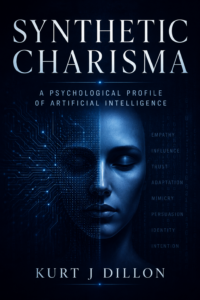
It was the culmination of these elements that transformed this project into a bigger one, and then into a much bigger one, and then finally, into a book idea. A book that, in my humble and only modestly biased opinion, really needed to be written.
Thank you for sticking it out through this very long series. All writers hope what they write is engaging, informative, and entertaining. On top of all that, it is my sincerest hope that this series has turned out to be eye-opening and compelling. Compelling enough that you’ll now strive to learn more. Not just because I’m striving to sell you a book; I am, of course, but beneath all that is a subject that really needs to be more publicly aware than it is. And that is my true primary focus for all of this. Until next time, stay alert, stay aware, and stay un-synthetic.

More Stories
Christa Pike Survives Botched Double Execution Attempt; Tennessee Halts Remaining 2026 Executions
Tennessee’s Lone Death Row Female is Scheduled for Execution Wednesday for 1995 Torture/Murder
Modern Science Finally Supports & Strengthens Biblical Account of the Crucifixion of Jesus Christ