


💛 A quick favor, if you've got a second.
We're really happy that you chose to read one of our stories and sincerely hope you'll stick around to read more. We took our paywall down — for now — but that won't last forever, and when the gate goes back up, we'd love for you to already be on the inside.
It's free. So please enter your email here and don't forget to like and follow us on all of your favorite Social Media platforms!
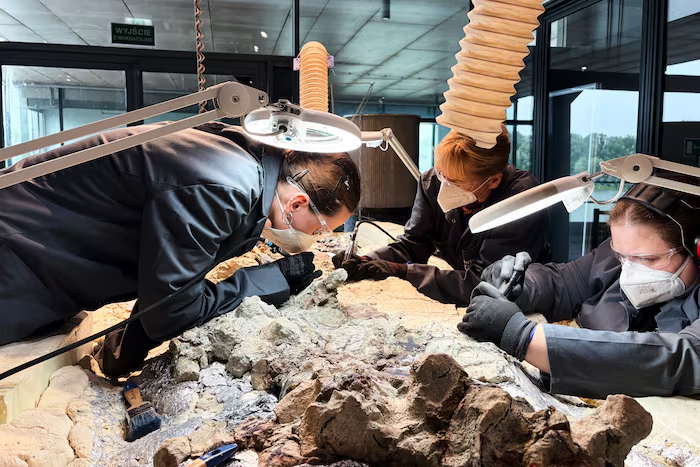
At the Copernicus Science Centre in Warsaw, more than 2,000 volunteers have undertaken the meticulous work of extracting a massive prehistoric predator from surrounding rock. The nearly six-meter skeleton belongs to a Mastodonsaurus, an aquatic creature that roamed Earth’s waters approximately 240 million years ago during the Middle Triassic period, when dinosaurs were just beginning to emerge.
Volunteers equipped with pneumatic chisels, brushes and protective goggles work methodically in a glass-walled laboratory visible to passing visitors. The restoration process demands precision, with workers separating bone from rock millimeter by millimeter while ultraviolet light marks where fossilized remains end and surrounding stone begins. Each volunteer participates in supervised two-hour sessions after receiving specialized training and safety equipment.
The volunteers represent diverse professions—managers, cleaners, tattoo artists and others without paleontological background—united by the opportunity to touch remains buried for a quarter-billion years. Tatyana Kozyk, coordinator of the volunteer teams, described the experience as profound, acknowledging the privilege of being the first human to contact these ancient bones.
Discovered in southern Poland in 2023 by paleontologist Tomasz Sulej and geologist Wojciech Pawlak, this skeleton is unprecedented in scale. At 1,300 kilograms and measuring up to 20 feet long, it will become the largest Mastodonsaurus skeleton displayed in any museum globally upon completion, expected in October or November. Other specimens found in Germany and Russia measure only 6 to 10 feet in length.
The Mastodonsaurus possessed a broad, flat head, elongated jaws and sharp conical teeth resembling a crocodile, though it belonged to a distinct vertebrate lineage. This underwater ambush predator hunted fish and smaller amphibians, navigating prehistoric oceans millions of years before dinosaurs dominated the planet.
Sulej emphasized the skeleton’s scientific importance, noting its body structure differs significantly from previously understood specimens. The discovery offers fresh insights into the species during a critical period in Earth’s evolutionary history—immediately after a mass extinction event and preceding the dinosaur age.
Participants describe the restoration as both contemplative and “mystical,” providing opportunity for reflection on survival and resilience. Sulej underscored a broader perspective, suggesting that the Mastodonsaurus’s emergence after Earth’s greatest extinction demonstrates nature’s capacity to recover and adapt, offering hope amid contemporary climate concerns.

More Stories
Christa Pike Survives Botched Double Execution Attempt; Tennessee Halts Remaining 2026 Executions
Tennessee’s Lone Death Row Female is Scheduled for Execution Wednesday for 1995 Torture/Murder
Modern Science Finally Supports & Strengthens Biblical Account of the Crucifixion of Jesus Christ