


💛 A quick favor, if you've got a second.
We're really happy that you chose to read one of our stories and sincerely hope you'll stick around to read more. We took our paywall down — for now — but that won't last forever, and when the gate goes back up, we'd love for you to already be on the inside.
It's free. So please enter your email here and don't forget to like and follow us on all of your favorite Social Media platforms!
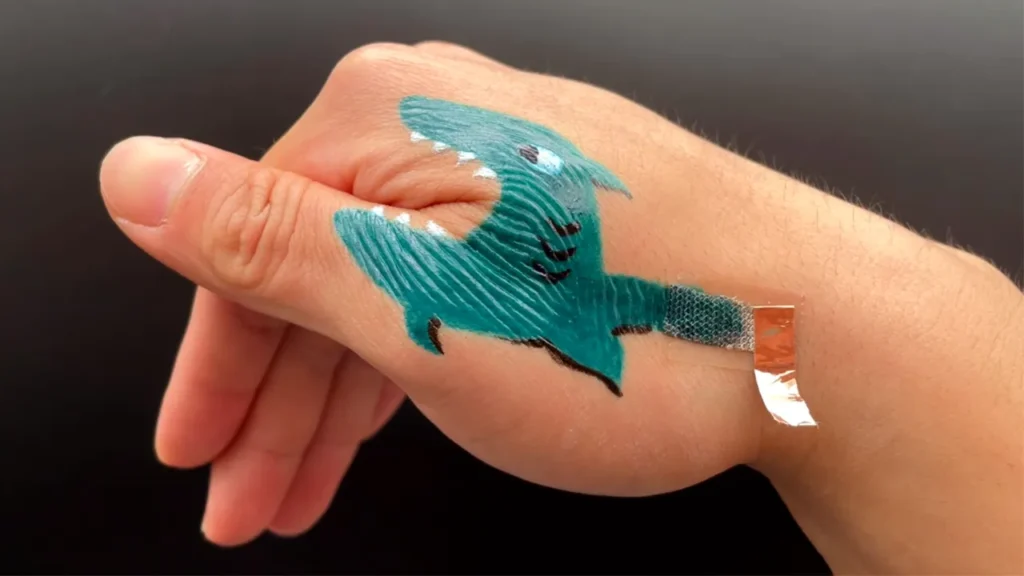
Researchers at Penn State University have engineered a novel medical sensor using conductive ink that adheres directly to the skin as a working electrode. The paint-like formula dries within 10 minutes and can be customized with food dye to resemble temporary tattoos or artistic designs rather than clinical medical patches. The university has filed a provisional patent for the technology, with findings published this month in the Proceedings of the National Academy of Sciences.
The conductive ink consists of water-based polymers and acidic additives mixed to create a glue-like consistency. Once applied to skin, the material conforms to the body’s natural ridges and texture, establishing superior contact compared to rigid metal electrodes or hydrogel alternatives that can lose adhesion during movement or dry out over time. The intimate skin contact produces more reliable electrical signal collection from the body.
A porous silver textile connects the painted electrode to an electronic module worn beneath clothing, which transmits data wirelessly to a computer via Bluetooth. The textile’s open structure permits the electrode to stretch beyond 150 percent of its original size without breaking, while allowing hair and moisture to pass through the material without compromising signal quality.
During testing, researchers wearing the electrodes successfully recorded electrocardiogram readings during 12 hours of daily activities and exercise, with the material remaining attached and maintaining signal accuracy. In additional experiments, the technology captured muscle contraction signals that controlled a robotic prosthetic hand, and detected brain electrical activity through hair without producing image artifacts during MRI testing.
Penn State researchers suggest the technology could eventually enable early detection of heart attacks by recording detailed electrocardiogram data revealing changes in cardiac electrical activity. However, the team has not yet demonstrated that the tattoo can diagnose an active heart attack, and clinical validation remains necessary before medical applications become viable.
The personalized aesthetic of the paint-on electrode may encourage longer-term wear among patients who feel self-conscious about visible medical devices, particularly children and teenagers. The conductive ink washes away after use, allowing patients to apply fresh electrodes while continuing to use the more expensive electronic module, with one ink bottle providing sufficient material for multiple applications over several days or a week.
Penn State envisions future iterations monitoring biomarkers such as glucose and cortisol levels, with potential applications extending to plant health monitoring and environmental research. The university has not announced consumer availability or a release timeline, noting that additional development and clinical validation are required before the technology can support medical decision-making.

More Stories
Looney Tunes’ ‘Coyote vs. Acme’ Debuts With $15.5 Million as ‘Spider-Man’ Holds Box Office Crown
Trump Calls NASA to Congratulate Agency on Roman Space Telescope Launch
Meta Ordered to Implement Sweeping Teen Safety Restrictions Under Settlement