


💛 A quick favor, if you've got a second.
We're really happy that you chose to read one of our stories and sincerely hope you'll stick around to read more. We took our paywall down — for now — but that won't last forever, and when the gate goes back up, we'd love for you to already be on the inside.
It's free. So please enter your email here and don't forget to like and follow us on all of your favorite Social Media platforms!
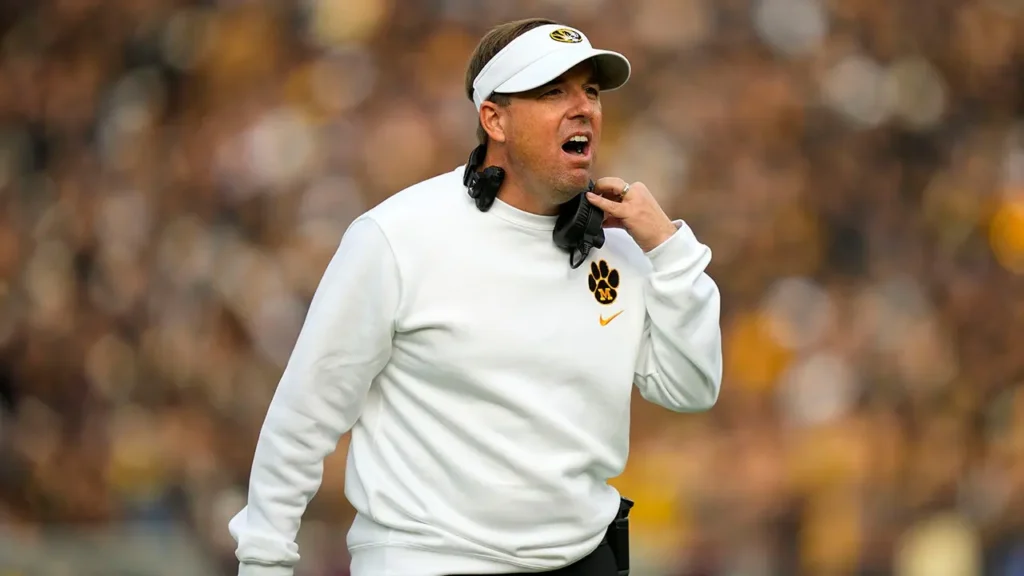
As college football enters its 2026 season, Missouri head coach Eli Drinkwitz has become the latest SEC figure to attribute his conference’s recent decline to scheduling disadvantages rather than competitive factors. Speaking at SEC media days, Drinkwitz pointed to the conference’s transition to a nine-game schedule as a primary reason the Big Ten has surpassed the SEC in recent years, according to reporting from Brett McMurphy and CBS Sports’ Brandon Marcello.
The timing of these complaints comes as the Big Ten has won the National Championship in three consecutive seasons while the SEC has failed to reach the final game during that same span. Preseason analytics suggest the Big Ten could extend that streak to four consecutive titles with Ohio State and Oregon positioned among the nation’s top programs heading into 2026.
Yet a closer examination of Missouri’s own scheduling practices undermines the argument. In 2025, the Tigers played only one true non-conference power program while opening their season with six consecutive home games beginning August 28. Their first road contest did not occur until October 18, and their four away games took them only to Auburn, Vanderbilt, Oklahoma, and Arkansas—all within the central time zone.
Missouri’s total travel distance for the entire 2025 season amounted to just 1,805 miles, while a single road non-conference game for Big Ten member USC against Notre Dame covered nearly 2,100 miles. The Tigers finished that season 2-2 in their road games and lost to Virginia 13-7 in a bowl game.
The real driver behind the SEC’s competitive decline lies elsewhere. The rise of Name, Image and Likeness deals and the transfer portal have redistributed talent more evenly across college football, eroding advantages the SEC once held through depth at elite programs like Alabama. This parity means championship-caliber matchups are now closer to 55-45 proposition rather than heavily favoring SEC teams.
The SEC has historically benefited from scheduling advantages that Drinkwitz’s Missouri program exemplifies: multiple non-conference cupcake opponents, inflated home-game counts, and minimal travel obligations that artificially inflate win-loss records. Now that other conferences are adopting similar strategies, SEC coaches are objecting. The solution is not scheduling revision but acknowledging that talent distribution has fundamentally shifted.
Recent playoff results provide the starkest evidence. The SEC is 2-7 against other Power Four conference opponents in the College Football Playoff over the past three seasons, and 5-9 overall when including intra-conference matchups. The Big Ten stands at 13-5 in the same period, a gap that no scheduling adjustment can explain away.

More Stories
Indiana coach Curt Cignetti tells restless Hoosiers fans not to gripe over 38-0 win
Packers Running Back Josh Jacobs Placed on Commissioner Exempt List Pending Misdemeanor Charges
Denver Broncos Linebacker Jonathon Cooper Placed on Commissioner’s Exempt List Amid Domestic Violence Charges