


💛 A quick favor, if you've got a second.
We're really happy that you chose to read one of our stories and sincerely hope you'll stick around to read more. We took our paywall down — for now — but that won't last forever, and when the gate goes back up, we'd love for you to already be on the inside.
It's free. So please enter your email here and don't forget to like and follow us on all of your favorite Social Media platforms!
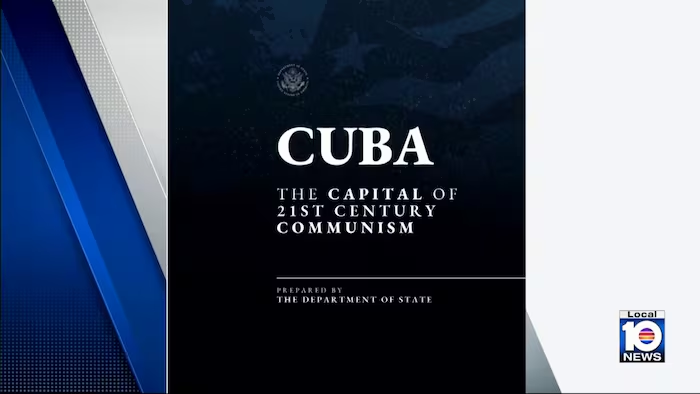
The U.S. State Department unveiled a comprehensive 100-page report Monday documenting what it characterized as Cuba’s systematic campaign spanning over six decades to advance left-wing extremism and subversion within American borders. The document alleges that the Cuban regime has worked through activist networks, militant groups, and foreign allies to undermine U.S. interests while serving as a conduit for Iranian and Russian interests.
Secretary of State Marco Rubio declared in a statement that the Cuban government stands as “the leading sponsor of radical leftism and Third Worldism in the United States” and pledged the State Department would expose Cuba’s historical record of espionage and subversive operations. President Trump reassigned Cuba to the state sponsors of terrorism list both in 2021 and again in 2025, triggering reinstatement of economic sanctions against the island nation.
The report details alleged military coordination between Cuba and Iran, including consultations on drone warfare tactics. It also describes connections between Cuba’s intelligence directorate, the DGI, and groups designated as part of an Islamist militant axis, encompassing Hamas, Hezbollah, and the Popular Front for the Liberation of Palestine.
According to the State Department analysis, Cuba has cultivated influence over prominent American radical movements by promoting the concept that “racist Yankee imperialism” victimizes both international populations and domestic minorities. The report identifies the Instituto Cubano de Amistad con los Pueblos, a Havana-based intelligence operation connected to over 2,000 solidarity organizations, as a principal vehicle for this influence.
The document cites historical examples including the late Fidel Castro’s associations with Black Panther founder Huey Percy Newton and activist Assata Shakur, a Black Liberation Army member. It characterizes these connections as part of a deliberate strategy to weaponize American social movements against the United States itself.
Cuban intelligence allegedly recruited university students at elite institutions to serve as long-term espionage assets within the federal government. The report highlights the cases of former U.S. Ambassador to Bolivia Victor Manuel Rocha, who admitted to acting as a secret agent for over 40 years, and former FBI analyst Ana Montes, who confessed to transmitting classified information to Cuba.
The State Department document identifies numerous organizations and individuals it alleges maintain ties to the Cuban government, including Code Pink, the Democratic Socialists of America, and People’s Forum founder Manolo De Los Santos. It also asserts that Cuba’s intelligence service infiltrated the National Lawyers Guild and associated international legal advocacy networks.
The report references the Wasp Network, a Cuban intelligence operation the FBI dismantled in 1998, and links it to Juan Pablo Roque, a defected Cuban Air Force pilot implicated in the 1996 fatal attack on two civilian aircraft operated by Brothers to the Rescue. That incident recently prompted the U.S. Department of Justice to indict former Cuban leader Raúl Castro.
The State Department accuses Cuba of providing support to left-wing armed groups across Latin America, including Colombia’s FARC and ELN, Mexico’s EPR, Uruguay’s Tupamaros, Argentina’s Montoneros, Nicaragua’s Sandinistas, Brazil’s Ação Libertadora Nacional, and Peru’s Shining Path organization.
Andy Gomez, former director of the University of Miami’s Institute for Cuban and Cuban-American Studies, stated Monday that the report contained no revelations he found unexpected. He suggested the document serves primarily to reinforce calls within the Cuban-American community for regime change.

More Stories
Colombia backs Trump security push while limiting U.S. role in anti-gang operations
Trump Threatens FCC Action Against NBC’s Welker Over Endorsement Coverage
Chicago Mayor Issues Executive Order Requiring Contractor Diversity Disclosures and ICE Ties Reporting