


💛 A quick favor, if you've got a second.
We're really happy that you chose to read one of our stories and sincerely hope you'll stick around to read more. We took our paywall down — for now — but that won't last forever, and when the gate goes back up, we'd love for you to already be on the inside.
It's free. So please enter your email here and don't forget to like and follow us on all of your favorite Social Media platforms!
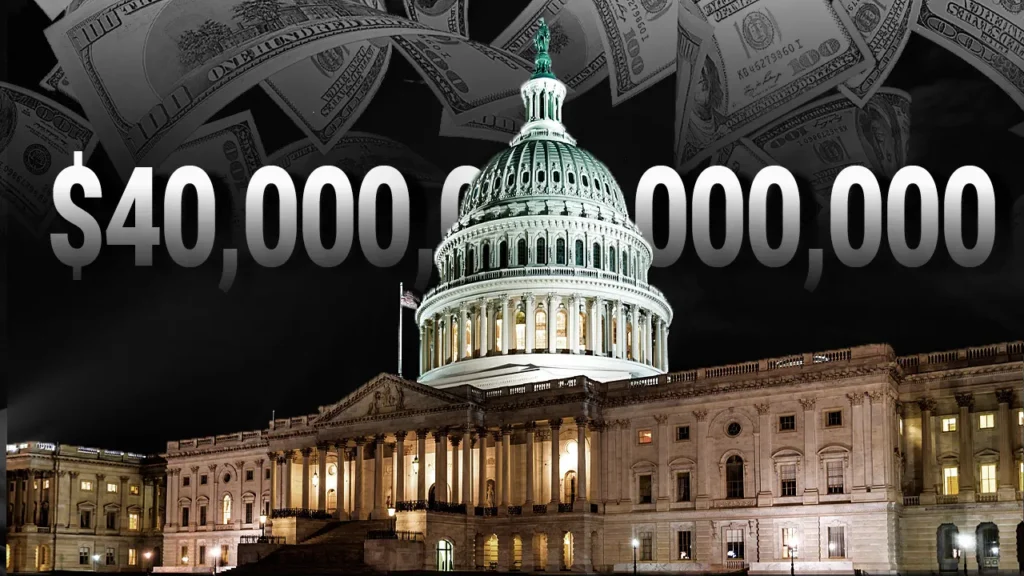
The United States has crossed a historic threshold with total public debt outstanding exceeding $40 trillion—a figure that translates to approximately $300,000 per American household. Despite the magnitude of this milestone, sustained political rhetoric promising simple remedies has diminished public concern about the nation’s mounting fiscal obligations.
The debt-to-GDP ratio, a standard measure of fiscal health, now stands at more than 124 percent. This places the United States among a limited group of nations with comparably high debt burdens, including Sudan, Venezuela, Japan, Greece and Italy. The Congressional Budget Office projects public debt held outside the federal government will climb from its current $32 trillion—roughly 100 percent of GDP—to 120 percent by 2036.
Elevated national debt constrains economic expansion, exerts upward pressure on inflation and interest rates, erodes investor confidence and diminishes the dollar’s global standing. A phenomenon known as the crowding-out effect illustrates the mechanism: when government borrowing increases through bond sales to finance deficits, available capital in the marketplace shrinks, driving up borrowing costs for both businesses and individuals while reducing private investment.
The Congressional Budget Office estimates that each dollar increase in the deficit corresponds to a 33-cent decline in private investment. Furthermore, an additional $1 trillion in debt reduces the long-run capital stock of productive assets by 0.7 to 0.8 percent. These cumulative effects diminish wages and living standards across the economy.
Some policymakers have rejected concerns about debt sustainability, citing Modern Monetary Theory—an approach endorsed by New York Representative Alexandria Ocasio-Cortez and economists advising Vermont Independent Senator Bernie Sanders. Proponents contend that as an issuer of fiat currency, the United States can indefinitely spend without fiscal constraint. Critics argue this framework ignores the erosion of consumer confidence and the necessity of underlying economic value to support currency stability.
Net interest costs have already exceeded $1 trillion annually and are projected to surpass $2 trillion within a decade, consuming an expanding portion of federal revenues. The 2025 deficit stands at $1.8 trillion. Addressing the crisis requires eliminating annual deficits, running budget surpluses and restraining expenditure growth in major entitlements while expanding policies that strengthen the productive private sector.
Both major political parties bear responsibility for the fiscal deterioration, making bipartisan action imperative. Without decisive intervention, the nation faces diminished fiscal flexibility during emergencies and a heavier tax or inflation burden transferred to future generations.

More Stories
Colombia backs Trump security push while limiting U.S. role in anti-gang operations
Chicago Mayor Issues Executive Order Requiring Contractor Diversity Disclosures and ICE Ties Reporting
University of Pennsylvania Climate Scientist Demands Supreme Court Packing Pledge From Democratic Candidates