


💛 A quick favor, if you've got a second.
We're really happy that you chose to read one of our stories and sincerely hope you'll stick around to read more. We took our paywall down — for now — but that won't last forever, and when the gate goes back up, we'd love for you to already be on the inside.
It's free. So please enter your email here and don't forget to like and follow us on all of your favorite Social Media platforms!
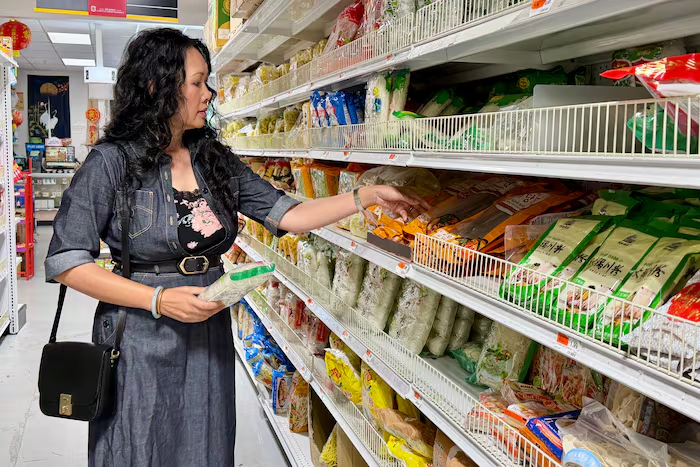
Facing the burden of deciding what to prepare for dinner each night has become increasingly challenging for American households contending with grocery price increases unseen in decades. Dining out or purchasing convenience foods presents financial strain for many families, while home cooking remains the healthier alternative by allowing better control over sodium and sugar content. International food markets have emerged as a practical solution in numerous communities, offering diverse ingredients at reasonable prices without sacrificing quality or nutrition.
Palina Louangketh, director of the Idaho Museum of International Diaspora and self-described foodie, emphasizes the accessibility of incorporating global flavors into everyday meals. By combining unfamiliar ingredients with basic pantry items, home cooks can create satisfying dishes without intimidation. Louangketh, who conducts cooking classes alongside refugee partners demonstrating traditional techniques, notes that adding savoriness through soy sauce, fish sauce, oyster sauce or hoisin sauce requires minimal additional effort beyond standard meal preparation.
New York video producer Beryl Shereshewsky, whose YouTube channel explores international cuisines and cultural connections, acknowledges that shopping in markets stocked with foreign-language labels may initially seem overwhelming. However, systematic approaches can simplify the process for novice international market shoppers. Market research firm IBISWorld reports steady growth in sales at international supermarkets and small groceries across the United States in recent years.
Boise, Idaho—home to just over 235,000 residents—contains more than 20 international markets, with additional options in nearby Meridian, Nampa and Caldwell. Shereshewsky recommends exploring beyond residential neighborhoods, noting that immigrant communities throughout America maintain traditional cooking practices accessible through local specialty grocers. Bailey Hughes, a cashier at Idaho Capital Asian Market in Boise, observes that customers frequently seek ingredients highlighted by viral internet food trends, such as Chinese Baddie Tea derived from traditional recipes using jujube dates and ginger.
Advance research through food bloggers specializing in single cuisines—including vegetarian chef Manjula Jain focused on Indian cooking, Lola Osinkolu specializing in Nigerian and African cuisine, and Maangchi for Korean recipes—provides valuable guidance. Shereshewsky suggests entering markets with prepared shopping lists based on specific recipe recommendations rather than browsing without direction. Starting with familiar foods reimagined through international approaches, such as replacing standard breakfast eggs with a Ugandan rolex or upgrading salads with Chinese spinach varieties, allows gradual exploration.
Spices, fresh produce and specialty sauces typically cost less at international markets than mainstream retailers, with some seafood options providing substantial savings due to multiple supplier relationships. However, pricing varies significantly across products, with certain specialty items commanding premium prices comparable to conventional supermarkets. Shereshewsky cautions consumers to evaluate individual prices rather than assuming universal savings throughout international markets.
Impulse purchases of intriguing ingredients enable reverse-engineered meal creation through online recipe searches, potentially expanding regular cooking rotations. Filipino dishes, pork floss, aji panca peppers and banana sauce represent examples of ingredients that simplify preparation while accommodating ingredient substitutions without compromising authentic flavors. Louangketh recommends attending cultural festivals, community events or specialized cooking classes to deepen appreciation beyond culinary applications alone.
True satisfaction emerges from understanding the cultural heritage and people connected to specific dishes, according to Louangketh, who frames food consumption as community building. While viral trends may provide initial entry points to unfamiliar cuisines, Shereshewsky emphasizes that investing time to comprehend a dish’s origins and historical context creates meaningful connections with the communities and people who developed these culinary traditions across generations.

More Stories
Four Kitchen Staples That Belong Outside the Freezer, According to Culinary Experts
CareCloud Breach Compromises 3.75 Million Patient Records, Among Largest Healthcare Data Thefts of 2026
Solar String Lights Hit All-Time Low Price With Additional Coupon Discount