


💛 A quick favor, if you've got a second.
We're really happy that you chose to read one of our stories and sincerely hope you'll stick around to read more. We took our paywall down — for now — but that won't last forever, and when the gate goes back up, we'd love for you to already be on the inside.
It's free. So please enter your email here and don't forget to like and follow us on all of your favorite Social Media platforms!
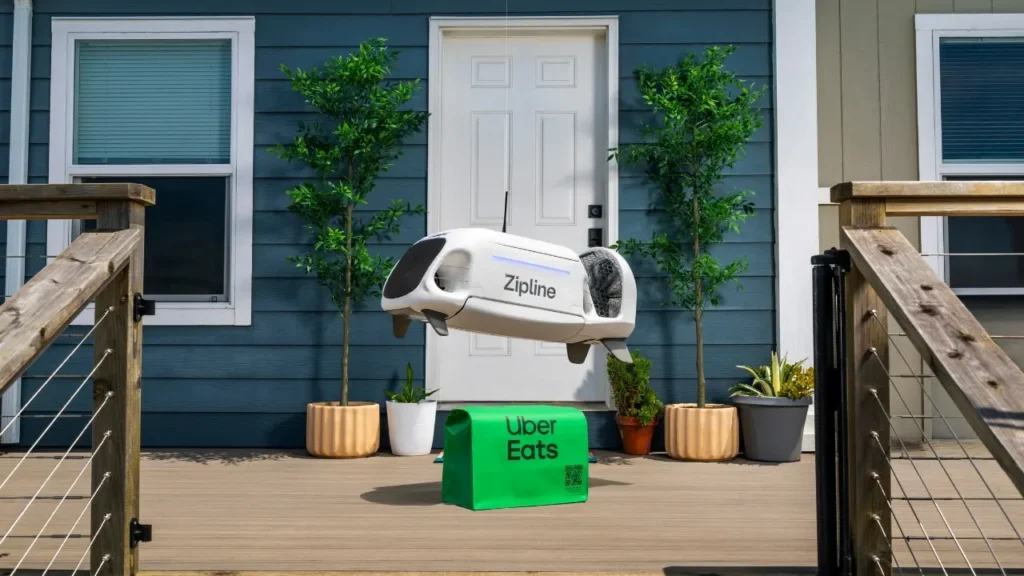
Uber Eats customers may soon receive meals delivered by autonomous aircraft rather than traditional vehicles. The company announced a strategic partnership with Zipline, an established autonomous delivery operator, earlier this month. Initial service launches will occur in markets where Zipline already maintains operations, with expansion to dozens of additional U.S. cities planned subsequently.
The collaboration aims to achieve an ambitious benchmark: conducting 1 million drone deliveries daily by the end of 2029. Zipline’s existing infrastructure in cities such as Dallas and Houston provides an operational foundation for the rollout. The company has already completed more than 2.7 million commercial deliveries and flown over 135 million autonomous commercial miles globally.
Zipline’s Platform 2 aircraft, referred to as P2, forms the backbone of the delivery system. The electric drone carries up to 8 pounds and operates within a 10-mile service radius, capable of completing certain deliveries in approximately 10 minutes at cruise speeds near 70 mph. During delivery, the aircraft hovers at roughly 300 feet altitude while a tethered unit descends to ground level, placing orders at designated locations autonomously.
Eligible customers will access drone delivery options through the standard Uber Eats application when the service launches later this year. Users can download the Zipline app independently to explore participating restaurants and merchants in current service areas. Once an order is placed, the restaurant prepares the meal, loads it into the autonomous system, and Zipline manages the entire flight and delivery process without human intervention.
The partnership reflects Uber’s broader strategy to develop a hybrid delivery network combining human couriers with autonomous technologies. Uber previously invested in drone company Flytrex in 2025 and currently operates autonomous sidewalk robots in select markets. The initiative positions the Uber Eats app as a central platform connecting customers with various delivery methods based on location and efficiency.
Noise concerns may emerge as drone traffic becomes commonplace in residential neighborhoods. Zipline reports investing substantially in noise reduction technology and maintains minimum flight altitudes of 300 feet to minimize sound exposure. Full delivery cycles typically require approximately 90 seconds, though regulatory requirements and local conditions may affect operational parameters in specific areas.
Safety measures include extensive testing protocols and Federal Aviation Administration approval for beyond visual line of sight operations. Zipline conducted tens of millions of simulated flights and executed over 150,000 test deliveries before launching residential services. However, regulatory clearance does not guarantee immediate neighborhood availability, as companies must secure appropriate operating infrastructure and local authorization first.
Uber is making an undisclosed strategic investment in Zipline as part of the agreement. Zipline previously raised over $600 million and achieved a $7.6 billion valuation earlier in 2026. Pricing structures for drone delivery remain unannounced, and customers should monitor whether additional fees apply compared to standard delivery options when the service becomes available.

More Stories
Looney Tunes’ ‘Coyote vs. Acme’ Debuts With $15.5 Million as ‘Spider-Man’ Holds Box Office Crown
Trump Calls NASA to Congratulate Agency on Roman Space Telescope Launch
Meta Ordered to Implement Sweeping Teen Safety Restrictions Under Settlement