


💛 A quick favor, if you've got a second.
We're really happy that you chose to read one of our stories and sincerely hope you'll stick around to read more. We took our paywall down — for now — but that won't last forever, and when the gate goes back up, we'd love for you to already be on the inside.
It's free. So please enter your email here and don't forget to like and follow us on all of your favorite Social Media platforms!
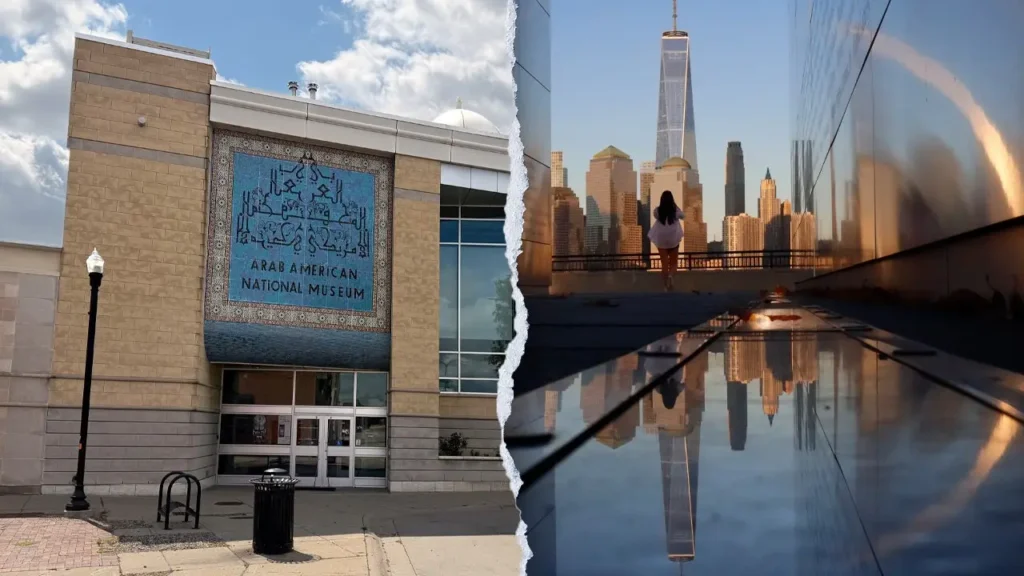
The Arab American National Museum in Dearborn, Michigan, has structured its exhibits and programming around post-9/11 discrimination against Arab Americans rather than the attacks themselves, nearly 25 years after the September 11 terrorist strikes. The museum, which maintains formal affiliation with the Smithsonian Institution, features displays arguing that Arab Americans experienced compounded harm from both the attacks and subsequent government treatment. The facility has received hundreds of thousands of dollars in federal grants from the National Endowment for the Humanities and other government agencies.
Museum placards highlight government detentions of immigrants investigated for possible terrorism connections, noting that virtually none faced terrorism-related charges. One exhibit states that “not a single Arab American was found guilty of any connection to September 11th,” despite unfair treatment by authorities. The Justice Department’s inspector general documented that 762 noncitizens were detained on immigration charges in the 11 months following the attacks, with some held under unnecessarily restrictive conditions despite lacking terrorism connections.
The 19 al Qaeda hijackers who attacked the nation on September 11, 2001, killed 2,977 people across four coordinated plane crashes at the World Trade Center, Pentagon, and a field in Pennsylvania. The attacks prompted the largest FBI investigation in history and shifted American foreign policy and security practices for decades. Public opinion data from the Pew Research Center showed American favorability toward Muslim Americans actually improved in the immediate aftermath, rising from 45 percent in March 2001 to 59 percent by November 2001.
Annual anniversary programming at the museum includes town halls described as offering “safe space” to discuss discrimination faced by Arab and Muslim communities, with limited focus on the 9/11 deaths themselves. A 2019 event receiving support from the National Endowment for the Arts criticized how communities of color were infiltrated by law enforcement and targeted by authorities following the attacks. The museum was founded in 2005, partly in response to heightened scrutiny of the Arab American community after the World Trade Center attack.
Federal funding for the institution has totaled well over half a million dollars from the National Endowment for the Humanities throughout its existence, supplemented by a $385,000 Department of Housing and Urban Development grant in 2013 and additional HUD funding exceeding half a million dollars between 2017 and 2019. The State Department provided at least $50,000 in funding between 2016 and 2017, according to museum annual reports. The Smithsonian has faced recent scrutiny from Republican lawmakers over allegations that its affiliated institutions advance left-leaning political perspectives through their exhibits.
The museum’s exhibits extend beyond 9/11 programming to include displays critical of Israel, featuring art installations and placards examining Israeli military operations and Palestinian casualties. A screening scheduled for September 10 will feature a film portraying Hamas’ October 7 attack as part of a decades-long Palestinian struggle. The museum gift shop sells Palestinian-themed merchandise, including maps, coloring books, and traditional keffiyehs.
Dearborn, where approximately 54.5 percent of residents identify as Middle Eastern or North African descent, represents a significant political center in Michigan during a competitive Senate race. The Arab American National Museum, the Smithsonian Institution, the National Endowment for the Arts, and the National Endowment for the Humanities did not respond to requests for comment.

More Stories
Colombia backs Trump security push while limiting U.S. role in anti-gang operations
Modern Science Finally Supports & Strengthens Biblical Account of the Crucifixion of Jesus Christ
Chicago Mayor Issues Executive Order Requiring Contractor Diversity Disclosures and ICE Ties Reporting