


💛 A quick favor, if you've got a second.
We're really happy that you chose to read one of our stories and sincerely hope you'll stick around to read more. We took our paywall down — for now — but that won't last forever, and when the gate goes back up, we'd love for you to already be on the inside.
It's free. So please enter your email here and don't forget to like and follow us on all of your favorite Social Media platforms!
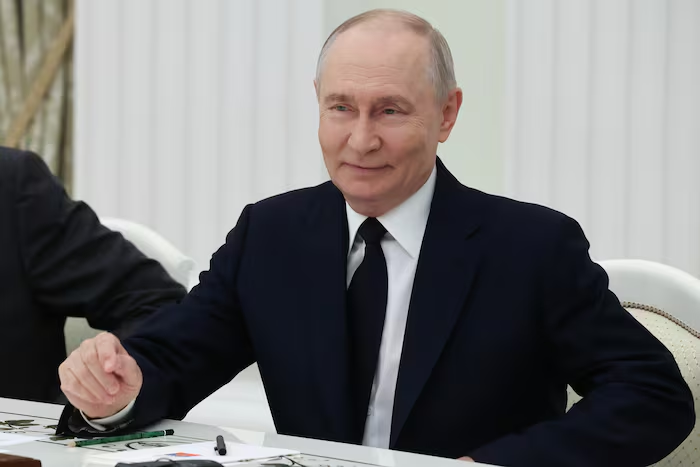
Russian President Vladimir Putin has signed an executive order granting the government authority to seize temporary control of essential infrastructure facilities should private operators fail to adequately defend them against Ukrainian attacks or complete necessary repairs following strikes. The move comes as Russia confronts intensifying economic and political strain from months of increasingly sophisticated and far-reaching Ukrainian drone operations targeting the nation’s industrial and energy sectors.
Ukraine’s domestically manufactured long-range unmanned aircraft have successfully struck critical petroleum refineries and major commercial centers, creating widespread fuel shortages and generating significant embarrassment for Moscow’s leadership. Meanwhile, Russia’s relentless aerial bombardment has systematically damaged Ukraine’s electrical infrastructure ahead of winter while leaving residential areas heavily destroyed, as the conflict approaches the completion of its fifth year of active combat.
Deputy Prime Minister Denis Manturov clarified in a statement Monday evening that the decree does not constitute company nationalization or a transfer of ownership rights, but rather represents “participation of the state in enterprise management to address particular security concerns.” Manturov emphasized that implementation would occur selectively, with determinations made exclusively at Russia’s highest administrative levels rather than through broad-based application.
Political analyst Abbas Gallyamov, formerly a Putin speechwriter, characterized the decree as a calculated pressure tactic designed to compel refinery operators to finance reconstruction efforts they have previously resisted. Refineries repeatedly struck multiple times have owners reluctant to commit billions in restoration funds when facilities face renewed vulnerability to attack, he suggested, describing the decree as government leverage demanding compliance with defense investments.
Ukraine’s military leadership reported that overnight operations destroyed facilities at Russia’s Afipsky refinery in Krasnodar region, igniting a significant fire at the installation. The latest strike reflects the continued effectiveness of Ukraine’s drone program in targeting Russia’s petroleum infrastructure despite defensive measures.
Russia confronts substantial macroeconomic difficulties as military expenditures mount. The government has implemented tax increases and expanded domestic borrowing to stabilize its budget deficit, while acquisition of major commercial enterprises could generate immediate revenue gains. However, assuming control of damaged assets simultaneously threatens to impose substantial fiscal obligations on state authorities already strained by wartime spending.
The Finance Ministry proposed Monday that tax and insurance payment deadlines be extended for Wildberries, Russia’s largest online retail platform, and the thousands of merchant partners utilizing its distribution network following warehouse destruction from Ukrainian strikes. This relief measure aims to provide financial stability for operations severely impacted by the attacks.

More Stories
Federal voting arrest in New Jersey adds new pressure point in Sherrill-Trump standoff
Colombia backs Trump security push while limiting U.S. role in anti-gang operations
Former NFL cheerleader and ex-aide face off in close Rhode Island GOP primary