


💛 A quick favor, if you've got a second.
We're really happy that you chose to read one of our stories and sincerely hope you'll stick around to read more. We took our paywall down — for now — but that won't last forever, and when the gate goes back up, we'd love for you to already be on the inside.
It's free. So please enter your email here and don't forget to like and follow us on all of your favorite Social Media platforms!
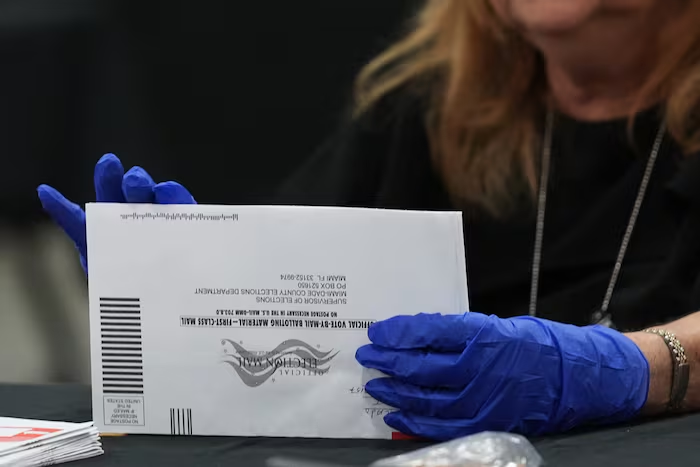
The Supreme Court cleared the way Monday for President Donald Trump’s executive order restricting mail voting to proceed, though legal experts say implementation remains unlikely before the November midterm elections. The unsigned order indicated only that it was premature for Democratic-led states to challenge the directive, rather than endorsing its constitutionality. The decision has nonetheless cast doubt on voting procedures used by approximately one-third of American voters.
Trump’s administration quickly moved to capitalize on the ruling, filing a motion late Monday to lift a separate injunction blocking the U.S. Postal Service from implementing compliance measures. New regulations from the Postal Service were poised to take effect Tuesday if legal obstacles were removed, requiring specific envelope formatting for mail ballots and mandating an electronic system to track which voters use mail voting. States failing to comply risk having their mail ballots undelivered.
Election officials across the country sounded alarms about the timeline, with initial overseas and military ballots scheduled to ship from North Carolina beginning September 4. Jesse Salinas, registrar of Yolo County in California, noted that his state begins distributing ballots in 11 days and has already printed envelopes. He expressed skepticism about whether jurisdictions could redesign materials to meet new federal specifications on such short notice.
Tammy Patrick, chief program officer at the Elections Center representing 2,500 election officials, stated flatly that no state currently conducts elections according to the Postal Service’s new requirements. She emphasized that officials assumed implementation would fail precisely because the procedures were operationally unfeasible within days. Nevada Secretary of State Cisco Aguilar pointed out that his state’s postal service had already misdelivered three dozen ballots during the June primary, yet now faced pressure to build a 100-percent-accurate database within a week.
Justice Ketanji Brown Jackson warned in her dissent that the decision “needlessly injects chaos and uncertainty into the upcoming midterm elections.” David Becker, executive director of the Center for Election Innovation and Research, agreed the ruling “seemed to create complete chaos” while making compliance “impossible” for states.
Trump has repeatedly attempted to restrict mail voting despite casting his own ballots by mail in recent years. He has falsely attributed his 2020 election loss to mail voting fraud and proposed various restrictions through executive order, though courts previously blocked similar attempts. His latest order emerged after a Senate bill to overhaul voting procedures stalled due to Democratic opposition.
Legal experts predicted additional litigation would likely prevent implementation in November. Rick Hasen, a UCLA law professor, stated the Supreme Court’s action “doesn’t necessarily mean anything in terms of November,” while Derek Muller of Notre Dame noted the ruling places courts “in a terrible place” given proximity to Election Day. The Constitution grants voting authority to states and Congress, not the presidency, constraining Trump’s ability to unilaterally reshape election procedures.
Election officials expressed frustration over the disruption. Patrick noted that election workers had prepared contingency plans for emergencies like fires or power outages but lacked protocols for sudden regulatory overhauls affecting one-third or more of voters. The compressed legal timeline and operational demands have left administrators scrambling to determine compliance pathways.

More Stories
Colombia backs Trump security push while limiting U.S. role in anti-gang operations
Former NFL cheerleader and ex-aide face off in close Rhode Island GOP primary
Trump Threatens FCC Action Against NBC’s Welker Over Endorsement Coverage