


💛 A quick favor, if you've got a second.
We're really happy that you chose to read one of our stories and sincerely hope you'll stick around to read more. We took our paywall down — for now — but that won't last forever, and when the gate goes back up, we'd love for you to already be on the inside.
It's free. So please enter your email here and don't forget to like and follow us on all of your favorite Social Media platforms!
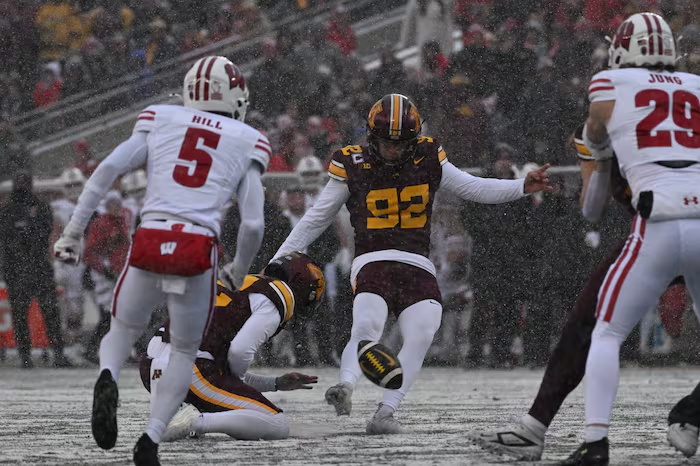
Uncertainty surrounding NCAA eligibility rules has upended preparations across college football programs as the regular season approaches, with Minnesota’s special teams operation serving as a prime example of the ongoing chaos. The kicking position for the Gophers has become particularly complicated following conflicting court rulings about whether athletes from the 2022 high school class qualify for a fifth year of eligibility under the NCAA’s new “five-for-five” policy.
A federal judge in Denver issued a ruling on July 31 that granted fifth-year eligibility to members of the 2022 high school class, a group the NCAA had initially excluded from the new rule designed to bring clarity to college sports during the era of the transfer portal and name, image and likeness deals. That decision was temporarily halted by an appeals court injunction on Friday, leaving thousands of athletes nationwide in legal limbo.
Minnesota coach P.J. Fleck acknowledged the frustration created by the ping-pong litigation just 10 days before his team opens against Eastern Illinois. “At the end of the day, if all we say is it’s about the student-athlete, then we have to make the decisions for them,” Fleck said. “Let’s get some direction of exactly what they’re going to be able to do.”
The kicking competition specifically involves four candidates: Brady Denaburg, who transferred from Syracuse after three seasons; sophomore Daniel Jackson; Michigan transfer Beckham Sunderland; and former New Mexico kicker Luke Drzewiecki, who entered the portal after his senior season. Between two and four of these candidates may be eligible for the season opener depending on how the legal matters ultimately resolve.
Denaburg completed 33 of 33 extra points last season and made 14 of 21 field goal attempts. Drzewiecki had an outstanding final year at New Mexico, making 36 of 36 extra points and 18 of 19 field goal attempts before joining the transfer portal to follow special teams coordinator Daniel Da Prato to Minnesota.
Indiana’s national championship defense has also been affected by the eligibility uncertainty. Sixth-ranked Indiana welcomed back defensive linemen Stephen Daley and Kellan Wyatt following the initial Denver ruling, though both were dealing with injuries from the previous season. Coach Curt Cignetti expressed full support for their return, saying the program would not need to make roster cuts if both players are ultimately deemed eligible.
The Denver ruling was further clarified three days after it was issued to exclude athletes who had already signed professional contracts, prompting a countersuit filed in Louisiana state court that resulted in a temporary restraining order on Wednesday. This added another layer to an already confusing situation.
Fleck compared the current preparation challenges to the 2020 COVID season when uncertainty about player availability forced teams to prepare for multiple scenarios. With potentially two to four eligible kickers available for the opener, Minnesota has increased field goal work during fall camp to ensure readiness regardless of which players ultimately take the field.

More Stories
Indiana coach Curt Cignetti tells restless Hoosiers fans not to gripe over 38-0 win
California Legislation Would Formally Recognize Islamic Holidays Eid al-Fitr and Eid al-Adha
Meta Ordered to Implement Sweeping Teen Safety Restrictions Under Settlement