


💛 A quick favor, if you've got a second.
We're really happy that you chose to read one of our stories and sincerely hope you'll stick around to read more. We took our paywall down — for now — but that won't last forever, and when the gate goes back up, we'd love for you to already be on the inside.
It's free. So please enter your email here and don't forget to like and follow us on all of your favorite Social Media platforms!
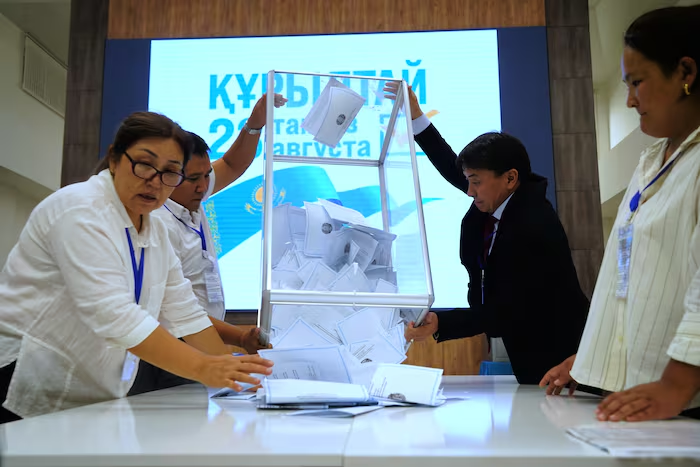
Kazakhstan’s pro-government Adilet Party claimed a commanding majority in parliamentary elections held Sunday, according to official results announced Monday. The victory is poised to consolidate President Kassym-Jomart Tokayev’s authority over Central Asia’s largest nation, with the party capturing 71% of the vote, the country’s central electoral commission reported.
Adilet, headed by a former official from Tokayev’s presidential administration, dominated the competition against rival parties. The Auyl Party finished second with 6.26% support, while three additional parties—the Nationwide Social Democratic Party, Respublica, and Aq Jol—each surpassed the 5% threshold required for parliamentary representation.
International observers from the Organization for Security and Cooperation in Europe noted significant constraints on genuine political competition, stating that “all contesting parties supporting the incumbent president’s policies” limited meaningful opposition during the contest. Voter turnout reached approximately 74% of the nation’s 12.6 million eligible citizens.
Sunday’s election represented the inaugural vote for Kazakhstan’s Kurultai, a newly created single-chamber legislature resulting from constitutional reforms Tokayev initiated in March. Voters had endorsed those reforms with 87% approval in a March referendum that consolidated the previous two-chamber system into one body.
The constitutional overhaul granted Tokayev expanded authority to appoint senior officials pending parliamentary approval. In a significant ruling last month, Kazakhstan’s Constitutional Court determined that the amendments reset his previous terms, permitting him to pursue an additional seven-year term when his current mandate concludes in 2029.
The 73-year-old president, who assumed office in 2019 after decades as a Soviet official and Kazakh diplomat serving at the United Nations, has justified the structural changes as necessary for swift decision-making in an unstable global environment. His approach mirrors strategies employed by leaders in Russia, Belarus, Uzbekistan, and Tajikistan, who have similarly revised term limitations through constitutional amendments.
The election occurred amid significant economic headwinds for Kazakhstan, with inflation reaching 10.2% in February and recent tax increases generating widespread discontent among citizens. Analysts attribute the government’s consolidation efforts partly to anxiety about repeating the violent January 2022 unrest, when fuel price demonstrations escalated into clashes resulting in dozens of deaths among protesters and security personnel.
The parliamentary vote unfolded as press freedom conditions deteriorated, with authorities pursuing criminal charges against multiple journalists and independent bloggers. Media organizations have appealed to Tokayev to dismiss charges against detained journalists and reform legislation to strengthen speech protections, though approximately 10 criminal cases remain active against independent media figures.

More Stories
Federal voting arrest in New Jersey adds new pressure point in Sherrill-Trump standoff
Colombia backs Trump security push while limiting U.S. role in anti-gang operations
Former NFL cheerleader and ex-aide face off in close Rhode Island GOP primary