

💛 A quick favor, if you've got a second.
We're really happy that you chose to read one of our stories and sincerely hope you'll stick around to read more. We took our paywall down — for now — but that won't last forever, and when the gate goes back up, we'd love for you to already be on the inside.
It's free. So please enter your email here and don't forget to like and follow us on all of your favorite Social Media platforms!
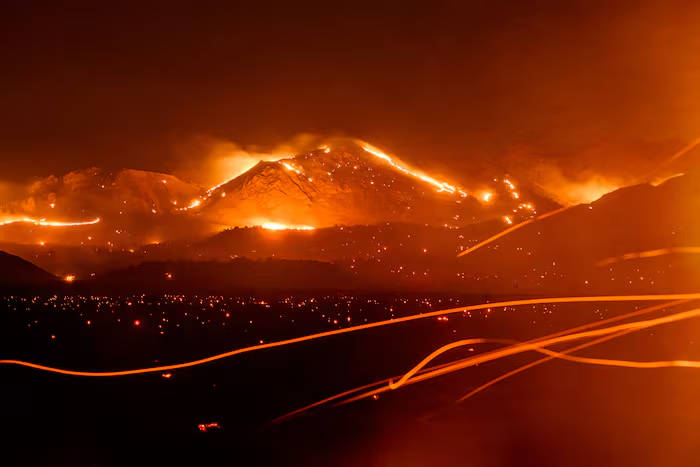
The world is experiencing an accelerating pattern of severe weather disasters that scientists increasingly view not as isolated incidents but as harbingers of worse to come. Recent years have brought unprecedented wildfires in Australia, devastating floods across Pakistan and South Asia, and destructive hurricanes in North America, signaling what climate researchers describe as an era of intensifying extremes that will test humanity’s capacity to adapt.
Global temperatures have risen 1.44 degrees Celsius (2.59 degrees Fahrenheit) since the early 1800s, a warming trend driven by massive quantities of greenhouse gases accumulating in the atmosphere. More than half of all human-produced greenhouse gases have been released over just the past 50 years, creating a heat buildup that alters weather patterns and destabilizes ecosystems at an accelerating pace. The United States has contributed more greenhouse gas emissions than any other nation throughout history, yet governmental response remains limited despite mounting evidence of climate impacts.
Daniel Swain, a climate scientist at the California Institute for Water Resources, acknowledged the challenge of communicating climate risks without appearing alarmist. “Sometimes wolves are real,” Swain said, referencing the “Boy Who Cried Wolf” dilemma that complicates public messaging about potential catastrophes. The difficulty lies in the impossibility of predicting precisely when disasters will strike, even as the probability of extreme events increases with each incremental rise in global temperature.
Scientific understanding of climate risks extends back over 150 years. In the 1850s, amateur scientist Eunice Newton Foote conducted experiments in Seneca Falls, New York, demonstrating that carbon dioxide heated faster and retained warmth longer than other substances when exposed to sunlight—a foundational observation that presaged modern climate science.
Sonia Seneviratne, a Swiss climatologist and vice chair of the Intergovernmental Panel on Climate Change, compared the relationship between greenhouse gas emissions and extreme weather to the link between smoking and lung cancer. While smokers do not inevitably develop cancer, the risk increases substantially, and physicians have an obligation to communicate that danger. Similarly, she said, scientists must inform the public that catastrophic events become more probable with each warming increment.
Sarah Perkins-Kirkpatrick, a climate scientist at Australian National University, experienced what she termed a “come to Jesus moment” when realizing that extreme weather events would persist even if the world immediately achieved net zero emissions. Because carbon dioxide persists in the atmosphere for centuries and vast quantities have already accumulated, reversing accumulated damage could require centuries. The lag between emissions reductions and climate stabilization means the planet will continue warming based on greenhouse gases already released.
Critical environmental systems are approaching or have already reached tipping points—thresholds beyond which deterioration becomes irreversible. The National Oceanic and Atmospheric Administration reported that between 2023 and 2025, 84 percent of the world’s coral reefs expelled microscopic algae in response to heat stress, often resulting in death. Recovery of most affected corals appears unlikely even with significant temperature declines. The Amazon rainforest faces similar risks, with ongoing deforestation, persistent drought, and wildfires degrading vast forest areas and potentially triggering a shift from carbon sink to carbon source.
Climate scientists have grown increasingly accurate in their predictions, though public perception often suggests otherwise. When researchers miss projections, they typically underestimate impacts rather than overstate them. In January 2022, the U.K. Climate Risk Assessment estimated only a 0.02 percent probability of temperatures reaching 40 degrees Celsius (104 degrees Fahrenheit) before 2040, yet that threshold was exceeded that same summer in parts of Britain.
Lucy Jones, a seismologist who has advised cities on disaster preparedness, noted that people adopt protective measures when they believe risks are genuine and solutions exist. Without conviction on both fronts, populations tend to dismiss threats. Climate denial functions as a coping mechanism, allowing individuals to rationalize that acknowledging the threat need not occur if they choose not to believe in it.
Tim Lenton, a climate science professor at the University of Exeter, emphasized the necessity of discussing potential catastrophic outcomes. “It’s natural to think that some bigger shocks are on the way,” Lenton stated, underscoring that candid dialogue about worst-case scenarios remains essential for motivating preparatory action.

More Stories
Colombia backs Trump security push while limiting U.S. role in anti-gang operations
Federal Prosecutors Convene Special Grand Jury to Investigate D.C. Schools’ Attendance and Graduation Practices
State Department Reissues Level 3 Travel Advisory for Israel Amid Terrorism and Armed Conflict Concerns