


💛 A quick favor, if you've got a second.
We're really happy that you chose to read one of our stories and sincerely hope you'll stick around to read more. We took our paywall down — for now — but that won't last forever, and when the gate goes back up, we'd love for you to already be on the inside.
It's free. So please enter your email here and don't forget to like and follow us on all of your favorite Social Media platforms!
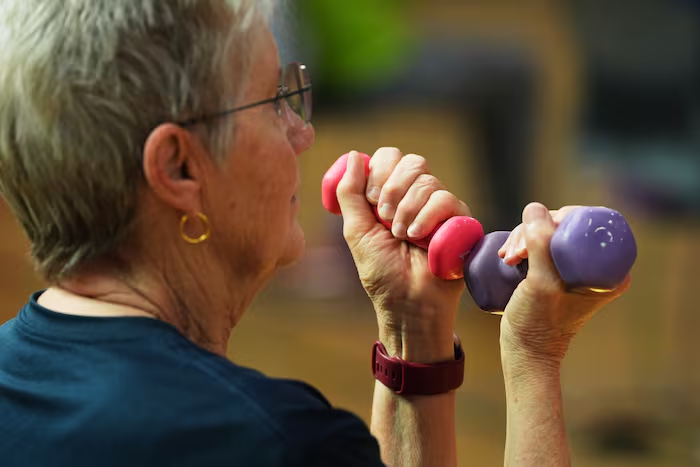
Physicians increasingly rely on physical assessments—including grip strength measurements, balance evaluations and chair-stand exercises—to gauge the fitness and overall health status of aging populations. While these examinations can reveal important information about stamina, strength and fall risk, medical professionals caution that the results should not be interpreted as forecasts of how long a patient will live. Auriel Willette, a brain aging researcher at Rutgers University, emphasized that declining mobility scores warrant further investigation into the underlying causes rather than serving as mortality predictions.
The U.S. Centers for Disease Control and Prevention administers a 30-second chair-stand test designed for patients over 60, measuring how many times they can rise from a seated position within the time limit. Another assessment that gained traction on social media requires individuals to lower themselves to the floor in a cross-legged position and then stand back up, with points deducted for each hand or knee used for support and for unsteadiness. Brazilian researchers published findings in 2020 and 2025 suggesting that middle-aged adults scoring higher on this test faced lower mortality risk within approximately a decade, though American physicians have not routinely adopted it for older populations.
Many U.S. medical professionals employ the “Timed Up and Go” test, which involves rising from a chair, walking 10 feet and returning to the seat, allowing clinicians to evaluate balance, mobility and leg strength simultaneously. Dr. George Hennawi at MedStar Health in Baltimore noted that all such tests aim to identify specific functional deficits and their causes, whether stemming from joint pain, diminished reflexes, balance problems or cardiovascular limitations. These screening tools narrow down potential issues but lack sufficient detail for comprehensive diagnosis on their own.
Additional assessments for physiological age include walking speed evaluations, hand grip tests, gait analysis and single-leg balance challenges. The Short Physical Performance Battery, a 10-minute assessment developed by the National Institute on Aging, incorporates multiple components and has demonstrated predictive value for mortality and disability outcomes in large clinical trials. Dr. David Lee of UCLA’s Multidisciplinary Falls Clinic stressed the importance of reviewing multiple tests collectively rather than relying on any single measure, as grip strength can be influenced by arthritis, previous stroke or simple muscle deconditioning.
Experts emphasize that mobility and strength represent only one dimension of healthy aging, with cognitive function, memory, hearing and vision equally important to overall assessment. Rather than training specifically to excel at a single test, physicians recommend comprehensive lifestyle practices including regular whole-body exercise, balanced nutrition, stress management, adequate sleep and cardiovascular care. Medical professionals also caution that test standards validated for one age group may not apply universally across different demographics.
Emily Nabors, a falls prevention specialist with The National Council on Aging, advised that patients scoring poorly or with fall concerns should consult their physician to determine whether they need assistive devices, physical therapy or medication adjustments. More than a quarter of older adults experience falls annually, yet most never report incidents to their healthcare providers. According to Nabors, individuals who have fallen should seek medical evaluation even if they feel unharmed, as underlying injuries or complications may not be immediately apparent.

More Stories
New York Health Officials Sound Alarm Over Rising Measles Cases as School Year Approaches
CareCloud Breach Compromises 3.75 Million Patient Records, Among Largest Healthcare Data Thefts of 2026
Month-Long HEPA Use Linked to Faster Cognitive Processing in Middle-Aged Adults