


💛 A quick favor, if you've got a second.
We're really happy that you chose to read one of our stories and sincerely hope you'll stick around to read more. We took our paywall down — for now — but that won't last forever, and when the gate goes back up, we'd love for you to already be on the inside.
It's free. So please enter your email here and don't forget to like and follow us on all of your favorite Social Media platforms!
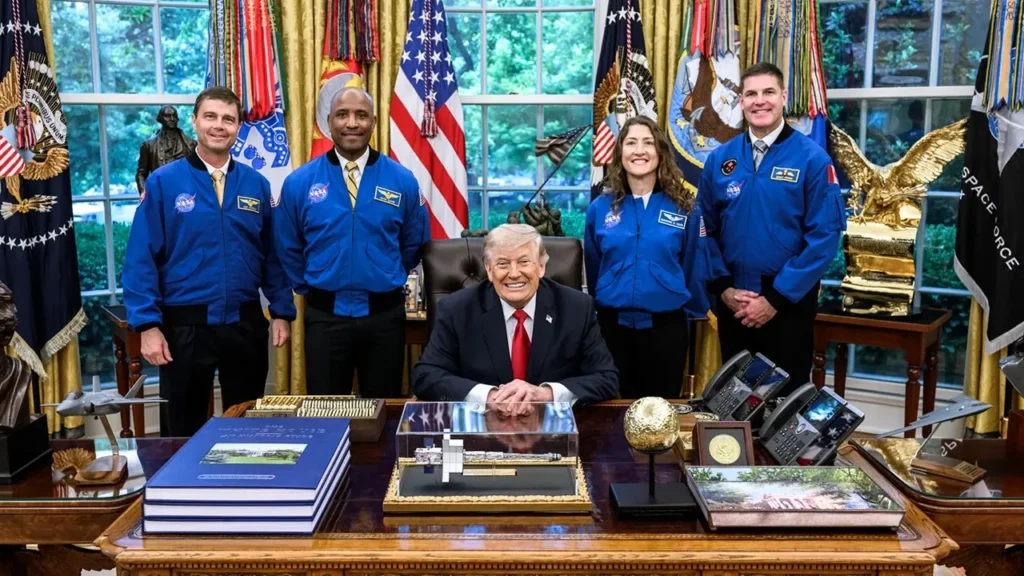
President Donald Trump will present the Congressional Space Medal of Honor to four astronauts who set a human spaceflight distance record during an April mission around the moon. The ceremony is scheduled for Aug. 28 at NASA’s Johnson Space Center in Houston, with honorees including NASA astronauts Reid Wiseman, Victor Glover and Christina Koch, along with Canadian Space Agency astronaut Jeremy Hansen.
The Artemis II crew made history as the first humans to fly the Orion spacecraft on a crewed mission and the first to travel around the moon since the Apollo program ended more than 50 years ago. At their farthest distance, the four astronauts reached 252,756 miles from Earth, breaking the previous record of 248,655 miles set by Apollo 13 in 1970 and traveling a total of 695,081 miles during their nearly 10-day mission.
NASA’s Space Launch System rocket carrying the crew lifted off April 1 from Kennedy Space Center in Florida with 8.8 million pounds of thrust. The spacecraft passed within 4,067 miles of the lunar surface on April 6 before returning to Earth on April 10, splashing down in the Pacific Ocean off California after re-entering the atmosphere at approximately 25,000 mph.
The Artemis II astronauts documented their journey with more than 7,000 photographs, capturing earthrise and earthset views, lunar surface features and a solar eclipse observed from space. NASA officials stated the crew also observed meteoroid impact flashes on the moon’s night side while testing critical life-support systems and manually piloting Orion to gather data for future missions.
Congress established the Congressional Space Medal of Honor in 1969, recognizing the “intelligence, dedication, bravery and self-sacrifice” required for spaceflight. NASA Administrator Jared Isaacman noted the crew accepted “significant risk” to test systems intended for deeper space exploration, adding that the astronauts’ achievement gives America confidence to return to the lunar surface.
The medal has been awarded to only a select group of space explorers, with 30 recipients on NASA’s official list including Neil Armstrong, John Glenn and Apollo 13 commander Jim Lovell. Armstrong received the medal from President Jimmy Carter on Oct. 1, 1978, and the four Artemis II honorees will bring the total number of recipients to 34.
NASA’s Artemis program aims to establish sustained human presence on the moon, with Artemis III scheduled for low Earth orbit testing of commercial lunar landers in 2027 and Artemis IV targeting the first crewed lunar landing in 2028. The agency ultimately plans to use the lunar base as a staging ground for sending astronauts to Mars.

More Stories
Christa Pike Survives Botched Double Execution Attempt; Tennessee Halts Remaining 2026 Executions
Tennessee’s Lone Death Row Female is Scheduled for Execution Wednesday for 1995 Torture/Murder
Colombia backs Trump security push while limiting U.S. role in anti-gang operations