


💛 A quick favor, if you've got a second.
We're really happy that you chose to read one of our stories and sincerely hope you'll stick around to read more. We took our paywall down — for now — but that won't last forever, and when the gate goes back up, we'd love for you to already be on the inside.
It's free. So please enter your email here and don't forget to like and follow us on all of your favorite Social Media platforms!
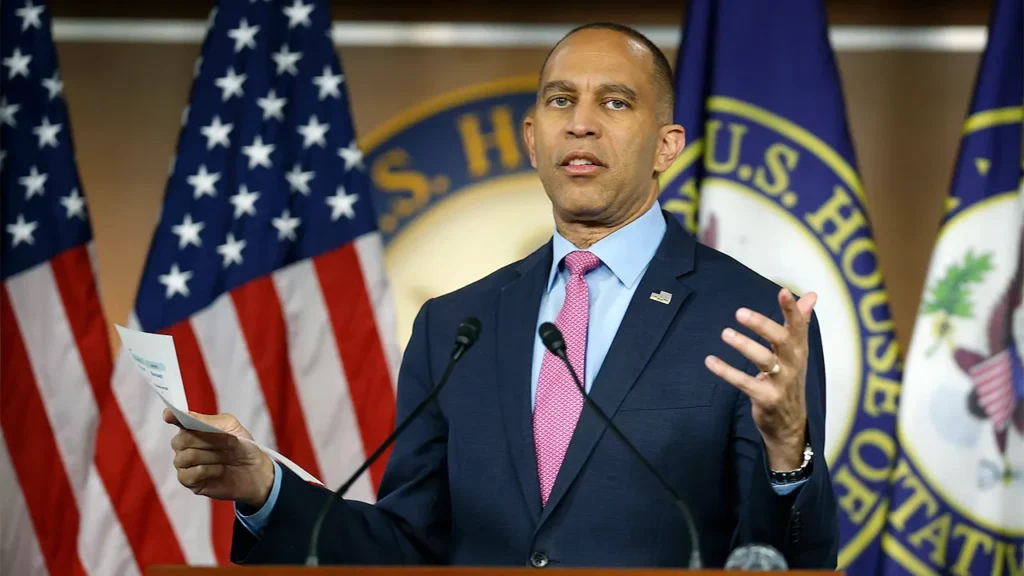
House Democratic Leader Hakeem Jeffries of New York publicly rejected the Democratic Socialists of America’s policy platform during a weekend NBC News interview, drawing a distinction between his leadership position and the organization’s far-left proposals. Jeffries stated unequivocally that he does not back the DSA’s stated agenda, even as the broader Democratic Party shows shifting attitudes toward socialism. His remarks came amid rising tension within Democratic ranks over the influence of socialist-leaning candidates in recent primary contests.
Democratic heavyweights have launched coordinated attacks on the socialist movement reshaping their party’s direction. Kentucky Governor Andy Beshear, viewed as a potential 2028 presidential contender, denounced socialism as a “failed experiment” during a CBS News appearance, while longtime Democratic strategist James Carville employed harsher language, calling DSA members “a pack of fools” on Fox News. These public rebukes underscore establishment Democrats’ alarm at the movement’s growing power within the party.
The DSA platform includes radical restructuring proposals: police and prison abolition, ending Immigration and Customs Enforcement operations, open borders, noncitizen voting rights, single-payer healthcare, Senate abolition, and replacing the presidency and Supreme Court with congressional leadership. Recently, DSA-backed and aligned progressive candidates have notched victories over moderate incumbents in Democratic primaries across Michigan, Minnesota, and Florida this month.
A Fox News national poll from last month found 52 percent of Democrats view socialism favorably compared to only 11 percent of Republicans, with Democrats showing greater preference for socialism over capitalism. A CBS News survey conducted earlier this month yielded similar results. The polling reflects years of economic pessimism among Americans grappling with inflation that has persisted throughout the decade.
Political scientists attribute the Democratic Party’s receptiveness to socialism partly to the lasting influence of Senator Bernie Sanders’ competitive 2016 and 2020 presidential campaigns. Saint Anselm College professor Chris Galdieri noted that younger Democrats particularly no longer view socialism as inherently threatening and have grown open to socialist policy implementation in American governance. Sanders’ challenge to Hillary Clinton fundamentally altered Democratic constituencies and priorities.
Republicans have weaponized socialism as a campaign issue for nearly a century, targeting everything from the New Deal to the Affordable Care Act as socialist overreach. Gallup polling from late last year showed socialism begins from a significantly disadvantaged position compared to capitalism or free enterprise in American public opinion. Republicans overwhelmingly characterize socialism as unequivocally harmful, a position reflected consistently in survey data.
New England College President Wayne Lesperance offered an alternative explanation for primary victories by self-described socialists, arguing most Americans lack clear understanding of socialism theoretically or practically. He contended voters supporting socialist candidates prioritize youth, novelty, and deviation from establishment norms rather than genuine ideological commitment. Primary voters, Lesperance suggested, are deliberately selecting outsiders to force systemic change.
Republican leadership sees Democratic primary shifts toward socialism as a strategic advantage heading into midterm elections. House Speaker Mike Johnson declared confidence in maintaining and expanding Republican congressional majorities, characterizing the election as a choice between “common sense” and “crazy” Democratic socialism. President Donald Trump has repeatedly branded Democrats as “communists” and accused socialist politicians of destroying the middle class through failed economic policies.
Democrats counter Republican criticism as a rhetorical distraction from substantive policy failures. Democratic strategist Joe Caiazzo, a veteran of Sanders’ campaigns, characterized GOP attacks as label-focused rather than addressing actual policy records. He argued progressives are winning primaries nationwide because voters desperately seek solutions to an affordability crisis afflicting healthcare, wages, and inflation.

More Stories
Federal voting arrest in New Jersey adds new pressure point in Sherrill-Trump standoff
Colombia backs Trump security push while limiting U.S. role in anti-gang operations
Former NFL cheerleader and ex-aide face off in close Rhode Island GOP primary