


💛 A quick favor, if you've got a second.
We're really happy that you chose to read one of our stories and sincerely hope you'll stick around to read more. We took our paywall down — for now — but that won't last forever, and when the gate goes back up, we'd love for you to already be on the inside.
It's free. So please enter your email here and don't forget to like and follow us on all of your favorite Social Media platforms!
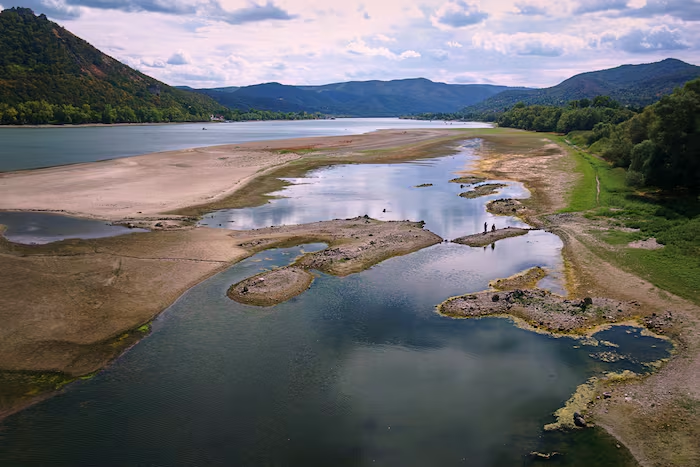
Lake Velence, Hungary’s third-largest body of water, has receded to record lows of approximately 20 centimeters, far below the 150-centimeter level typically expected in August. Fisherman Árpád Selmeci reported navigating even small vessels has become treacherous on the shrinking lake, while swimming beaches that once attracted tourists have closed entirely. The 58-year-old said he has never witnessed such depleted conditions during his lifetime on the lake’s shores.
Hungary currently faces an acute water emergency as droughts intensify and heat waves sweep across Europe. This summer brought wildfires from the United Kingdom to Greece, while Hungary endured damaged crops, drinking water shortages and the threat of shutting down its sole nuclear power plant. Around 99 percent of Hungarian territory now experiences severe or extreme drought conditions, with desertification threatening the Great Hungarian Plain.
Environmental experts attribute much of Hungary’s vulnerability to two centuries of water mismanagement. The country constructed over 40,000 kilometers of drainage canals—a network exceeding Earth’s circumference—designed to remove water from fields and wetlands for agricultural use. A 2023 Nature study found Hungary lost more than 80 percent of its historical wetlands, fundamentally altering precipitation patterns and lowering water tables across the nation.
Lake Garancsi, a medieval recreational lake northwest of Budapest and filming location for the 2001 comedy “Glass Tiger,” has nearly vanished. The lake bed now lies exposed and cracked, with remaining water too shallow and warm to support fish. Authorities predict the lake will dry completely by summer’s end, eliminating all recreational activities that once defined the area.
Prime Minister Péter Magyar’s new government committed in late June to reversing course on water policy. On the day Hungary recorded a temperature high of 42 Celsius, Magyar pledged to implement comprehensive water conservation programs and redesignate water retention as the fundamental principle of national water management. He also identified that aging infrastructure causes 20-25 percent of drinking water losses through leaking pipes, costing approximately 17 billion forints annually.
The Danube River, Europe’s longest waterway, has set successive low-water records this summer, threatening to force Hungary’s Paks nuclear power plant offline for the first time in its 44-year operational history. The government deployed emergency measures including positioning two 80-meter barges upstream and installing riverbed structures to direct additional water toward the facility’s cooling systems.
Restoring wetlands could help mitigate future crises by serving as natural reservoirs during dry periods and potentially boosting localized summer precipitation. Experts say such restoration efforts, combined with climate adaptation strategies, remain essential as Hungary confronts increasingly extreme weather patterns and prolonged droughts driven by human-caused climate change.

More Stories
Colombia backs Trump security push while limiting U.S. role in anti-gang operations
Federal Prosecutors Convene Special Grand Jury to Investigate D.C. Schools’ Attendance and Graduation Practices
State Department Reissues Level 3 Travel Advisory for Israel Amid Terrorism and Armed Conflict Concerns