


💛 A quick favor, if you've got a second.
We're really happy that you chose to read one of our stories and sincerely hope you'll stick around to read more. We took our paywall down — for now — but that won't last forever, and when the gate goes back up, we'd love for you to already be on the inside.
It's free. So please enter your email here and don't forget to like and follow us on all of your favorite Social Media platforms!
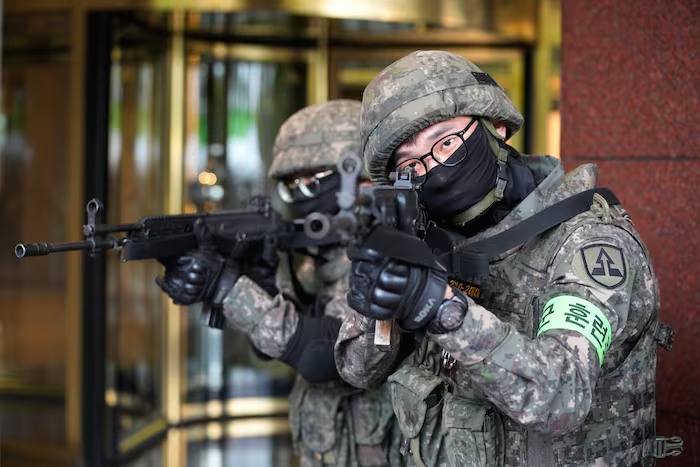
South Korea and the United States concluded their Ulchi Freedom Shield exercises on Friday, cutting the drills short by six days in what officials characterized as a conciliatory move toward Pyongyang. The early termination came one day after North Korea fired roughly 10 short-range ballistic missiles into the sea, rejecting the decision to scale back the joint operations as insufficient grounds for resuming diplomatic talks.
President Donald Trump had ordered the Pentagon to “substantially reduce” the exercises immediately before they commenced Monday, citing his relationship with North Korean leader Kim Jong Un and South Korea’s stance on the Iran conflict. The U.S. Pacific Command determined that the missile launches posed no immediate threat to American territory or regional allies, reaffirming Washington’s commitment to defending the peninsula.
Kim Yo Jong, the North Korean leader’s sister and a key figure in Pyongyang’s decision-making, dismissed Trump’s concession on Wednesday, asserting that shortening the drills would not alter their fundamentally “provocative, aggressive nature.” Her measured response, notably avoiding characteristic North Korean invective and referencing an “excellent” relationship between her brother and Trump, suggested the regime remains open to future negotiations while seeking more substantial American concessions.
Analysts note that North Korea’s diplomatic strategy appears designed to extract greater concessions from Washington, including potential sanctions relief and recognition as a nuclear power. The regime’s deepening military partnership with Russia over Ukraine, combined with its expanded ties offering leverage with Beijing, has strengthened Pyongyang’s negotiating position heading toward potential resumed talks.
Trump indicated Wednesday that he expects to meet with Kim Jong Un this year, though Kim Yo Jong denied that her brother had responded to any request for conversation. Experts suggest any breakthrough in negotiations may depend on the outcome of U.S. midterm elections, when Trump could seek prominent foreign policy achievements from a weakened domestic political position.

More Stories
Colombia backs Trump security push while limiting U.S. role in anti-gang operations
Trump Threatens FCC Action Against NBC’s Welker Over Endorsement Coverage
Federal Prosecutors Convene Special Grand Jury to Investigate D.C. Schools’ Attendance and Graduation Practices