


💛 A quick favor, if you've got a second.
We're really happy that you chose to read one of our stories and sincerely hope you'll stick around to read more. We took our paywall down — for now — but that won't last forever, and when the gate goes back up, we'd love for you to already be on the inside.
It's free. So please enter your email here and don't forget to like and follow us on all of your favorite Social Media platforms!
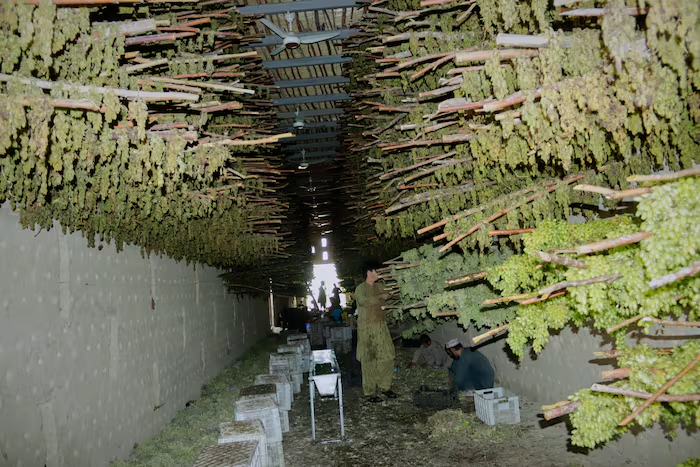
Kandahar’s grape harvest arrived in abundance this year, but Afghan farmers find little reason for celebration as military tensions with Pakistan have shuttered the border crossings that constitute their lifeline to market. The Taliban government in Kabul and Pakistan’s military have engaged in sporadic cross-border combat for months, with Islamabad alleging that Afghan militants conduct attacks from Taliban-controlled territory—accusations the Afghan government rejects. The escalating conflict has prompted authorities to close border routes, severing a vital commercial corridor.
Facing an inability to ship fresh grapes across the border, producers have flooded Afghanistan’s domestic market, triggering a sharp decline in prices. In response, many growers have adapted by converting their harvests into raisins, a lower-value product they hope will find buyers despite similarly depressed market conditions. In warehouses throughout Zhari district, bunches of green grapes hang from wooden racks while overhead fans circulate the summer heat necessary for the drying process.
Even this pivot has yielded disappointing results. Sakhi Jan, an orchard owner in Zhari, reports that seven kilograms of raisins that once commanded 1,000 to 1,200 afghanis ($13 to $16) now fetch only 400 to 450 afghanis ($5 to $6), forcing his household of 10 to subsist on severely diminished earnings. In a nation where poverty and malnutrition remain widespread, such income losses carry grave consequences for vulnerable families.
Data from Abdul Baqi Bina, deputy director of the Kandahar Chamber of Commerce and Investment, underscores the economic catastrophe. In 2025, five southern provinces producing Afghanistan’s primary grape supply exported 44,225 tons valued at $13.8 million, with nearly 43,000 tons reaching Pakistan and the remainder shipped to Bangladesh, Iraq, and India. Through the current year, exports have plummeted to just 256 tons worth $100,000.
Veteran exporter Haji Abdul Hai, who has spent 50 years in the trade, characterized the current situation as unprecedented. Previous border disruptions typically lasted days or affected individual crossing points while others remained operational, he noted, but the comprehensive nature of today’s closures presents an entirely different challenge.
Employment in the sector has collapsed alongside trade volumes. An orchard where Qudratullah Popal worked as a picker employed approximately 1,500 laborers last season; this year, that figure has shrunk to roughly 15 workers. The abundant crop cannot reach international customers, leaving growers with no alternative but to direct production to domestic markets already saturated with supply, Popal explained, warning that the trade freeze has paralyzed the entire value chain affecting traders, workers, and landowners alike.

More Stories
Colombia backs Trump security push while limiting U.S. role in anti-gang operations
Federal Prosecutors Convene Special Grand Jury to Investigate D.C. Schools’ Attendance and Graduation Practices
State Department Reissues Level 3 Travel Advisory for Israel Amid Terrorism and Armed Conflict Concerns