


💛 A quick favor, if you've got a second.
We're really happy that you chose to read one of our stories and sincerely hope you'll stick around to read more. We took our paywall down — for now — but that won't last forever, and when the gate goes back up, we'd love for you to already be on the inside.
It's free. So please enter your email here and don't forget to like and follow us on all of your favorite Social Media platforms!
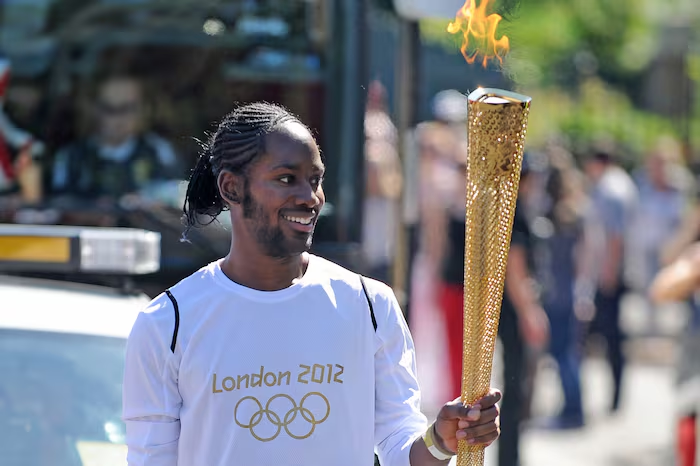
Jason Arday, 41, was discovered dead Friday at his residence in south London, weeks after news reports alleged he had engaged in plagiarism and fabricated biographical details. The Cambridge University sociology professor had gained prominence in 2023 when the institution announced his appointment as its youngest Black academic, citing his accomplishments despite childhood struggles with autism spectrum disorder that reportedly prevented him from speaking until age 11.
Arday’s death has ignited fierce debate across Britain regarding institutional accountability and journalistic responsibility. Critics contend that Cambridge rushed to elevate Arday to advance diversity initiatives without conducting adequate vetting, while media observers argue that news organizations maintained disproportionate coverage of the academic that may have contributed to his despair.
James Cleverly, a Black parliamentarian with prior Cabinet experience, asserted that universities “failed to do the proper due diligence” on Arday. He suggested institutions prioritized having a “wunderkind” who was “young and Black and good-looking” over rigorous credential verification, despite warning signs about his qualifications.
Patrick Vernon, recently knighted for racial equality advocacy, shifted blame toward the press. He contended that Arday faced scrutiny unprecedented for someone in his position, held to standards typically reserved for senior government officials and corporate leaders.
Cambridge appointed Arday in February 2023 as a professor of sociology of education. The university emphasized his distinction as the youngest Black professor in its 800-year history and his commitment to increasing minority representation in higher education, while highlighting his biographical narrative of overcoming developmental challenges.
The controversy erupted when Nathan Cofnas, a former Cambridge researcher dismissed following controversial statements about diversity initiatives, alleged plagiarism in Arday’s doctoral thesis. The Times of London and other newspapers subsequently published analyses identifying passages in his thesis as “identical or near-identical” to earlier academic work.
News outlets additionally scrutinized Arday’s personal claims, including assertions that he completed 30 marathons in 35 days and raised 5.5 million pounds for charity. Such scrutiny intensified as Arday’s memoir, “Great and Unfortunate Things,” prepared for publication through Simon & Schuster in the United States and scheduled for U.K. release August 27.
Cambridge initially defended Arday but reversed course August 5, announcing an investigation into his qualifications after receiving “new information.” He resigned the same day. Glasgow University and Durham University, where Arday previously held positions, subsequently opened their own investigations.
Cambridge Chancellor Chris Smith defended the institution’s initial response while criticizing media coverage, stating the university could simultaneously uphold academic integrity standards and reject “a racist feeding frenzy” targeting a particular academic.
An open letter circulating through the Good Law Project and signed by more than 107,000 individuals by Tuesday afternoon requested a government public inquiry into media handling of Arday’s case. The letter cited warnings from Simon Baron-Cohen, director of Cambridge’s Autism Research Centre, that intense focus on a “vulnerable autistic man” created safeguarding concerns.
Steven Barnett, a University of Westminster communications professor, calculated that British newspapers published 289 stories about Arday across 22 days, with nearly two-thirds appearing after his resignation. He attributed primary responsibility to mainstream press rather than social media, emphasizing the cumulative impact of such concentrated coverage.
Charles Moore, former Daily Telegraph editor, challenged this criticism in a Monday column. He argued that Cambridge’s own decision to publicly trumpet Arday’s historic appointment, rather than discreetly investigating emerging concerns from 2023, precipitated the subsequent scrutiny and shame Arday experienced.
Sarah Ditum, writing in the Times of London, acknowledged Arday as legitimate news given his actions harmed plagiarized academics and public confidence in academic rigor. However, she noted the story gained amplified attention during summer parliamentary recess when journalists seek significant narratives, and because Arday’s high-profile memoir with celebrity endorsements positioned him as a public figure.
Vernon urged the public to remember Arday as a person, husband and father amid the media storm. He established a GoFundMe campaign supporting his family that accumulated more than 193,000 pounds, which he characterized as evidence that Britain remains committed to justice and supporting those experiencing hardship.

More Stories
Federal voting arrest in New Jersey adds new pressure point in Sherrill-Trump standoff
Modern Science Finally Supports & Strengthens Biblical Account of the Crucifixion of Jesus Christ
Trump Threatens FCC Action Against NBC’s Welker Over Endorsement Coverage