


💛 A quick favor, if you've got a second.
We're really happy that you chose to read one of our stories and sincerely hope you'll stick around to read more. We took our paywall down — for now — but that won't last forever, and when the gate goes back up, we'd love for you to already be on the inside.
It's free. So please enter your email here and don't forget to like and follow us on all of your favorite Social Media platforms!
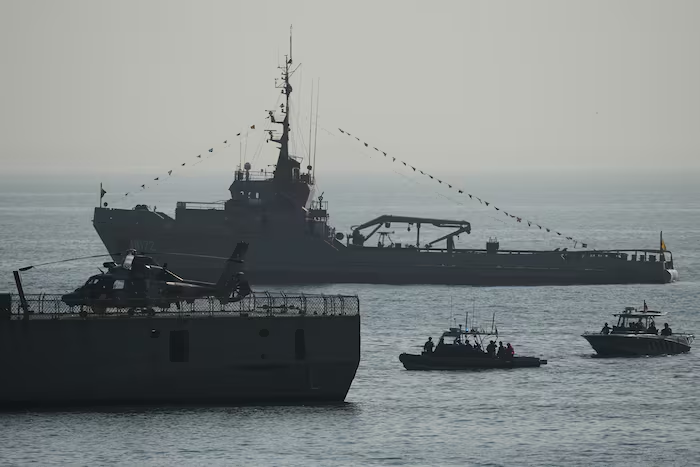
The Trump administration is moving to expand its military campaign against drug trafficking in Latin America beyond controversial sea operations into ground-based joint missions with allied nations. Defense Secretary Pete Hegseth announced last week during a Panama visit that Colombia, Guatemala and Honduras have agreed to coordinate with U.S. forces against criminal organizations operating within their borders, building on similar arrangements Ecuador established in March.
Hegseth characterized the planned land operations as a continuation of the administration’s approach to maritime drug interdiction, stating they would produce comparable results. The initiative reflects the Trump administration’s broader push to establish what officials describe as “American dominance over the Western Hemisphere” and pressure regional governments to prioritize U.S. security objectives.
Since returning to office in January 2025, the administration has designated 20 Latin American criminal groups as foreign terrorist organizations and conducted more than 60 boat strikes in the Caribbean and eastern Pacific that have killed over 200 people. The strikes have generated legal questions and criticism regarding evidence that those targeted were engaged in narcotics trafficking.
Guatemala’s government contradicted Hegseth’s characterization, denying it had reached any agreement for joint operations. Colombia, Honduras and Ecuador declined to comment on the defense secretary’s statements regarding their respective arrangements with Washington.
The expansion represents a significant escalation in direct U.S. military involvement across the region, raising concerns among analysts about sovereignty and potential civilian casualties. Ecuador’s experience demonstrates the risks: a New York Times investigation determined that one March strike intended for a drug laboratory destroyed a cattle farm instead, despite voters overwhelmingly rejecting foreign military bases in a November 2025 referendum.
Latin America experts caution that sustained military campaigns may prove counterproductive. Jeremy McDermott, co-director of investigative organization InSight Crime, warned that armed groups operating among civilian populations would likely disband camps and relocate into populated areas rather than face conventional military strikes.
Colombia’s newly inaugurated president, Abelardo de la Espriella, a Trump-backed candidate, has requested expanded U.S. military assistance targeting the National Liberation Army and other armed groups. Following a drone attack by the ELN on Colombian troops Saturday, de la Espriella pledged the rebels would “pay a high price.”
Mexico remains notably absent from the expanding U.S. military alliance despite being a major source and transit route for fentanyl entering the United States. President Claudia Sheinbaum has resisted escalating American military involvement on Mexican territory, even as Washington intensifies pressure for greater cooperation.
Michael Shifter of the Inter-American Dialogue think tank argued the campaign reflects an attempt to legitimize expanded U.S. military power rather than genuine cooperation, describing the relationship as “asymmetrical.” Analysts question whether such military escalation produces lasting security improvements or instead generates backlash that could outlast the current administration.
Even Trump-aligned leaders face domestic constraints on how much sovereignty they can surrender before public opinion turns against foreign military presence. Adam Isacson of the Washington Office on Latin America warned that governments across the political spectrum may prove uncomfortable with deeper U.S. military involvement, regardless of ideological alignment with the Trump administration.

More Stories
Colombia backs Trump security push while limiting U.S. role in anti-gang operations
Trump Threatens FCC Action Against NBC’s Welker Over Endorsement Coverage
Chicago Mayor Issues Executive Order Requiring Contractor Diversity Disclosures and ICE Ties Reporting