


💛 A quick favor, if you've got a second.
We're really happy that you chose to read one of our stories and sincerely hope you'll stick around to read more. We took our paywall down — for now — but that won't last forever, and when the gate goes back up, we'd love for you to already be on the inside.
It's free. So please enter your email here and don't forget to like and follow us on all of your favorite Social Media platforms!
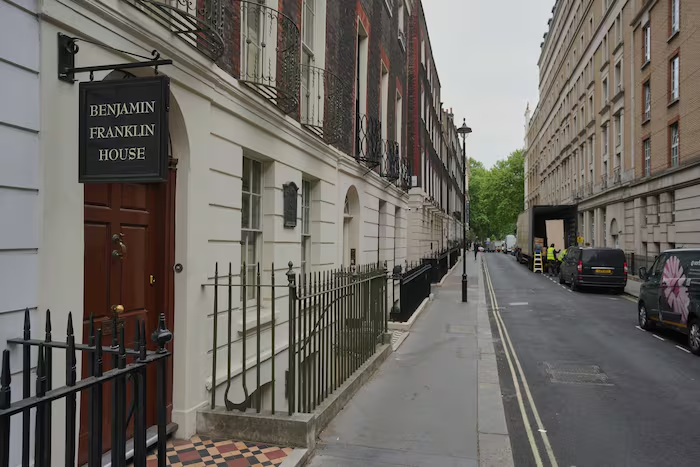
William Franklin, the eldest son of Founding Father Benjamin Franklin, rests in a London graveyard far from the nation his father helped create. Buried at St. Pancras Old Church following his 1813 death, William Franklin’s final resting place stands as a testament to the profound divisions the American Revolution created within families and across colonial society, more than three decades after he was forced to flee the newly independent United States.
The younger Franklin’s trajectory illustrates how the Revolutionary War functioned as much as a civil conflict as a struggle for independence. Historians underscore that approximately one-third of the colonial population remained loyal to King George III, with some periods seeing loyalist Americans comprise the largest contingent of British military forces. Enslaved Black people and Indigenous nations similarly divided their allegiances based on calculations about which side offered greater prospects for freedom and justice.
Benjamin Franklin and William Franklin initially shared experiences that bonded them to Britain. When Benjamin Franklin conducted his famous kite experiment in 1752, William stood alongside him, and five years later both traveled to London together as part of Pennsylvania’s colonial delegation. William pursued legal studies, married, and embraced London’s cultural life before returning to America in 1763 to serve as New Jersey’s royal governor—a position he maintained for thirteen years.
Their ideological rupture accelerated when Benjamin Franklin returned to Philadelphia in 1775 and joined the Continental Congress in advocating independence. William Franklin categorically rejected congressional authority and maintained his loyalty to the crown. Revolutionary forces arrested him in January 1776 as “an enemy of the country’s liberty,” subjecting him to imprisonment until October 1778, including extended solitary confinement. He subsequently emerged as a leading figure in New York City’s loyalist community.
Benjamin Franklin had warned his son repeatedly that royal service would trigger government action against him, but William refused to resign his governorship. Historian Daniel Mark Epstein, author of “The Loyal Son: The War in Ben Franklin’s House,” noted that William remained the final royal governor to vacate office and had to be removed forcibly in restraints. William Franklin sailed for London in 1782 following British military defeat, with only one documented meeting with his father before Benjamin Franklin’s 1790 death.
Museum of the American Revolution curator James Taub contextualized the Franklin family’s fracture within America’s broader historical narrative. He emphasized that American history represents 250 years of fundamental disagreement and that the Revolutionary struggle continues to shape contemporary conflicts. Understanding the complexities of the Revolutionary era, he argued, illuminates both the unprecedented nature of the Declaration of Independence and why subsequent nations modeled their founding documents accordingly.
Historian Epstein drew cautionary parallels between colonial-era disputes and modern American polarization. Colonial America boasted exceptional literacy rates, with approximately 90 percent of the population capable of reading, creating conditions where citizens favored reasoned debate over violence despite fundamental disagreements. Contemporary America, by contrast, confronts declining educational standards alongside widespread access to firearms—conditions Epstein characterized as contributing to contemporary social crisis.

More Stories
Tennessee’s Lone Death Row Female is Scheduled for Execution Wednesday for 1995 Torture/Murder
Colombia backs Trump security push while limiting U.S. role in anti-gang operations
Modern Science Finally Supports & Strengthens Biblical Account of the Crucifixion of Jesus Christ