


💛 A quick favor, if you've got a second.
We're really happy that you chose to read one of our stories and sincerely hope you'll stick around to read more. We took our paywall down — for now — but that won't last forever, and when the gate goes back up, we'd love for you to already be on the inside.
It's free. So please enter your email here and don't forget to like and follow us on all of your favorite Social Media platforms!
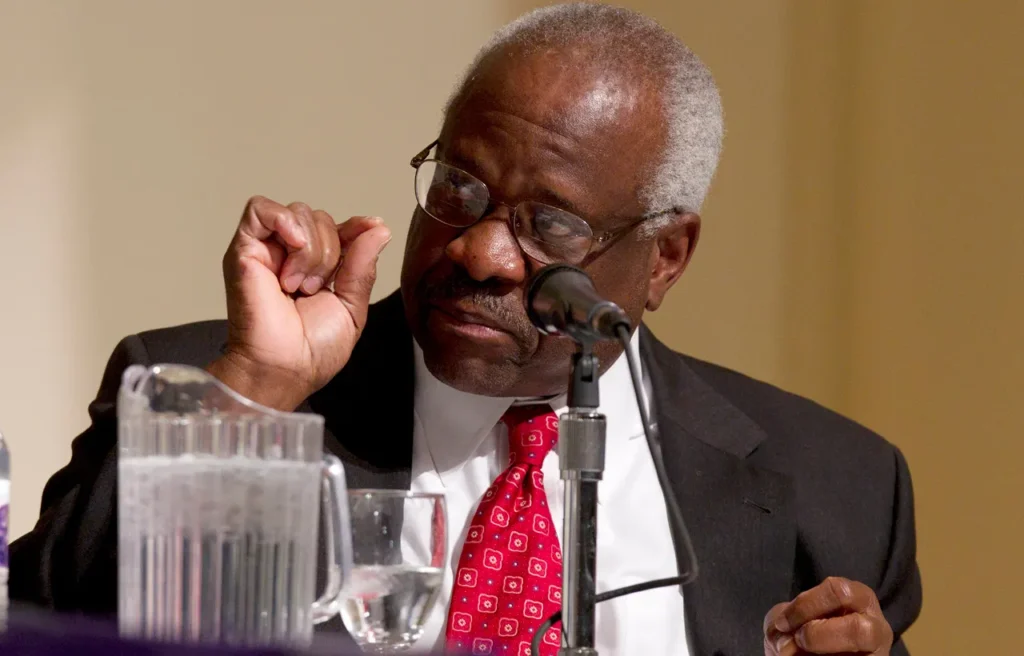
Supreme Court Justice Clarence Thomas asserted during a Hoover Institution event that prominent law schools, including Stanford, have effectively closed their doors to conservative voices and jurists. Speaking with host Peter Robinson, Thomas stated he has never visited Stanford Law School and suggested that ideological gatekeeping prevents conservative thought leaders from accessing such institutions.
Thomas characterized the situation as symptomatic of a broader cultural reality where certain academic venues remain “presumptively off limits” to right-wing perspectives. He acknowledged visiting Yale Law School but emphasized that resistance to conservative speakers represents standard practice at many leading universities, describing the phenomenon as undeniable reality rather than disputed claim.
The justice argued that without platforms like YouTube, younger generations would lose exposure to influential conservative thinkers such as economist Thomas Sowell, whose work shaped his own intellectual development. Thomas contended that college students lack access to viewpoints deemed “unpalatable” by campus communities, forcing them to seek alternative sources for ideological diversity.
Stanford Law School’s administration directly contradicted Thomas’s characterization, issuing a statement expressing willingness to host the justice. A school spokesperson noted that the Constitutional Law Center, led by former Tenth Circuit Judge Michael McConnell, regularly invites judicial figures and would welcome Thomas’s engagement with students and faculty.
The school’s assertion stands against a recent history of disrupted conservative speaker events on campus. In 2023, Fifth Circuit Judge Stuart Kyle Duncan’s presentation drew protest from approximately 90 law students affiliated with LGBTQ organizations, preventing him from completing his remarks despite Stanford’s subsequent apology and policy clarifications.
Three years prior, then-Texas Solicitor General Kyle Hawkins faced a coordinated walkout by twelve student organizations opposing his involvement in litigation against Deferred Action for Childhood Arrivals protections. More than 75 percent of his audience departed within five minutes of his presentation beginning.
Thomas did not reference either incident during his remarks and did not specify whether he had received invitations to Stanford. His comments reflect broader conservative criticism that college campuses have become intellectually inhospitable to right-wing ideas through student activism and faculty orientation.

More Stories
Federal voting arrest in New Jersey adds new pressure point in Sherrill-Trump standoff
Colombia backs Trump security push while limiting U.S. role in anti-gang operations
Former NFL cheerleader and ex-aide face off in close Rhode Island GOP primary