


💛 A quick favor, if you've got a second.
We're really happy that you chose to read one of our stories and sincerely hope you'll stick around to read more. We took our paywall down — for now — but that won't last forever, and when the gate goes back up, we'd love for you to already be on the inside.
It's free. So please enter your email here and don't forget to like and follow us on all of your favorite Social Media platforms!
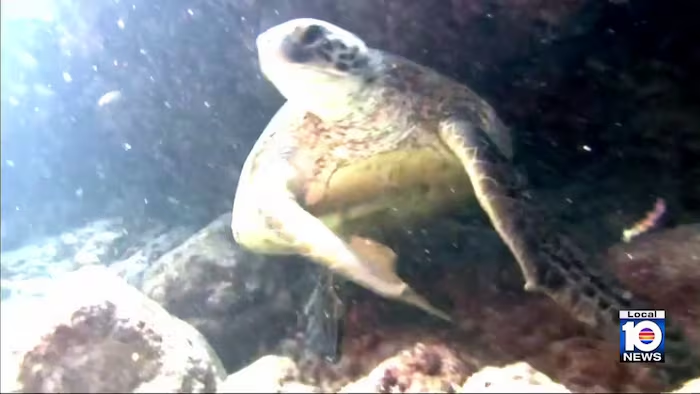
South Florida’s marine ecosystem—home to coral, sea turtles, manatees, and whales—generates substantial tourism revenue while serving as a cornerstone of regional identity. Yet sweeping changes at the federal level threaten to dismantle protections these species have relied upon for decades. The Trump administration is fundamentally altering a foundational environmental statute that has governed wildlife conservation for more than 50 years.
The administration is rescinding the definition of “harm” from the Endangered Species Act, a move that marine scientists say will eliminate habitat protections crucial to species survival. Nora Ives, a marine scientist with Oceana, warned that stripping these safeguards renders the law ineffective. “These changes take the teeth out of this law, and what is the value of listing a species if you can’t protect its home?” Ives said. The revision directly jeopardizes Florida’s green sea turtles and manatees, both federally designated as endangered species.
Green sea turtle nesting demonstrates the law’s historical effectiveness. Before the species received protection under the Endangered Species Act in 1978, virtually no turtle nests appeared on Florida beaches. Today, more than 200,000 green sea turtle nests occur annually along the state’s coast, illustrating how habitat protections drive recovery. Ives emphasized that coastal economies and communities benefit directly from the law’s success.
Florida manatees face particularly acute vulnerability. Five years ago, a seagrass die-off caused by pollution triggered a catastrophic mortality event claiming over 1,200 manatees, many perishing from starvation. Beth Brady, director of science and conservation at Save the Manatee Club, cautioned that additional habitat threats—including oil contamination of seagrass beds—could trigger another crisis. Manatee populations serve as ecological indicators; their health reflects broader ecosystem stability.
Scientists report that current seagrass and manatee population fluctuations suggest an increasingly fragile ecological balance. Dr. Jeremy Kiszka, associate professor of biology at Florida International University, expressed concern that further habitat degradation could prove catastrophic. The delicate equilibrium sustaining these populations leaves little margin for additional environmental stress.
President Richard Nixon signed the Endangered Species Act into law in 1973, establishing bipartisan consensus around species conservation. The statute has protected over 99 percent of listed species from extinction, with polling demonstrating broad public support across the political spectrum. In March, the Trump administration convened the Endangered Species Committee—colloquially known as the “God Squad”—for the first time in more than 30 years to exempt oil-and-gas exploration from key protections.
The U.S. Fish and Wildlife Service subsequently eliminated automatic protections for future threatened species and relaxed regulations governing critical habitat designations. President Trump defended the changes in social media posts, characterizing the Endangered Species Act as overreach by climate activists that obstructs oil, natural gas, and timber production.
Conservation organizations are mounting legal challenges to the policy reversals. Earthjustice filed multiple federal lawsuits joined by Oceana and numerous environmental groups nationwide, arguing that dismantling 50-year-old protections serves no purpose when the system has demonstrably succeeded. Congress has also responded, with lawmakers introducing a bipartisan House bill last month to restore the “harm” definition.
The Trump administration faces a 60-day deadline to respond to federal litigation. In South Florida, Oceana is organizing rallies with Surfrider and the Endangered Species Coalition in the Florida Keys to mobilize public support for marine species protection. Conservation advocates stress that preserving these species extends beyond individual animals, representing efforts to maintain a healthy Florida ecosystem for future generations.

More Stories
Federal voting arrest in New Jersey adds new pressure point in Sherrill-Trump standoff
Colombia backs Trump security push while limiting U.S. role in anti-gang operations
Former NFL cheerleader and ex-aide face off in close Rhode Island GOP primary