


💛 A quick favor, if you've got a second.
We're really happy that you chose to read one of our stories and sincerely hope you'll stick around to read more. We took our paywall down — for now — but that won't last forever, and when the gate goes back up, we'd love for you to already be on the inside.
It's free. So please enter your email here and don't forget to like and follow us on all of your favorite Social Media platforms!
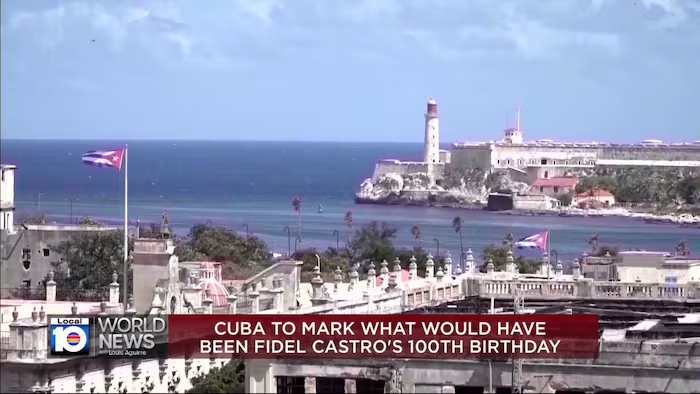
Cuba is grappling with severe economic deterioration as the island nation prepares to observe what would have been Fidel Castro’s 100th birthday. The communist state faces mounting pressures from American sanctions and internal structural failures that have prompted observers to reassess Castro’s enduring influence on the country he led for decades.
Dr. Andy Gomez, a Cuba analyst at Local 10, argued that Castro’s political legacy has effectively dissolved amid present-day governance failures. He characterized the current leadership as operating under corrupt military interests rather than ideological principles, noting that the state-run military conglomerate GAESA, founded by Raul Castro, prioritizes enriching elites over supporting ordinary citizens.
Gomez attributed the erosion of revolutionary ideology to the collapse of Soviet support, which had sustained Castro’s regime throughout the Cold War era. He observed that while citizens still invoke Fidel Castro’s name in public discourse, they no longer champion Raul Castro, suggesting the military’s continued backing represents the only force preventing state failure.
The U.S. indicted Raul Castro in May for his involvement in the 1996 Brothers to the Rescue incident, which resulted in four deaths. Gomez indicated that Castro’s advanced age and potential succession creates uncertainty that complicates American diplomatic strategy, particularly given Secretary of State Marco Rubio’s stated commitment to fostering democratic change.
Rubio has publicly committed to placing Cuba on an “irreversible path” toward U.S.-aligned governance within the current administration’s tenure. Gomez expressed skepticism about such timelines, arguing that decades of sanctions have harmed ordinary Cubans more than government officials and have failed to provoke the popular uprising Washington hopes for.
The analyst cautioned that meaningful change in Cuba would require extraordinary intervention beyond current policy frameworks. He emphasized that the regime continues implementing incremental economic adjustments that lack adequate infrastructure for implementation, while ordinary Cubans face severe consequences for any dissent against the government.
More Stories
Federal voting arrest in New Jersey adds new pressure point in Sherrill-Trump standoff
Colombia backs Trump security push while limiting U.S. role in anti-gang operations
Former NFL cheerleader and ex-aide face off in close Rhode Island GOP primary