
💛 A quick favor, if you've got a second.
We're really happy that you chose to read one of our stories and sincerely hope you'll stick around to read more. We took our paywall down — for now — but that won't last forever, and when the gate goes back up, we'd love for you to already be on the inside.
It's free. So please enter your email here and don't forget to like and follow us on all of your favorite Social Media platforms!
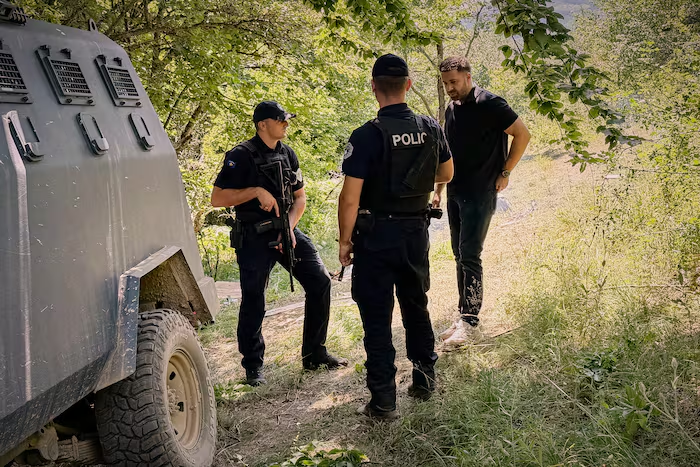
Excavation efforts have commenced at mass grave sites recently discovered in northern Kosovo, reigniting hopes among families searching for loved ones lost during the 1998-99 conflict. Workers began digging near the village of Kalluder e Vogel in Zubin Potok municipality in late July following the initial discovery of human remains in the area. Prime Minister Albin Kurti indicated that authorities believe the graves may contain the remains of missing intellectuals allegedly detained while attempting to flee Serbian military roundups.
Erblin Ademi, whose father Adem Ademi—a prominent surgeon—vanished in April 1999 along with 22 other intellectuals, watched the excavations unfold with conflicting emotions. Nearly three decades after his father’s disappearance, Ademi expressed both hope and pain at the prospect of finally locating his remains. He emphasized that every person deserves a proper grave where they can be honored and remembered.
Approximately 1,600 individuals remain unaccounted for from the war, according to casualty records, with bodies believed scattered throughout unmarked grave sites. The missing include roughly 1,200 ethnic Albanians, approximately 400 ethnic Serbs, and dozens of Roma, the Humanitarian Law Center reported. Some 13,000 people died during the conflict, which erupted as ethnic Albanians sought independence from Serbia.
Kosovo declared independence in 2008, though Serbia has refused to recognize the action. A May 2023 agreement between the two nations committed both sides to clarifying the fates of the missing, yet mutual accusations of cooperation failures have emerged. The European Union has made normalization of Kosovo-Serbia relations a prerequisite for either nation’s bloc membership.
Kosovo police arrested two ethnic Serbs on suspicion of war crimes connected to the mass graves just days before excavations began, with both men remaining in custody. Multiple high-ranking Serbian political and military officials have previously been convicted of Kosovo war crimes at the United Nations tribunal in The Hague.
More Stories
Federal voting arrest in New Jersey adds new pressure point in Sherrill-Trump standoff
Colombia backs Trump security push while limiting U.S. role in anti-gang operations
Packers Running Back Josh Jacobs Placed on NFL Commissioner’s Exempt List Following Domestic Arrest