




💛 A quick favor, if you've got a second.
We're really happy that you chose to read one of our stories and sincerely hope you'll stick around to read more. We took our paywall down — for now — but that won't last forever, and when the gate goes back up, we'd love for you to already be on the inside.
It's free. So please enter your email here and don't forget to like and follow us on all of your favorite Social Media platforms!
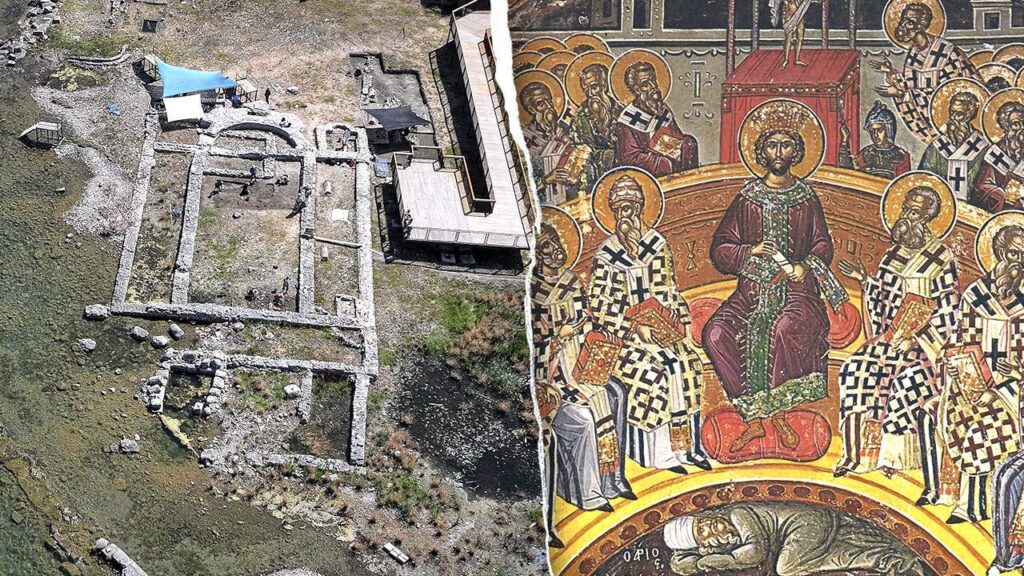
An international archaeological team working in Turkey has identified what researchers believe may be the remains of the church that hosted the First Council of Nicaea, one of Christianity’s most consequential gatherings. The team, led by excavation director Mustafa Şahin, conducted fieldwork in July at an ancient site in İznik, the modern location of the city of Nicaea, according to Turkish state media outlet Anadolu Agency.
The Church of St. Neophytos, as Şahin identified the structure, was destroyed during an earthquake in 368 A.D. and subsequently replaced by the Church of the Holy Fathers, which was constructed around 380 A.D. Archaeologists uncovered the stone foundations of the ancient complex along the shores of Lake İznik, revealing centuries-old walls and masonry through systematic excavation.
Şahin’s team discovered evidence of an earlier, smaller church beneath the later basilica after observing that floor paving extended beyond the known exterior walls. “That was our most important question this season,” Şahin told the agency, describing how the team began excavating in the area east of the prothesis and confirmed their suspicions within the first week of work.
The First Council of Nicaea convened in 325 A.D. as Christianity’s first ecumenical council, producing the Nicene Creed that affirmed Jesus as “begotten, not made” and fully divine—a direct rejection of Arianism, which held that Christ was a created being subordinate to God the Father. The council represented an early attempt to unify Christian doctrine throughout the Roman Empire.
Coins discovered in graves beneath the Church of the Holy Fathers provided dating evidence for its construction around 380 A.D., supporting Şahin’s theory that an earlier structure occupied the site during the council’s assembly. Historical accounts by Eusebius of Caesarea, who attended the council, described the meeting space as remarkably small, a detail that aligns with the dimensions of the newly identified Church of St. Neophytos.
“The church was so small that one wonders how so many bishops fit inside,” Şahin remarked, adding that the fit itself constituted “a great miracle of God.” He expressed confidence that the Church of the Holy Fathers was built deliberately atop the earlier site to commemorate the bishops who participated in the historic gathering.
Turkey continues to yield significant archaeological discoveries related to early Christianity. Recent excavations at Olympos in southern Turkey uncovered a fifth-century Christian church with a previously unknown inscription, while southwestern sites have revealed Roman hospitals subsequently converted into Christian places of worship.



More Stories
Colombia backs Trump security push while limiting U.S. role in anti-gang operations
Federal Prosecutors Convene Special Grand Jury to Investigate D.C. Schools’ Attendance and Graduation Practices
State Department Reissues Level 3 Travel Advisory for Israel Amid Terrorism and Armed Conflict Concerns